
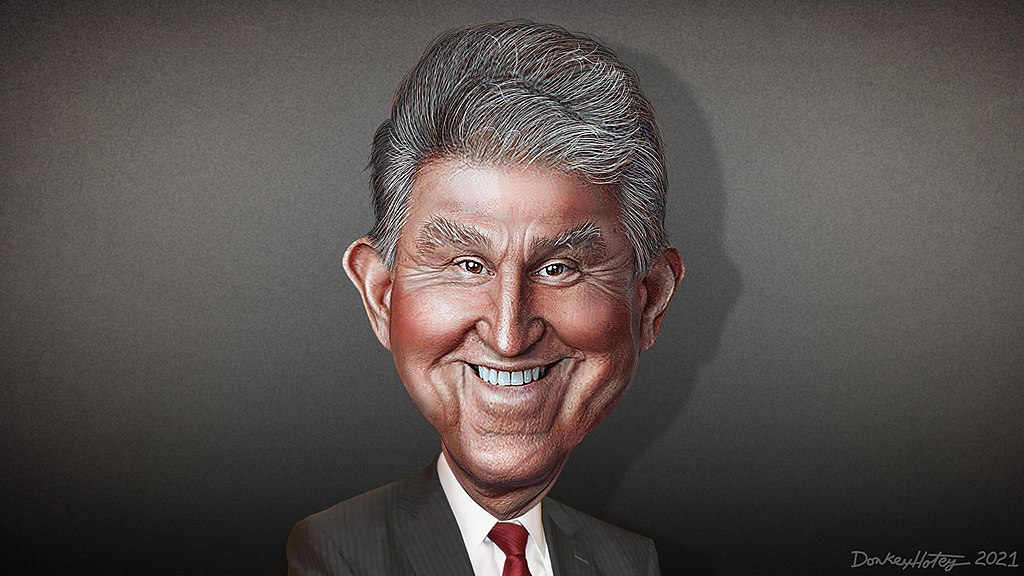

ABC News (“Democrats vent their fury as Joe Manchin shelves action on climate change“):
Democrats are sounding dire warnings after Sen. Joe Manchin tanked their hopes of acting on climate change.
“We’re all going to die,” House Budget Committee Chairman John Yarmuth, D-Ky., told reporters when asked about the consequences of Congress failing to act.
Yarmuth’s remarks on Friday captured the cocktail of anger, frustration, resentment and powerlessness that many Democrats felt after Manchin, D-W.Va., took a one-man wrecking ball to what’s left of President Joe Biden’s agenda, dealing a heavy blow to their big policy ambitions and further complicating a tough midterm election landscape for the party.
“It doesn’t matter what I advise. The Senate’s the Senate. It doesn’t matter what any of us do. Apparently, it doesn’t matter what the administration does. We’ve got one person who’s trying to dictate policy for the entire country and that’s a shame,” Yarmuth told NBC News, describing the mood in the party as “incredible frustration.”
“Unfortunately, we have one Democrat who thinks he knows better than every other Democrat,” he said.
Given how Manchin has made his money, it’s quite reasonable to question his motives. But it’s just silly to say that he’s “dictat[ing] policy for the entire country.” He’s one vote out of a hundred in one half of the legislative branch of government. It just so happens that there are 50 Republican votes and the Democrats need Manchin and every single other Democrat to go along to get anything done. To the extent he opposes the policy, the other party has a majority.
As for “think[ing] he knows better than every other Democrat,” his job is to vote his conscience and/or the interests of his constituency, not that of his party leadership. Our system isn’t and isn’t supposed to be a parliamentary one. (And all of this elides Kyrsten Sinema, the other recalcitrant Democrat.)
Sen. Martin Heinrich, D-N.M., openly questioned if Manchin should keep his gavel as chairman of the Senate energy committee.
It’s perfectly fair to ask that question. Republican leadership has stripped power from a handful of their caucus who have dared to stand up to the Big Lie and attempt to steal the election. Manchin isn’t entitled to lead a key committee.
But, when evaluating the prudence of hardball tactics, it’s important to consider the recursions. Stripping Liz Cheney of power isn’t particularly dangerous, considering she’s in an incredibly safe Republican seat. Manchin could simply flip to the Republican caucus if he wants to. And there’s essentially zero chance West Virginians send a different Democrat back to the Senate if Manchin isn’t their standard bearer.
In a radio interview Friday with WV MetroNews, Manchin confirmed that he told Senate Majority Leader Chuck Schumer Thursday he was ready to vote to empower Medicare to negotiate drug prices and extend funding under the Affordable Care Act. But he said he wanted to hold off on clean energy funding and other provisions in the Biden agenda bill until at least mid-August, citing inflation concerns.
“I said, ‘Chuck, it’s wrong, it’s not prudent to do the other [items] right now,’” Manchin said, adding that if inflation comes down, “we can come back the first of September and pass this piece of legislation, if it’s a good piece of legislation.”
In a statement, Biden vowed that “if the Senate will not move to tackle the climate crisis and strengthen our domestic clean energy industry, I will take strong executive action to meet this moment.”
In the meantime, he said, the Senate “should move forward” with the parts that Manchin has agreed to — a bill on drug pricing and ACA funding and “pass it before the August recess, and get it to my desk so I can sign it.” Without naming Manchin, he said even that smaller bill will “lower the cost of prescription drugs and health care for families” and “reduce the deficit and help fight inflation.”
So, again, it’s reasonable to wonder if inflation is really driving Manchin here. But, regardless, of course the Senate should just move forward with the parts of the bill they have the votes to pass. What choice do they have?
Around Washington, some Democrats were befuddled by Manchin citing inflation as a reason to hold off on the package. In December, he rejected the even larger Build Back Better Act over inflation concerns and restructured negotiations around a narrower set of provisions that included clean energy funding and taxes.
According to a Democrat familiar with the conversations, the party had been crafting a climate and energy bill around Manchin’s demand that it not be inflationary, by dropping the items he didn’t want and including provisions that he supports.
In recent days, Schumer had offered Manchin a proposal to approve the climate provisions Manchin backed without the taxes that he was “recently skittish” about, like a corporate minimum tax. But Manchin rejected that deal, said the Democrat, who discussed sensitive negotiations on condition of anonymity.
I haven’t been in the room for these negotiations. But if Manchin indeed said he would support these provisions and Democrats have spent months crafting a bill around his preferences, they have every right to be angry that he’s reneging at the eleventh hour.
House Ways & Means Committee Chair Richard Neal, D-Mass., said he remains “ever so hopeful” for a larger deal, but that he believes drug pricing and ACA funding would represent progress. He said he believes Manchin is still negotiating in good faith but that it’s time for the party to chart a path forward.
“You go to the altar — at some point you need to say ‘I do,’” Neal said.
Again, there’s little alternative.
Rep. Pramila Jayapal, D-Wash., who chairs the progressive caucus, said the failure to deliver an economic and safety net package will harm Democrats in the midterm elections.
“It has already hurt Democrats,” Jayapal said. “The single biggest thing that has hurt our chances for the midterm — and I still believe we can win, I want to make that clear — but the number one thing is the failure of Senator Manchin and the Senate to act on passing some version of Build Back Better.”
The likely failure of a larger package leaves many House Democrats in the lurch, vulnerable to attack ads from Republicans on pieces of the nearly $2 trillion Build Back Better Act they voted on last year, but without the tangible new benefits that a law would provide.
Jayapal argued that the broader bill would have eased inflation and pocketbook pressures through funding for child care and universal pre-K to help parents, along with housing aid for lower-income Americans — provisions that Manchin has said should be excluded from the Democrats-only package.
Jayapal’s analysis is mostly wrong. Universal pre-K and various welfare programs are not going to win over a single swing voter. But she’s almost certainly right that the failure to pass so much of Biden’s agenda has demoralized Democrats. Why bother to vote if, even if you win, you don’t get the policies you were promised?
Democrats, not unreasonably, were exultant when they won both of the Georgia runoffs and therefore had a Senate “majority” thanks to Vice President Kamala Harris’ tie-breaking vote. But they didn’t count on Manchin and Sinema generally being unsupportive of the agenda. In a 50-50 Senate, every vote matters and the party simply couldn’t get unanimous support within their caucus for most of the agenda. And that’s to say nothing of the filibuster, which allows the minority party to effectively veto most measures even if every Democrat is on board.
Jayapal ain’t wrong here, either:
Jayapal said Manchin’s recent demand to shelve climate change funding and tax increases on the wealthy didn’t surprise her after he nixed the Build Back Better Act in December, stunning the White House in the process. She said she would evaluate a potential slimmer deal with prescription drug savings and health insurance aid if and when the Senate passes such a bill.
“He has shown that he doesn’t know how to close a deal, or he doesn’t want to close a deal, and that you can’t trust him,” Jayapal said, of Manchin. “You can’t negotiate with someone like that.”
Manchin claims otherwise:
In the local radio interview, Manchin said Democrats are trying to “put all this pressure on me,” but added: “I am where I have been. I would not put my staff to this, I would not put myself through this if I wasn’t sincere about trying to find a pathway forward to do something good for our country.”
Again, I haven’t been in the room. But, time after time, key Democrats have said that they felt lied to by Manchin in these negotiations. I’m inclined to believe them, given that it’s hardly in their interest to further alienate him.









