
In “Once a duty, military service recast as a right,” Andrew Bacevich bemoans the social impact of the all-volunteer force.
WHAT ARE the duties inherent in citizenship? For Americans, the answer to that question has changed dramatically over time. With regard to military service, the answer prevailing today is this one: No such duty exists. Service in the armed forces, whether pursuant to defending the homeland, advancing the cause of freedom abroad, or expanding the American imperium, has become entirely a matter of individual choice.
In that regard, the recent Pentagon decision to remove restrictions on women serving in combat hardly qualifies as a historic change. Instead, it ratifies a decades-old process that has removed military service from the realm of collective obligation and converted it into an issue of personal preference.
The really big change occurred at the end of the Vietnam War when, heeding President Richard Nixon’s request, Congress abolished the draft. In effect, the state thereby forfeited its authority, exercised in each major US war of the 20th century, to order citizens to take up arms on behalf of country and countrymen. That forfeiture proved irrevocable. Once surrendered, the government’s authority to mandate military service could not be reclaimed. That 18-year-old males still perform the ritual of registering for Selective Service — an action about as weighty as getting a flu shot — does not alter that fact.
So today, to fill the ranks of the armed forces, the state no longer issues orders. Instead, it dangles inducements. In that regard, we should credit the Pentagon with impressive success in its effort to rebrand military service. Once considered an imposition, it now signifies opportunity, offering prospects (depending on rank) of security, status, privilege, or even power.
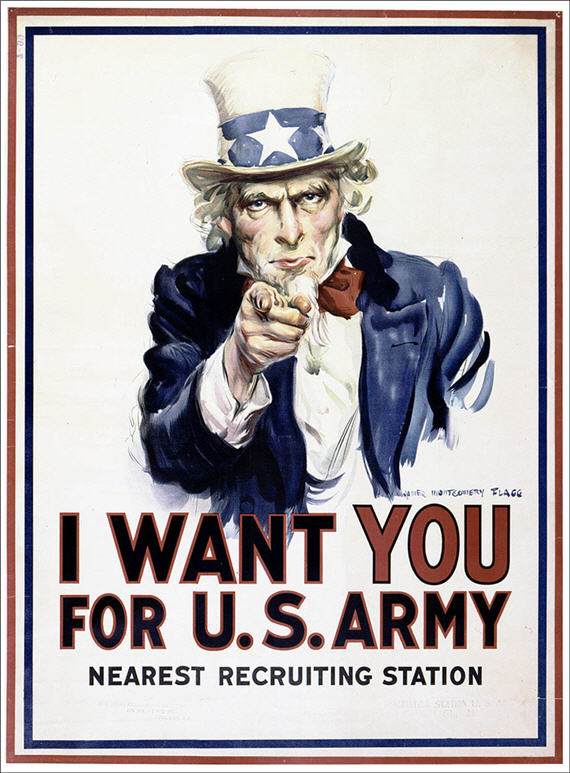
Nothing better captures the shift in emphasis than the iconic US Army recruiting jingle of the 1980s: “Be All That You Can Be.” To an extent that would have astonished the G.I.’s who fought in World War II, Korea, or Vietnam, military service has become a venue for individual self-actualization. In the recruiting sergeant’s office, as elsewhere in American life, the conversation centers not on “us” but on “me.”
[…]
On the surface, the transformation of military service from collective obligation to personal choice meshes nicely with our existing definition of democracy: It demands nothing while excluding no one. What could be fairer?
Yet probe beneath the surface, and the results are anything but democratic. Current arrangements have allowed and even encouraged Americans to disengage from war at a time when war has become all but permanent. Rather than being shared by many, the burden of service and sacrifice is borne by a few, with the voices of those few unlikely to be heard in the corridors of power.
Relieving citizens of any obligation to contribute to the country’s defense has allowed an immense gap to open up between the US military and American society. Here lies one explanation for Washington’s disturbing propensity to instigate unnecessary wars (like Iraq) and to persist in unwinnable ones (like Afghanistan). Some might hope that equipping women soldiers with assault rifles and allowing them to engage in close combat will reverse this trend. Don’t bet on it.
Amidst all the hand-wringing and lamentation for the soul of our society, the only tangible harm Bacevich points to is “Washington’s disturbing propensity to instigate unnecessary wars (like Iraq) and to persist in unwinnable ones (like Afghanistan).” But, of course, the reason that we abandoned the draft to begin with was because we forced millions to serve in and almost 60,000 to die in the unnecessary and unwinnable war in Vietnam. Indeed, with the dispassionate hindsight of history, the vast majority of America’s wars were unnecessary; whether we relied on volunteers or conscripts seems wholly unconnected to our propensity for bad wars. The difference, then, is one of choice: Anyone serving in Iraq or Afghanistan damn well volunteered to be there and was at least able to command a reasonable wage and premium benefits for their sacrifice.
Is it worth mourning that relatively few Americans feel as sense of “duty” to country, at least one that manifests in military service? I suppose. Then again, we have far more people under arms today than we need for any reasonable conception of the national defense under a volunteer system. Why would we want to displace some number of those who wish to be there in favor of those who don’t?
That “the state no longer issues orders” but instead “dangles inducements” strikes me as an unalloyed good. In some circles, we call that “freedom.” And, by almost all accounts, we have a better force because it’s staffed with people who choose to be there rather than are forced to by a coercive state.
Bacevich notes the dearth of accessions from Harvard and at least implies that the current system unfairly burdens the less fortunate. But when hasn’t that been the case? Surely, not during the Vietnam era that immediately preceded the move to an all-volunteer force. We’d decided that those capable or fortunate enough to get into college were too valuable to conscript as cannon fodder. Even during the present wars, when the increased risk of being killed would seem to outweigh the value of the inducements offered, we’re still fielding a force mostly from the middle three quintiles. The sons and daughters of the privileged are indeed mostly eschewing the risk in favor of safer, more prestigious endeavors. The sons and daughters of the poor, meanwhile, have a much harder time qualifying for service, since they’re less likely to be high school graduates and otherwise meet the relatively rigorous enlistment requirements.
It’s probably true that “Current arrangements have allowed and even encouraged Americans to disengage from war at a time when war has become all but permanent.” But, aside from World War II and perhaps the Civil War, when was it otherwise? The Indian Wars were essentially a state of permanent war; arguably, so was the Cold War. Nowadays, through the power of instant mass communications, it’s more possible than ever to follow our war effort. That most don’t isn’t surprising.
Similiarly, that “the burden of service and sacrifice is borne by a few, with the voices of those few unlikely to be heard in the corridors of power” is hardly a new phenomenon. Nor is it obviously a function of a volunteer vice conscript force; after all, we’d likely have the same number of families with sons and daughters in Afghanistan regardless of our staffing procedures. Unless Bacevich is arguing that we’d have vastly more troops there if we could simply order them up? But, surely, he wouldn’t see that as a positive development.
Editor’s note: I’ve appended “and daughters” to “sons” in the first two instances above; it was there originally in the third instance. While we’ve never drafted women and the men are still doing a disproportionate share of the dying, women do constitute some 13 percent of the force.