NYT (“Elon Musk’s Team Now Has Access to Treasury’s Payments System“):
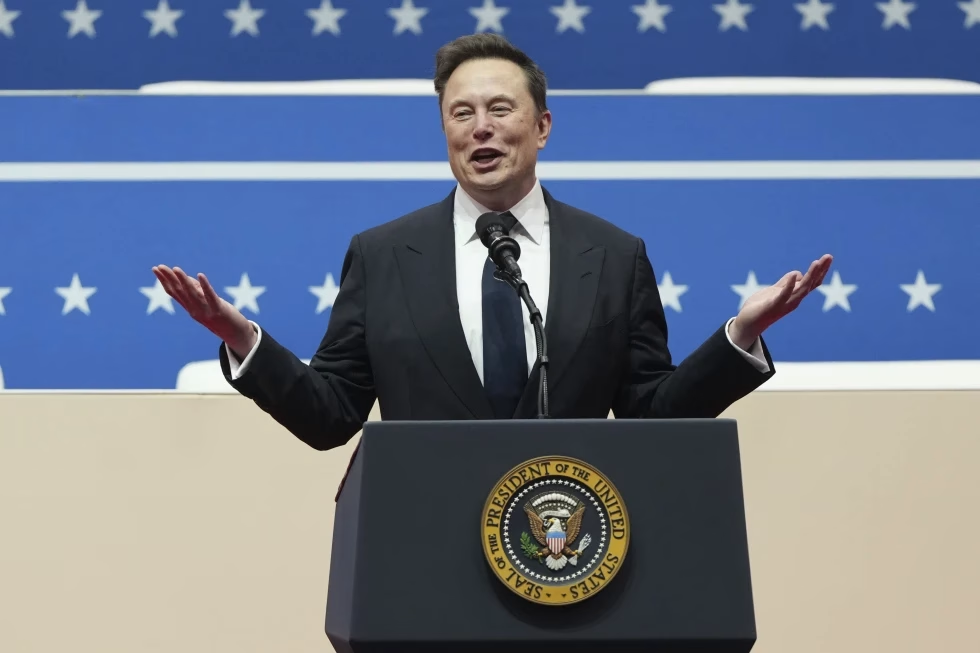
Treasury Secretary Scott Bessent gave representatives of the so-called Department of Government Efficiency access to the federal payment system late on Friday, according to five people familiar with the change, handing Elon Musk and the team he is leading a powerful tool to monitor and potentially limit government spending.
The new authority follows a standoff this week with a top Treasury official who had resisted allowing Mr. Musk’s lieutenants into the department’s payment system, which sends out money on behalf of the entire federal government. The official, a career civil servant named David Lebryk, was put on leave and then suddenly retired on Friday after the dispute, according to people familiar with his exit.
The system could give the Trump administration another mechanism to attempt to unilaterally restrict disbursement of money approved for specific purposes by Congress, a push that has faced legal roadblocks.
Mr. Musk, who has been given wide latitude by President Trump to find ways to slash government spending, has recently fixated on Treasury’s payment processes, criticizing the department in a social media post on Saturday for not rejecting more payments as fraudulent or improper.
The Musk allies who have been granted access to the payment system were made Treasury employees, passed government background checks and obtained the necessary security clearances, according to two people familiar with the situation, who requested anonymity to discuss internal arrangements. While their access was approved, the Musk representatives have yet to gain operational capabilities and no government payments have been blocked, the people said.
Mr. Musk’s initiative is intended to be part of a broader review of the payments system to allow improper payments to be scrutinized and is not an effort to arbitrarily block individual payments, the people familiar with the matter said. Career Treasury Department attorneys signed off on granting the access, they added, and any changes to the system would go through a review process and testing.
The Department of Government Efficiency, or DOGE, is not a government department, but a team within the administration. It was put together at Mr. Trump’s direction by Mr. Musk to fan out across federal agencies seeking ways to cut spending, reduce the size of the federal work force and bring more efficiency to the bureaucracy. Most of those working on the initiative were recruited by Mr. Musk and his aides.
Similar DOGE teams have begun demanding access to data and systems at other federal agencies, but none of those agencies control the flow of money in the way the Treasury Department does.
[…]
Former officials said the onus was on individual agencies to ensure their payments are proper, not the relatively small staff at the Treasury Department, which is responsible for making more than one billion payments per year.
[…]
Democrats raised alarm this week that the Trump administration and Mr. Bessent, who was just confirmed by the Senate this week, were compromising the federal government’s payments system.
“To put it bluntly, these payment systems simply cannot fail, and any politically motivated meddling in them risks severe damage to our country and the economy,” Senator Ron Wyden of Oregon, the top Democrat on the Senate Finance Committee, wrote in a letter to Mr. Bessent on Friday. “I can think of no good reason why political operators who have demonstrated a blatant disregard for the law would need access to these sensitive, mission-critical systems.”
On Saturday, Mr. Wyden expressed concern that access to the payment system had been granted and pointed out Mr. Musk — a billionaire with a vast portfolio — has potential conflicts of interest.
“Social Security and Medicare benefits, grants, payments to government contractors, including those that compete directly with Musk’s own companies. All of it,” he wrote on social media.
During the transition, Mr. Musk vocally opposed Mr. Bessent being picked as Mr. Trump’s Treasury secretary. Mr. Musk, then just an empowered adviser to Mr. Trump, went public with his opinion that he preferred Howard Lutnick, a Wall Street executive, for the role because Mr. Bessent was “a business-as-usual choice.” Mr. Lutnick became Mr. Trump’s choice for Commerce secretary.
WaPo (“Musk aides gain access to sensitive Treasury Department payment system“) adds:
The sensitive systems, run by the Bureau of the Fiscal Service, control the flow of more than $6 trillion annually. Tens of millions of people across the country rely on the systems. They are responsible for paying Social Security and Medicare benefits, salaries for federal personnel, payments to government contractors and grant recipients, and tax refunds, among tens of thousands of other functions.
Typically, only a small group of career employees control the payment systems, and former officials have said it is extremely unusual for anyone connected to political appointees to access them.
The notion that it’s up to Treasury to audit millions of payments directed from every agency in the government is sheer lunacy. That these decisions will now be made by amateurs with clear conflicts of interest is, to say the least, disturbing.
As with so many of the actions taken in the less than two weeks (!) since Trump began his second administration, this will almost certainly be quickly challenged in court. But, even if ultimately reversed, substantial damage will be done in the meantime.
The weird rollout of DOGE made it seem very much like a sophomoric joke. It was a non-department department named after a meme coin for lulz. But the actual implementation has been sheer evil genius.
On literally Day 1, Trump renamed the existing US Digital Service DOGE, with an Administrator in the Executive Office of the President reporting directly to the White House Chief of Staff and essentially authorizing a full takeover of other agencies of government:
Sec. 4. Modernizing Federal Technology and Software to Maximize Efficiency and Productivity. (a) The USDS Administrator shall commence a Software Modernization Initiative to improve the quality and efficiency of government-wide software, network infrastructure, and information technology (IT) systems. Among other things, the USDS Administrator shall work with Agency Heads to promote inter-operability between agency networks and systems, ensure data integrity, and facilitate responsible data collection and synchronization.
(b) Agency Heads shall take all necessary steps, in coordination with the USDS Administrator and to the maximum extent consistent with law, to ensure USDS has full and prompt access to all unclassified agency records, software systems, and IT systems. USDS shall adhere to rigorous data protection standards.
(c) This Executive Order displaces all prior executive orders and regulations, insofar as they are subject to direct presidential amendment, that might serve as a barrier to providing USDS access to agency records and systems as described above.
This has directly enabled the shock and awe dismantling of agency leadership that we’ve been documenting the last few days. Techdirt’s Mike Masnick takes stock:
Remember how Elon Musk destroyed Twitter by ripping apart its infrastructure without understanding it? Now imagine that same playbook applied to the federal government. It’s happening, and the stakes are exponentially higher. When reviewing Kate Conger and Ryan Mac’s book “Character Limit” last fall, I highlighted two devastating patterns in Musk’s management: his authoritarian impulse to (sometimes literally) demolish systems without understanding them, and his tendency to replace existing, nuanced solutions with far worse alternatives (even when those older systems probably did require some level of reform). Those same patterns are now threatening the federal government’s basic functions.
Let’s be crystal clear about what’s happening: A private citizen with zero Constitutional authority is effectively seizing control of critical government functions. The Constitution explicitly requires Senate confirmation for anyone wielding significant federal power — a requirement Musk has simply ignored as he installs his loyalists throughout the government while demanding access to basically all of the levers of power, and pushing out anyone who stands in his way.
[…]
For all of Musk and fans whining about the hiring of “unqualified” people (which has been very clearly coded to mean non-white, non-male, non-cisgender), the fact that he’s hired a kid whose experience is “camp counselor” into a high-level position is fucking insane.
But this isn’t just about personnel changes. It’s about systematically dismantling government institutions from the inside out.
And it’s only getting more and more dangerous. It’s been reported (and a lawsuit has been filed over it) that the “fork in the road email” was sent via a hastily setup on-premises server that these idiots needed to do the email blast, even though that almost certainly violates federal law.
On top of that, there are multiple reports of Musk basically taking over various parts of the government. He apparently showed up at the General Services Administration on Thursday, just after his right-hand man in the Twitter shakeup, Steve Davis, told them they were ending a bunch of leases on government buildings (another thing that Twitter also did). Even worse, Wired reports that Musk’s friends are using the GSA to try to get access to a variety of systems, including remote access to laptops, and even reading emails of government employees.
[…]
Then, later [Friday], Reuters reported that Musk’s aides have locked career civil servants entirely out of government computer systems.
[…]
Again, Elon has not been nominated as an officer of the US, and the Senate has not even been given the ability to review any such nomination. Instead, he’s basically acting like he runs the government and is slashing and cutting with wild abandon.
There are all sorts of laws that have been broken in the process, forcing courts to jump in. Earlier today, for example, a judge in Rhode Island had to stop the Musk/Trump administration from carrying out their attempt to stop spending money apportioned by Congress.
[…]
While just at the district court level, this judicial smackdown echoes historic rebukes like Youngstown Sheet & Tube Co. v. Sawyer, where SCOTUS reminded Truman that “the President’s power to see that the laws are faithfully executed refutes the idea that he is to be a lawmaker.” Musk’s shadow administration represents a constitutional crisis orders of magnitude greater than Twitter’s blue check chaos.
When Elon took over Twitter, he certainly had the right to go in and destroy the place through ignorance and overconfidence.
But this is the US government. He doesn’t own it. He wasn’t elected. He wasn’t officially appointed. And there are laws that are being broken left and right. Even worse, the impact of all this nonsense is way more significant and way more serious than any of the shit he pulled at Twitter.
Millions of people actually depend on the US government functioning. You can’t just have some random jackass show up and rip out fences and assume shit won’t go south. They went completely south with Twitter, but that was just a random social media site people could move on from. This is the most powerful country in the world, and it’s being ripped apart by someone with no concern or care for the actual damage he’s doing.
Henry Farrell adds:
For years, many people in Silicon Valley have been convinced that if only they were in charge, they could eliminate the waste and ideological excesses of government, getting rid of all the obstructionists, and creating a leaner, tighter machine instead.
From this unique perspective, the fact that none of the DOGE people actually understand how government functions is a feature, not a bug. If you understand the workings of the federal bureaucracy you are almost certainly part of the problem, not the solution.
That’s how we end up in a world where a 21 year old and a recent high school graduate seem to have taken effective charge of a crucial engine of government. Unfortunately, “Let’s see what this button does,” worse, “we’ll find out what we need by ripping everything out and seeing what fails,” and worst of all, “government rulemaking is _so_ mid: we’ll have AGI by 2027!” are not viable approaches to reform.
Both Masnick and Farrell are highly sympathetic to the need to reform government processes, which are indeed often archaic. They simply prefer that it be done through legal means by people who know what they’re doing.
Clearly, Musk and company have a plan. The speed and scope with which they’re dismantling core mechanisms of government—the HR, communication, and payment systems among them—is breathtaking and way beyond what I could have imagined.
Now we get to see if our institutions can hold. Rather clearly, a Republican-controlled Congress is not going to intervene. The combination of Trump’s hold over the base and Musk’s money and control of the means of communicating with the public has them afraid for their political future, if not their safety. That means, at least for the next two years, it’s up to the courts.