
When I first saw the headline “Elon Musk and Vivek Ramaswamy will lead new ‘Department of Government Efficiency’ in Trump administration,” my first reaction was to roll my eyes at the absurdity. My second was that it would take them four years to fill out the legally-required disclosure paperwork. It turns out, though, that there will be no actual Department.
That’s not at all clear from the CNN report with the aforementioned headline:
President-elect Donald Trump announced Tuesday that Elon Musk and Vivek Ramaswamy will lead a new “Department of Government Efficiency” in his second administration.
“Together, these two wonderful Americans will pave the way for my Administration to dismantle Government Bureaucracy, slash excess regulations, cut wasteful expenditures, and restructure Federal Agencies,” Trump said in a statement.
The announcement of Ramaswamy and particularly Musk, who leads companies with existing, lucrative government contracts, raises immediate questions about potential conflicts of interest. It is not immediately clear how the department – which Trump said would “provide advice and guidance from outside of Government” – would operate, and whether a Congress even fully controlled by Republicans would have the appetite to approve such a massive overhaul of government spending and operations.
Trump had proposed the creation of a government efficiency commission as part of a slate of new economic plans that he unveiled in early September. At the time, he said Musk had agreed to lead it if he were to secure a return to the White House.
Trump’s statement Tuesday night quoted Musk as saying that “this will send shockwaves through the system, and anyone involved in Government waste, which is a lot of people!”
Ramaswamy separately responded on X with a slogan he often used during his presidential campaign to call for the elimination of federal agencies, writing: “SHUT IT DOWN.”
On the campaign trail, Trump pointed to his proposed government efficiency commission as a way to reduce government spending. “As the first order of business, this commission will develop an action plan to totally eliminate fraud and improper payments within six months,” he said in September. “This will save trillions of dollars.”
Ramaswamy, who previously challenged Trump in the Republican presidential primary before endorsing him in January, made reducing waste in government spending a key policy platform for his campaign.
Last year, Ramaswamy – who had promised on the campaign trail to eliminate the FBI, the Department of Education and the Nuclear Regulatory Commission, which would lay off thousands of federal workers in the process – released a white paper outlining a legal framework he said would allow the president to eliminate federal agencies of his choice.
Musk, for his part, said while supporting Trump on the campaign trail that he’d pitch a massive rollback of government regulations, of which he has long griped. The Tesla and SpaceX CEO has also floated an assessment system that threatens layoffs to wasteful employees and proposed offering generous severance packages to laid-off government workers.
Musk first suggested Trump form a government efficiency commission and appoint him to it in an August conversation between the two hosted on X. Trump responded, “I’d love it.”
A few days later, Musk posted on X an image of himself at a podium labeled Department of Government Efficiency and D.O.G.E., the name of Musk’s favorite meme and cryptocurrency. “I am willing to serve,” he wrote.
The NYT report (“Trump Taps Elon Musk and Vivek Ramaswamy to Slash Government“) plays along:
How do you slash, cut, restructure and even dismantle parts of the federal government?
If you’re President-elect Donald J. Trump, you turn to two wealthy entrepreneurs: the spaceship-inventing, electric-car-building owner of a social media platform and a moneymaking former pharmaceutical executive who was once one of your presidential rivals.
Mr. Trump said on Tuesday that Elon Musk and Vivek Ramaswamy will lead what he called the Department of Government Efficiency. It will be, he said, “the Manhattan Project” of this era, driving “drastic change” throughout the government with major cuts and new efficiencies in bloated agencies in the federal bureaucracy by July 4, 2026.
“A smaller Government, with more efficiency and less bureaucracy, will be the perfect gift to America on the 250th Anniversary of The Declaration of Independence,” Mr. Trump wrote in a statement. “I am confident they will succeed!”
The statement left unanswered all kinds of major questions about an initiative that is uncertain in seriousness but potentially vast in scope. For starters, the president-elect did not address the fact that no such department exists. And he did not elaborate on whether his two rich supporters would hire a staff for the new department, which he said is aimed in part at reducing the federal work force.
But then drops this deep in the piece:
Mr. Trump’s statement said only that this new department would “provide advice and guidance from outside of government,” suggesting that Mr. Musk will not take a formal role as a federal official.
Which makes sense. There’s essentially no legal* way for Musk to serve. The richest man in the world isn’t going to divest himself of his businesses or put them into a blind trust to run a department tasked with doing something he’s only interested in because the government is currently frustrating him in running said businesses.
WaPo (“Trump taps Musk, Ramaswamy to oversee ‘drastic’ changes to U.S. government“) gets it right:
President-elect Donald Trump announced Tuesday that he is appointing business executives Elon Musk and Vivek Ramaswamy to lead a new commission on cutting government spending and regulation, handing an enormous portfolio to the tech billionaire who gave political and financial support to his presidential bid.
In a statement, Trump said that his billionaire ally and his former Republican primary rival will lead the Department of Government Efficiency, an idea championed by Musk. Trump said the department would operate outside of government to drive “drastic change,” while partnering with the White House and its budget office to provide recommendations to slash regulations, cut staff and overhaul federal operations. Musk has adopted the nickname “DOGE” for the commission, a reference to a meme-based cryptocurrency he also touted.
There will be no Department. Musk is trolling us with DOGE** and Trump is going along with it.
And, of course, there’s the small issue of implementation
It is not clear how the effort will be funded or whether its recommendations will be approved, because federal spending is controlled by Congress and the White House. Still, Republicans are poised to control the House, Senate and White House, giving the GOP the opportunity to implement at least some of the commission’s proposals — potentially triggering major repercussions for the U.S. government and millions of federal workers.
[…]
Still, some analysts are doubtful much will materialize from the effort. Congress must approve any changes to federal appropriations, and it is not clear if the Musk commission will produce recommendations in time for action by the new GOP majorities. Trump’s statement said the commission’s work must be completed by “no later” than July 4, 2026 — not long before the next midterm elections.
Look, I’m a federal government employee (albeit in the Excepted Service rather than the Civil Service) and have a personal stake in all of this. I’m sure there’s legitimate waste that can be cut. Maybe some sort of outside commission is a more efficient way of finding it than the cumbersome process wherein the Executive agencies vie for funding in the President’s budget proposal and then the byzantine House and Senate committees fight over it. But the overwhelming share of the budget is mandatory spending on Social Security and other entitlement programs, interest on the national debt, and national defense:
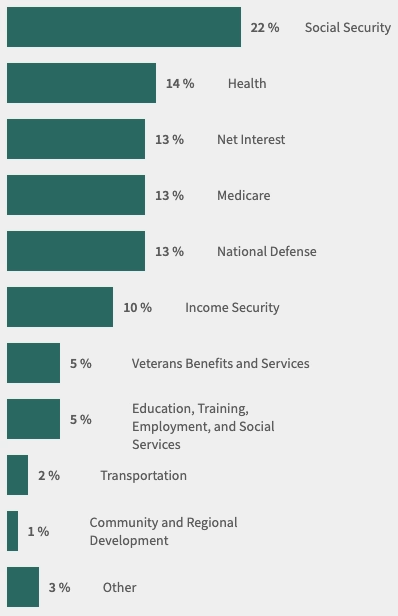
Here it is by dollars:

There aren’t trillions—or even hundreds of billions—of dollars left.
I work for the Defense Department and there’s certainly an argument that $900 billion a year is too much given our relative standing in the world. But, aside from signaling that our support for Ukraine may diminish considerably, Trump’s rhetoric—and his nominees in the defense and foreign policy space—signal that, if anything, we’re going to be even more hawkish on China and Iran while increasing our support for Israel. That doesn’t comport with significant savings at DoD.
*Yes, I’m aware that Trump flouted all manner of disclosure and divestment rules, not to mention the Emoluments Clauses, throughout his first administration. I wrote about it numerous times. Unless Congress impeaches and removes a President, though, there’s no real way to enforce those norms. Lesser government officials are actually bound by the normal processes of the law.
**DOGEcoin’s value briefly surged after the announcement before falling back to earth. One can only speculate as to whether Musk capitalized on this.









