
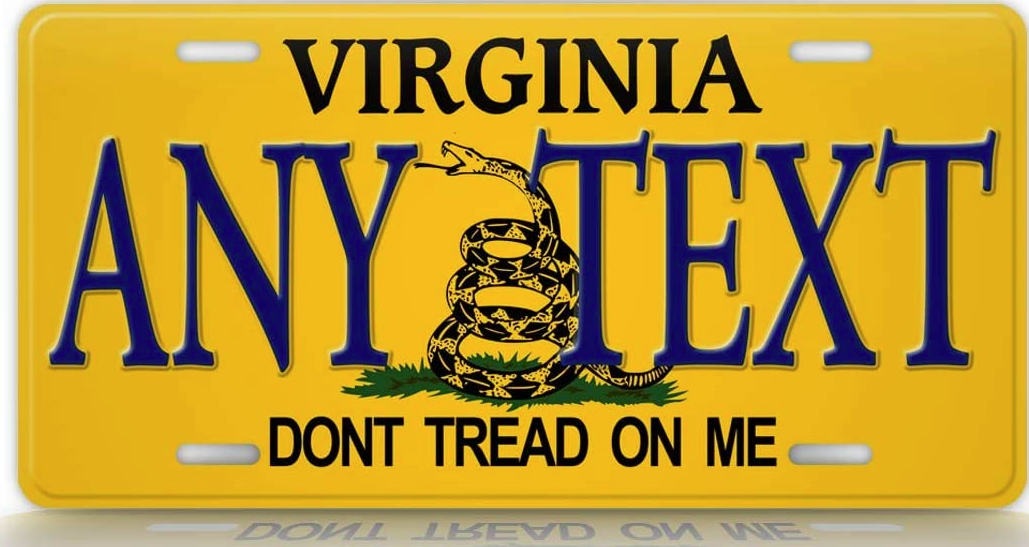

NPR (“A Florida license plate has reopened the debate over the ‘Don’t tread on me’ flag“):
When Florida Gov. Ron DeSantis recently tweeted an image of what he said was a new state license plate featuring a coiled rattlesnake and the words “Don’t Tread on Me,” he said it sends a “clear message to out-of-state cars.”
So, I’m not sure sending messages to out-of-state cars is what license plates are for. And, especially for a state that thrives on tourism, unfriendly ones are particularly foolish.
The imagery of the Revolutionary War-era Gadsden flag dates to Benjamin Franklin but has, for many, come to symbolize a far-right extremist ideology and the “Stop the Steal” movement that sought to overturn the 2020 presidential election results.
“‘Love, love, love’ Florida Gov. DeSantis new license plate; ‘Don’t Tread on Me!’” one Twitter user said. “This is how we feel about our great country..that is right now being systematically destroyed by the radical Left.”
How the Gadsden flag came to represent “Stop the Steal” is unclear to me but it had long been adopted by libertarians and Tea Party types.
But such plates have gotten push back, not only in Florida, but in states such as Kansas, Missouri and Virginia, where similar plates have been available, in some cases for years, as fundraising tools for various organizations.
“The state can’t claim a lack of knowledge about what this image represents to most of the public,” says Rachel Carroll Rivas, deputy director of research and analysis for the Intelligence Project at the Southern Poverty Law Center.
She says it’s become clear that the flag has been used for some “really awful” causes, most notably the Jan. 6 insurrection at the U.S. Capitol, where violent protesters attacked police as part of an effort to overturn the results of the 2020 presidential election.
The proliferation of organizational and other customized license plates has been ongoing around the country for decades. As we’ve gone from plates hand-made by prisoners, usually with a solid background with contrasting numbers and letters in a single color, to computer-printed plates that can be rather ornate, there has been a lot of opportunity to raise additional revenue from those wanting to represent some organization or cause. Alabama was doing that as far back as I can remember and Virginia, where I have lived almost exactly 20 years to the day now, is supposedly the state with the highest percentage of customized and personalized tags.
The plates I used to illustrate the post are in fact rather popular here and have been for quite some time. A report from 2013 had some 22,000 of them currently on the road. Because they’ve been around so long, I don’t associate them with the Stop the Steal movement or even Trumpers per se. But, in my unscientific but widespread sampling, I have determined that those who have them on their vehicles seem to have a disproportionate propensity to be asshole drivers.
Carroll Rivas compares it to a similar controversy over the use of the Confederate “stars and bars” flag on license plates. In 2009, the group Confederate Veterans, Inc., requested the flag on a specialty license plate, but Texas refused. The veterans group sued, and the case ultimately went to the Supreme Court. In 2015, in a 5-4 decision, the court held that such specialty plates (not to be confused with “vanity plates”) were government speech and therefore states have the right to pick and choose what goes on them.
That case was odd, indeed, and may or may not hold up. The majority opinion was written by Stephen Breyer, who is now retired, and joined by the late Ruth Bader Ginsburg, Sonia Sotomayor, and Elena Kagan—with Clarence Thomas, of all people, providing the deciding vote. The dissent was written by Samuel Alito and joined by Chief Justice Roberts and two departed justices, Anthony Kennedy and Antonin Scalia. It’s anyone’s guess whether that precedent would be followed by the current group.
While I could preach the issue of whether these tags constitute “private speech” or “government speech” either way, I tend to side with the point made by Texas Solicitor General Scott Keller in oral argument: “that while people are free to festoon their cars with bumper stickers saying whatever they want, they cannot force the government to give its stamp of approval to those messages.” Surely, the state shouldn’t be forced to sell “Ku Klux Klan” tags if the requisite 500 people (or whatever the number; it’s usually rather low) commit to purchasing them.
Benjamin Franklin was the first to use the rattlesnake as a symbol of defiance against the British crown, says Marc Leepson, a journalist, historian and author of Flag: An American Biography. In 1775, Christopher Gadsden, a South Carolina politician, “took that menacing rattle rattlesnake and put it on the flag,” Leepson says.
“One thing we can say about its origins, regardless of how it’s used or who uses it or why it’s used today, is that it really was just completely an anti-British [and] anti-colonial symbol,” he says.
The journalist Rob Walker, writing in The New Yorker in 2016, said, “The Gadsden design remained something of a Revolutionary relic for many years.” However, “[by] the nineteen-seventies, it had some popularity in Libertarian circles, as a symbol of ideological enthusiasm for minimal government and the rights of individuals.”
It seems like something I’ve always seen around. And it has been used off and on over the years as an official symbol of the US Navy. But it clearly took off in a big way with the Tea Party movement.
Then came the Tea Party movement, which adopted the banner in 2010 as a sort of catch-all symbol of disgust with government. Since then, it has gone on to become a symbol for anti-government groups and individuals.
Extreme or not, First Amendment scholars such as Eugene Volokh of the University of Southern California say the Gadsden flag and the “Don’t Tread on Me” motto are legitimate — and protected — speech, whether they are on a flag waving inside the besieged U.S. Capitol or on a vehicle license plate heading down a Florida highway.
“We know that some people are upset by that slogan,” Volokh says. But, “the government is perfectly entitled to take controversial stands or in this case stands that have become newly controversial because some very small group of people have ended up using a symbol for purposes that are very different” from what it originally signified.
I bow to Volokh’s superior expertise in First Amendment law but, again, the most recent (only?) SCOTUS ruling went the other way.
Other political and potentially controversial slogans routinely appear on license plates across the country, says Matt Dallek, a political historian at George Washington University’s Graduate School of Political Management.
“I’ve seen some ‘Live free or die’ license plates in New Hampshire, which of course has been the state motto for decades,” Dallek says. “You could argue that that certainly is a political statement” with a “fairly strong libertarian streak.” District of Columbia plates, which have long sported the colonial-era rallying cry “No taxation without representation” are also in that vein, he says.
“But I think that ‘Don’t Tread on Me’ has different, more extreme connotations, and therefore is more political and certainly is much more politicized,” Dallek adds.
That’s a slippery slope, of course. Obviously, there are groups and ideas that almost everyone considers “extreme.” But the Tea Party could just as easily have adopted “Live Free or Die” over its more active counterpart. Would it then become an “extreme” slogan?
Politicized plates are available for other hot-button issues, as well. For example, “Trust Women/Respect Choice” is an option in Virginia, just as “Choose Life” is available on plates in Nebraska.
Rather obviously, whether plates are private or government speech, allowing “Respect Choice” and not “Choose Life” plates or vice-versa would constitute viewpoint discrimination. Virginia sells both (“Choose Life” is here). I’m not seeing a pro-choice plate available in Nebraska, but it’s possible that there simply hasn’t been a group sponsor for it.
In the states where “Don’t Tread on Me” plates have been introduced, they appear to be top sellers. And that’s good news for the Florida Veterans Foundation, a veterans’ advocacy group that stands to get $25 per Gadsden flag license plate.
But it hasn’t been an easy road, says Chairman Dennis Baker. The choice of the Gadsden flag was made not by the group, but by a lawmaker pushing for the fundraising plate in 2019. “I think it was because other states were having such good success with it,” he says.
He says the money the foundation hoped to raise could go a long way toward helping Florida veterans.
“Then January 6th happened and it was like, ‘oh, s***,’” he says. By then it was too late, because Florida’s legislature had already approved the design.
That’s a rather amusing irony—the controversial plate is raising money for a rather uncontroversial cause, the leaders of which didn’t even choose the plate design.
The opposite was true in Kansas:
While Florida introduced the plate design in 2019, Virginia and Missouri did so a decade ago. Kansas approved the “Don’t Tread on Me” plates only weeks after the Jan. 6, 2021 insurrection, when television images of rioters waving the flag were still fresh.
Democrat Dinah Sykes, minority leader in the Kansas Senate, opposed the measure when it came up for a vote in March of last year. “Whatever the original symbology of [the Gadsden flag] was … I think a lot of people would argue that it’s become a symbol of the people who marched on the Capitol,” she says.
The plate design, meant to raise funds for the Kansas State Rifle Association, was subsequently vetoed by Kansas Gov. Laura Kelly, a Democrat, before the Republican-controlled legislature overrode it.
“I don’t think it’s appropriate,” says Sykes, who is the Kansas Senate minority leader. “When I see that, whether it’s a flag or a license plate … it’s not a good feeling for me.”
Sigh.










