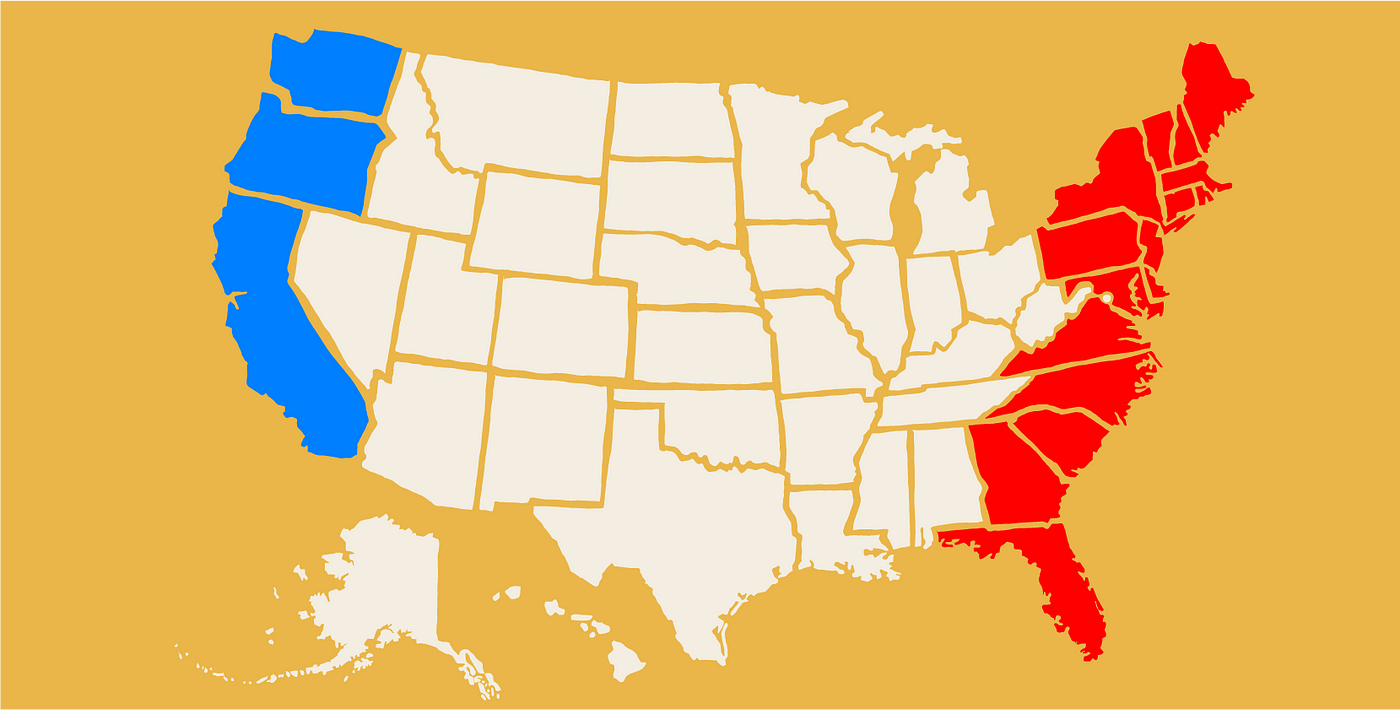

So, I read the Nicolas Kristof piece that was mentioned in yesterday’s open forum, What Have We Liberals Done to the West Coast? I found it to be more than a bit odd. It makes a sweeping claim about West Coast v. East Coast liberalism and while it makes some legitimate points about housing in particular, it is an otherwise weird and unconvincing piece.
He sounds more like a weird combination of sympathetic bleeding-heart and Fox News commentator.
As Democrats make their case to voters around the country this fall, one challenge is that some of the bluest parts of the country — cities on the West Coast — are a mess.
Centrist voters can reasonably ask: Why put liberals in charge nationally when the places where they have greatest control are plagued by homelessness, crime and dysfunction?
So, I understand that homelessness is a major problem on the West Coast in particular. Over the last several years I saw it myself when I traveled to Portland in 2021 and to California in the spring of 2023 (from San Francisco down to Orange County). There was a significant presence of homelessness in downtown Portland and I will note that the rental car company was quite strident about concerns about automobile break-ins in San Francisco. I saw homeless encampments in various places as we traveled south. I didn’t see all that much of it, by the way, in San Diego on a separate trip in late 2023. Of course, I was hardly on sociological field studies but was instead on vacation or business trips, so am hardly making scientific claims.
By the same token, I hardly found the Bay Area to be a post-apocalyptic hellscape, and while I fully accept that there is crime, homelessness, and dysfunction in these cities, it isn’t like those things aren’t present in the East but nor is it the case that Los Angeles, for example, is emptying out.
Indeed, a core part of the problem in California specifically is that demand for housing is a major component of price. It has been that way for quite some time.
Kristof also plays the game of peppering in some wacky tales of political silliness, for example.
For example, as a gesture to support trans kids, Oregon took money from the tight education budget to put tampons in boys’ restrooms in elementary schools — including boys’ restrooms in kindergartens.
Ok, that sounds super dumb, but what does it have to do with homelessness, which really is his central issue? Nothing questionable or dumb ever happens anywhere else?
The column seems mostly predicated on this, from a HUD report he links and was discussed in the Open Forum yesterday:
The two states with the highest rates of unsheltered homelessness are California and Oregon. The three states with the lowest rates of unsheltered homelessness are all blue ones in the Northeast: Vermont, New York and Maine.

He also adds in:
Liberal Massachusetts has some of the finest public schools in the country, while liberal Washington and Oregon have below-average high school graduation rates.
Oregon ranks dead last for youth mental health services, according to Mental Health America, while Washington, D.C., and Delaware rank best.
These are all legitimate issues to note. But he is just throwing things out without any systematic comparison being deployed. He also notes this:
Democratic states enjoy a life expectancy two years longer than Republican states. Per capita G.D.P. in Democratic states is 29 percent higher than in G.O.P. states, and child poverty is lower. Education is generally better in blue states, with more kids graduating from high school and college. The gulf in well-being between blue states and red states is growing wider, not narrower.
So my rejoinder to Republican critiques is: Yes, governance is flawed in some blue parts of America, but overall, liberal places have enjoyed faster economic growth and higher living standards than conservative places. That doesn’t look like failure.
So the problem isn’t with liberalism. It’s with West Coast liberalism.
But guess what when you look at life expectancy, via his link, we find the following (emphases mine):
The top 10 states, in order, are: Hawaii, Washington, Minnesota, California, Massachusetts, New Hampshire, Oregon, Vermont, Utah and Connecticut.
So my point is simply to point out that he is cherry-picking so as to make his case that there is some kind of clearly obvious West Coast liberalism problem, but I don’t think that stands up to scrutiny (or, as a minimum, I don’t think he makes his case). By the way, and along those lines, while New York does a far better job of sheltering their homeless, they have more homeless per capita than California, according to that same HUD report. Indeed, New York and Vermont are in the top category. A massive failure of East Coast liberalism? Or, maybe this is all just a silly dichotomy and not an especially good set of analytical categories?
By the way, Hawaii does a poor job of sheltering their homeless as well (third worse behind CA and OR as per the above graphic), but yet they have the best life expectancy? What does it mean?!?!?
Back to another of his stats while Oregon and Washington rank poorly with high school graduation rates, West Virginia has the highest rate in the country according to the stats he provided. With all due respect to the residents of West Virginia, I am going to need more data to determine that, in fact, high school graduation rates are the sine qua non of determining the quality of education in a given state. My state of Alabama has a graduation rate of 88% (one point better than the national average of 87%-yay, us?), but I don’t think that tells me much.
Here’s the deal: there is a long-term, ongoing housing crisis in California in particular. The cost of living is quite high and creates problems for any number of people, not just the unhoused. Yes, the place is rife with NIMBYism and a lot of liberals will not live up to their ideals in those places in these policy areas. Moreover, I do agree that as one goes northward in cases (e.g., San Francisco and Portland in particular) one can find a specific strain of progressivism that can lend itself to some fanciful politics.
But this piece, like a lot of conservative attacks on California in particular, is of a kind of argumentation that rankles me intellectually because it is a combination of cherry-picking (as noted above) and firm denial of empirical reality.
California, for all its flaws, in one of the most successful states in the union. This is just true and has been for decades. And note, while I did live there and have family there still, this is not some starry-eyed love-of-place motivated argument. I have a sincere affection for California (and think it a truly beautiful place), but I have no desire to live there. For one thing, it is too damn expensive to live there! I could not live my current lifestyle in California. And, moreover, and somewhat to my basic point, there are too many people in California for my taste.
But, of course, it is too expensive and too crowded, because people like living there and its economy is vibrant.
I always find these over-the-top (“plagued by homelessness, crime and dysfunction” and ” the problem isn’t with liberalism. It’s with West Coast liberalism”) critiques to be weird versions of Yoga Berra’s famous statement that “Nobody goes there anymore. It’s too crowded.”
Ultimately, the empiricist in me has a hard time looking at California and asserting it is a dumpster fire (and that is not to say, in the least, that there aren’t real problems worthy of discussing). And the comparativist in me requires a far better argument from data than he provides. If there really is a difference between West Coast and East Coast liberalism, do a better job of showing it systematically! I can say that just a minor dive into the data suggests to me that the data are far more mixed that Kristoff suggests.