That US presidential elections are decided through the mechanism of the Electoral College which, with two minor exceptions, awards all of the Electors of each of the 50 states (the number of House seats, which varies by population, and Senate seats, which is two per) plus the District of Columbia (fixed at three per the 23rd Amendment) to the winner of that state’s votes, regardless of margin, will not be news to OTB readers. Not only are you reading a political blog, and thus likely to have known this for a very long time, but it’s a topic we’ve harped on repeatedly for the last two decades.
In “The systemic bias Kamala Harris must overcome in order to win,” The Economist breaks down just how much this matters.
This electoral system is an obstacle for Ms Harris, the Democratic nominee, as it was for Joe Biden and Hillary Clinton before her. Although our presidential forecast gives her a 71% chance of winning more votes than Mr Trump nationwide, she has only a 51% chance of winning the electoral college.
The electoral college is formed of electors from every state and the District of Columbia, roughly in proportion to their population. To get to the White House, a presidential candidate must win a majority—270—of the 538 electors. Aside from those in Maine and Nebraska, practically every elector votes for the winner of the popular vote in their state. This winner-takes-all system encourages candidates to focus on swing states, rather than on places where the outcome is pretty much assured.
This year, we estimate that Pennsylvania is the most likely state to be the “tipping-point”: it provides the 270th elector for Mr Trump or Ms Harris in 26% of forecast simulations. Pennsylvania is followed by Michigan, North Carolina and Wisconsin as the likeliest pivotal states. On average, the tipping-point states are whiter and poorer than the country as a whole. All this shapes candidates’ stances. Ms Harris has recanted her opposition to fracking, a big employer in Pennsylvania, for example. Both candidates have endorsed eliminating taxes on tips, which could play well with hospitality workers in Nevada, another potential tipping-point state.
We’ve seen the distortions of the peculiarities of our electoral system in myriad ways. Notably, the fact that Iowa led off both the Republican and Democratic primaries for half a century (until Biden’s team changed it for the irrelevant 2024 cycle) meant a whole lot of pandering to Big Corn. But that Harris has changed a signature policy because of the outsized power of Pennsylvania voters and that Trump came up with one of the dumbest ideas ever (and Harris jumped on the bandwagon!) to suck up to Las Vegas has drawn less attention.
Regardless, the main issue is that, for all intents and purposes, the so-called “swing states” choose our presidents rather than the American people writ large, which is the most notable distortion.
Though Ms Harris leads in our tracker of national (pre-debate) polls by 2.5 percentage points, her margins are narrower in swing states.
This should not shock anyone. The thin margins are what make them “swing states,” after all.
In Pennsylvania she leads by 0.7 points, according to FiveThirtyEight, an aggregator. By itself, this suggests the electoral college has a bias of 1.8 points—smaller than the 2.9 points in 2016 or 3.3 points in 2020.
That’s an odd way of describing it. The bias created by the Electoral College shouldn’t be impacted by the closeness of the polls in a given state. While it’s technically true that, if Harris won every state, the Electoral College outcome and the national outcome would be the same, the distortion is to make small-population states more important than they ought to be (because each state gets two Senate-driven electors regardless of population, whether it’s Wyoming’s 584,000 or California’s 39 million) and makes voters in “safe” states irrelevant (because of the wnner-take-all distribution).
So, for example, in 2020, Biden received 3,458,229 votes in Pennsylvania to Trump’s 3,377,674 (50.01% to 48.84%)—a difference of 80,555 votes (1.17%). In 2016, Trump received 2,970,733 votes to Clinton’s 2,926,441 (48.18% to 47.46%)—a difference of 44,292 (0.72%). In both instances, the winner got 20 Pennsylvania Electors and the loser 0.
By contrast, Biden won California 11,110,250 to 6,006,429 (63.48% to 34.32%)–a whopping 5,103,821 (29.16%) margin. Clinton won 8,753,788 to 4,483,8810 (61.73% to 31.62%)—damn near doubling Trump’s vote and percentage. In both instances, the Democrat got 55 Electors and Trump 0. But here’s the thing: far, far more people voted for Trump in California than in Pennsylvania both times. Their votes are completely discounted under our system.
Alas, the rest of the article isn’t particularly helpful, as it doesn’t really explain the model.
But state opinion polls should be taken with a pinch of salt. In 2016 they indicated that Mrs Clinton was on course for victory. Although polls correctly suggested she had a small lead nationwide, they systematically overestimated her strength in swing states. Mr Trump won despite getting 2.9m fewer votes in total. Four years later, after months of favourable polling, Mr Biden won by the narrowest of margins in Wisconsin and Pennsylvania.
To hedge against this, our forecast combines polling with a “fundamentals” estimate of how states will lean, relative to the country, for example taking into account their tilt at the last election. The model believes Ms Harris will face an uphill struggle in the electoral college similar to Mr Biden: she would need a 2.1-point lead in the two-party popular vote to be the favourite to win the electoral college (see chart).
I’m not sure how helpful said chart is:
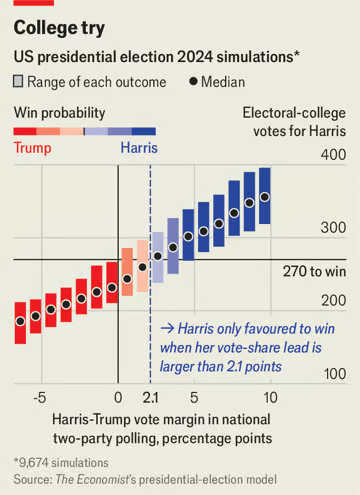
The standalone model page shows the overall and state-by-state but no how it’s derived. But, as of this morning, is shows Harris with just enough Electors to win (272) but with a range of anywhere from 191 to 377. Trump has 266 Electors and a range of 161 to 347. You’d rather be in Harris’ shoes than his but it’s still essentially a toss-up.
And, once again, while we have 50 states and the District of Columbia participating in the election, the Economist concurs with pretty much everyone that only seven states are in play. Here’s their model’s current assessment:

Harris is certainly doing better than Biden was, as Georgia and North Carolina were rather solidly in Trump’s column before Biden exited the race. Still, it’s remarkable that the contest is even in doubt given Trump’s performance in office, his attempt to steal the last election, his felony conviction, and all the rest. But here we are.