
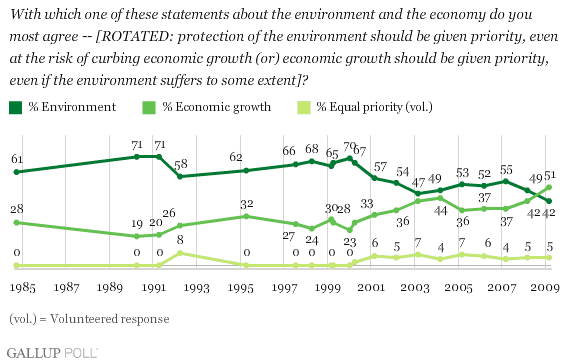
Michael Barone (via Glenn Reynolds) argues that elites are “out of touch” on climate change and gun control:
Many years ago, political scientists came up with a theory that elites lead public opinion. And on some issues, they clearly do. But on some issues, they don’t. Two examples of the latter phenomenon are conspicuous at a time when Barack Obama enjoys the approval of more than 60 percent of Americans and Democrats have won thumping majorities in two elections in a row. One is global warming. The other is gun control. On both issues, the elites of academe, the media and big business have been solidly on one side for years. But on both, the American public has been moving in the other direction.
One could argue that these are cases where counter-elites are exceedingly well organized and have fought back with counter-propaganda. Regardless, they’re obviously cases where the elites have failed to dominate the debate.
Over the past decade, the Gallup organization has been asking Americans whether the seriousness of global warming is generally exaggerated or generally correct. From 1998 to 2007, except for the run-up to the 2004 election, they said it was generally serious by roughly a 2-1 margin — 66 to 30 percent in 2006, for example. But in March 2009, that margin slipped to only 57 to 41 percent, with two-thirds of Republicans and nearly half of independents saying concern is exaggerated.
Actually, this is a rather bizarre cherry picking of the data. What the March poll tells us is that people are more concerned about the economy than they are about the environment during the worst economic crisis in generations. Indeed, Frank Newport‘s report is titled “Americans: Economy Takes Precedence Over Environment – First time majority has supported economy in 25 years of asking question.”
 Still, as Newport’s April 2008 report makes clear, the overall concern about global warming has been essentially static for two decades.

This, not the bogus comparison in relative intensity, is a much better indication that the elites have failed to win this battle. On the other hand, a related question shows the people who think global warming “will pose a serious threat to you or your way of life in your lifetime” has increased from 25 percent to 40 percent over that period.
The difference is even more stark on guns, as Gallup‘s various trendlines show. The most relevant question has seen a steady decline since 1991:

Furthermore, gun ownership has fluctuated considerably since 1960, starting from a high of 49 percent, going as low as 34 percent in 2000, but is back to 42 percent today.









