
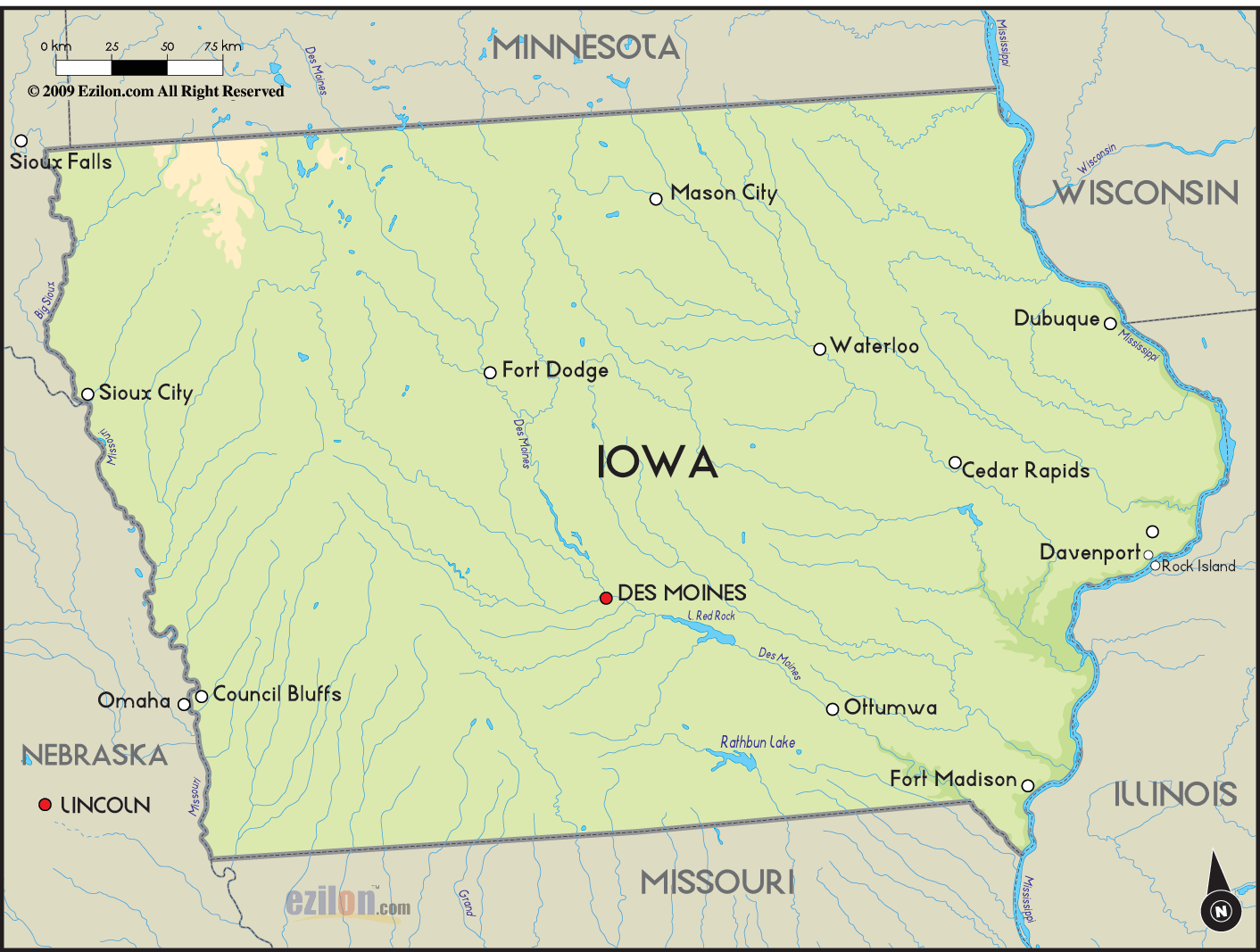

A political earthquake in Iowa over the weekend that resulted in a clear victory for the “establishment” over Tea Party and other forces could have big implications for the 2016 Presidential race:
DES MOINES, Iowa — Establishment forces officially wrested control of the Iowa Republican Party from supporters of Rand Paul on Saturday, a development the victors said would help save the state’s first-in-the-nation presidential caucus from being marginalized and possibly spell the demise of the Ames Straw Poll.
The transfer of power to those loyal to Gov. Terry Branstad — which has been in the works for months but was completed on Saturday — increases the likelihood that center-right GOP candidates, such as Chris Christie or Jeb Bush, will choose to compete in the caucus. It also jeopardizes next year’s straw poll: Branstad said the annual ritual has “outlived its usefulness,” and other critics say it’s become a spectacle that raises a lot of money for the party but has little significance politically. Pro-Paul forces, however, enthusiastically support the event and want to keep it going.
For all the attention showered on the Iowa caucuses in the presidential sweepstakes, they suffer from a credibility crisis. It is fueled by the perception that the competition favors the most conservative candidates in the field or forces more moderate contenders to the right, damaging their prospects in the general election. Rick Santorum and Mike Huckabee won in 2012 and 2008, respectively, only to lose the nomination.
The battle for control of the party was primarily an effort by Branstad to reestablish himself as the undisputed leader of Republican affairs in Iowa — perhaps most critically the future of the caucuses.
After the 2012 results, Ron Paul supporters mobilized at district-level conventions to take over the party — despite the fact he finished third on caucus night — and wound up controlling the delegation to the national convention.
Branstad, cruising to an unprecedented sixth term as governor, has spent the better part of the past two years sparring with A.J. Spiker, a co-chair of Ron Paul’s Iowa campaign who defeated the governor’s preferred pick to lead the state party in 2012. As chairman of the party, Spiker was publicly critical of Branstad’s legislative agenda. Establishment-minded donors refused to contribute to the state party as long as Paul people were in charge.
Their rivalry came to a head earlier this year.
At local conventions starting in January and continuing through April, the governor’s machine successfully mobilized supporters to elect a slate of 16 people to the GOP central committee, including a few loyal holdovers. This group, essentially the party’s board of directors, took over Saturday night. There is no longer a single Paul-aligned, libertarian on the central committee.
Rand Paul’s supporters in Iowa insist that this isn’t a setback for their efforts because they were intending to concentrate their efforts on campaigning for their candidate rather than controlling the state party in any case. However, it strikes me that this is mostly an effort on their part to sugar coat a loss that could have a big impact on whatever momentum Paul may have in Iowa if he runs. With control of the state party apparatus, Branstad and the party “establishment” will be the ones who set the rules for the 2016 caucuses and the events that lead up to them, including any party debates. Additionally, they’ll be able to use that apparatus to help generate support for whichever candidate they wish. If we end up with a result in Iowa similar to the one we saw in 2012, where the margin between Mitt Romney and Rick Santorum was razor thin and, indeed, changed significantly several weeks after the caucuses themselves, this could have a big impact on who has momentum heading into New Hampshire and South Carolina.
Perhaps the biggest impact that these results will have, though, will be in what they mean for the future of the Ames Straw Poll:
The big question now is what happens to the straw poll, a ritual that dates back to 1979. The next one would happen only a year from now, in August.
Right after Romney’s loss in 2012, Branstad announced that he did not think there should be a straw poll in 2016. “It has been a great fundraiser for the party but I think its days are over,” he said then.
The remark drew an immediate rebuke from Spiker, who said the party would go ahead with it.
In 2011, Rep. Michele Bachmann won the straw poll before flaming out and finishing sixth in the caucus. Romney, meanwhile, had invested heavily to win the 2007 version but decided to skip it altogether that year – and then went on to win the nomination.
The feeling is that the straw poll empowers the most ardent activists and thus elevates candidates who could not win in a general election. Iowa political hands say it is hard to imagine someone like Christie, Sen. Marco Rubio (R-Fla.) or Wisconsin Gov. Scott Walker winning at Ames, though George W. Bush prevailed in 1999.
Doing away with the straw poll might hurt Paul and Ted Cruz. The Texas senator would like be able to both raise enough money to bus people in and could demonstrate the intensity of his grassroots support.
Still, even within Team Branstad, there are differing opinions. The straw poll is a huge fundraiser for the state party, and it’s a fun time for those who go. Reporters love to cover it because it’s colorful and offers an early read on the GOP horse race.
Several substitute options are being discussed, such as a cattle call in each of the four congressional districts or another big event in Ames, but with no balloting. It’s also possible that the straw poll will go on just as it has before.
Branstad has spoken about eliminating the Ames Straw Poll in the past, and the Bachmann victory in 2011 is certainly a strong argument in favor of doing so. As the article notes, though, the poll is also a huge fundraiser for the state Republican Party. In 2011, the state GOP pulled in $113,000 in space rental fees alone, with Ron Paul’s campaign spending the most for their space at an astounding $31,000. For better or worse, the straw poll draws political media from all over the country into Iowa for an entire week as candidates come out to meet and greet people attending the Iowa State Fair in what is, in many ways, the beginning of the campaign for the caucuses that will be held the following year. Most of all, though, it is the single biggest fundraiser for the party throughout an entire four year cycle, so it seems unlikely that the Iowa GOP is going to totally give up the idea completely. Instead, we’re likely to see the rules for the poll modified to make it more difficult for candidates to stack the results in the manner that Bachmann and Ron Paul did in 2011. However it turns out, though, we’re likely to see a much more conventional caucus in 2016 than we did last time around, and that could pose problems for unconventional candidates like Rand Paul and Ted Cruz.









