Reuters (“AfD leads as Merz rues ‘disaster’ in worst state election result in postwar Germany“):
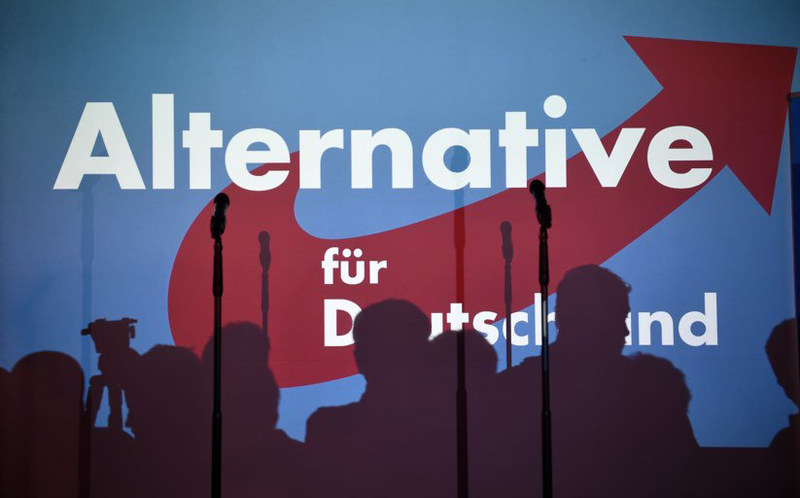
The far-right Alternative for Germany (AfD) took first place in state elections in northeastern Germany on Sunday, voting projections showed, delivering the worst result for Chancellor Friedrich Merz’s mainstream conservative party since 1949.
“It’s a disaster,” Merz said after exit polls were published, although he signalled he would fight on as chancellor and continue his reform agenda after speculation that a bad result could prompt him to resign.
The AfD was set to win 38.3% in the state of Mecklenburg-Western Pomerania, ahead of the centre-left Social Democrats (SPD) at 35.4%, according to projections on ARD public television. Both parties were far ahead of Merz’s conservatives, who at the latest count had fallen to 4.9%, below the 5% threshold needed to enter the state parliament and indicating they may be excluded altogether.
Sunday’s result has given the AfD its second top-place finish this month at the state level. The party leads in national opinion polls but has been kept from power by the other main parties’ refusal to work with it.
In another election on Sunday in the capital Berlin, the far-left Linke party was at 25.3% while the vote share of Merz’s conservatives, who currently govern the state in a coalition with the Social Democrats, tumbled to 19%. The AfD also gained in strength in the typically liberal city, hitting 16.3%. It is the first time Linke has topped polls in the state, where it wants to nationalise housing from corporate landlords and cap rents.
Sunday’s results may not prove a knock-out blow for Merz, but his low approval ratings, unpopular reforms and the triumph of the AfD in an earlier state election in Saxony-Anhalt have left his future in the balance.
“It will now become even more difficult for the federal government to muster the courage and political support for a fundamental reform programme,” Marcel Fratzscher, president of the Berlin-based DIW research institute, told Reuters.
If the ruling coalition parties stick to their red lines, he said, “political paralysis will become entrenched, economic weakness will persist, and the likelihood of an AfD election victory in 2029 will rise further.”
In addition to the longstanding cultural issues, including immigration, that have created support for right-populist parties across the West, the centrist parties’ support for Ukraine was a big issue:
The SPD’s popular state premier in Mecklenburg-Western Pomerania, Manuela Schwesig, had climbed in the polls ahead of Sunday’s vote by openly criticising both the AfD and the Merz-led federal government’s reforms.
Schwesig also said the AfD had won votes by criticising Germany’s support for Ukraine. She had supported the Nord Stream pipelines carrying Russian gas through her Baltic Sea coast state into Germany before they were blown up in 2022, but later changed her position.
“First, in my state, many people oppose support for Ukraine, both financial and military,” she said.
“And a second point: Many people also wish to see energy flowing through Nord Stream again.”
There has been a broad consensus among the traditionally dominant parties, SPD and CDU/CSU, that the pain of being cut off from Russian energy was a worthwhile price to pay to avoid financing the illegal war in Ukraine. Clearly, a large swath of the citizenry disagrees.
Merz is doubling down:
German Vice-Chancellor Lars Klingbeil, who is also the SPD leader, signalled he wanted a change of course, citing voters’ concerns over pension reforms.
But Merz instead doubled down on a reform agenda he says will revive sluggish growth in Europe’s largest economy.
“What needs to be done now requires backbone, steadfastness, and patience,” he said. “I would go so far as to say that these reforms are the antidote to the authoritarian poison that is penetrating ever deeper into our society, driven by the allure of authoritarianism.”
It’s worth noting that all three of the statewide contests in which AfD came in first are in the former East Germany. That’s not a coincidence.
Writing seven years ago, on the occasion of the 70th anniversary of Germany’s Basic Law, American-German Institute fellow Stephen F. Szabo described the system designed by postwar scholars thusly:
The Grundgesetz was written by Germans who did not trust their country. The founders, with the assistance of American authorities and German emigrés, created a constitution which was not even called a constitution but a Basic Law (Grundgesetz), as it was meant to be temporary until the country was reunified and an all-German constitution could be written. It was written with both the Weimar and Hitler experiences seared into German memory. Both the failure of democracy in Weimar and the mass support for Adolf Hitler meant that the framers believed that the German public could not be trusted to be democrats and had to be restrained within a democratic context. Consequently, a number of “never agains” were built into the constitution which was not a constitution.
The Basic Law contains a ban on anti-democratic parties and speech both to prevent a return of an extreme right nationalist party like the National Socialist German Workers’ Party (NSDAP), as well as to prevent the Communists from taking power. The Communist Party (KPD) was banned in 1956 by the Constitutional Court and only reemerged under a different name in 1968. Strict laws on hate speech including those pertaining to social media are a current manifestation of this concern. The numerous checks and balances built into the political system including a vigorous federal system of strong state governments, a Constitutional Court, the limits on a federal police force to prevent a new Secret State Police (Gestapo) and a liberal asylum clause all stem from this aim. The restrictions on militarism and the military was another goal, and the Grundgesetz limits the autonomy of the German military and its missions by requiring it to operate in a multinational coalition and expressly for territorial defense. The Bundestag must approve any deployments of German forces and the Chancellor is not even granted the power as commander-in-chief.
In addition to the bans on extreme parties and speech, the electoral law passed after the constitution includes a 5 percent clause which limits the number of parties in the federal parliament with the hope of avoiding the ineffective multiparty system of Weimar. The office of the President, which was held by Paul von Hindenburg in Weimar and led to Hitler being appointed Chancellor, was downgraded to a figurehead role. The Constructive vote of No Confidence (which requires a parliamentary majority not only to remove the Chancellor, but also to elect his or her replacement) was designed to maximize executive continuity and prevent revolving door governments. The limited use of referenda, which had the misuse of referenda in Weimar in mind, limits direct democracy and has spared Germany from a Brexit type quagmire.
The system worked extremely well at producing stable governments, led by either the center-right CDU or the center-left SPD, through the Cold War. Unification, though, presented a huge challenge: bringing in 16 million Germans who had lived under Communist rule for 45 years.
In addition to the legacies of Weimar and the Third Reich, the reunification of the country in 1990 has been influenced by the Constitution. When Germany was able to get the agreement of the Allied Powers to reunify under the Treaty which followed the Two Plus Four negotiations, Germany had two ways to constitutionally unify. It chose the Article 23 accession route, which simply extended the constitution to the eastern states of Germany rather than the Article 146 route, which would have called for a new all-German constitution. By doing so, the Grundgesetz remained in force. This has had a number of consequences, most notably the lack of a feeling of agency in the former East Germany (GDR) and the failure to consolidate the Länder (states). This left 16 state governments in a country the size of Tennessee and Oregon combined.
And—again, this was seven years ago—Szabo observes,
All successes contain the seeds of demise and Germany is no exception. The consensus-oriented centrist politics of coalition governments has limited the role of opposition, and of the Bundestag. Grand coalition governments, as is also the case in Austria, have opened the door to the extremes which argue that there is an elite consensus which prevents real change. Despite the 5 percent clause, the voting system set up by the electoral law is essentially one proportional representation which has ensured a multiparty system. As a result, Germany now has a six-party system which includes a far-right extremist party as the largest opposition faction in the Bundestag. The fact that much of the former GDR, despite receiving close to $1.5 trillion in funding since unification, has been left behind, has opened the door for the rise of the Alternative für Deutschland (AfD) and other extremist groups.
I was living in West Germany when the Berlin Wall came down and when reunification happened. The latter will have its 36th anniversary in a few days. That the former East Germans still feel like they’re living in a different country at this stage is a signficiant problem.
While there has been talk of banning AfD, it hasn’t gotten very far. And Timothy Garton Ash has it right:it’s too late for that now, anyway.
The German constitution provides for political parties that are “hostile” to its basic liberal democratic principles to be banned. Senior German politicians have called for an application to be made to the constitutional court to ban the AfD, or at least its most extreme parts, on those grounds. But it’s too late for that. The AfD has been a major force in the Bundestag since its success (off the back of the migration crisis) in the 2017 general election and, like Reform UK in Britain, has led nationwide in opinion polls. To suddenly tell so many citizens “you’re not allowed to vote for the party you support!” would itself be an assault on democracy.
And I think he’s also right here:
But this is not democracy as the tyranny of the majority: the people have spoken, off with your head! It’s liberal democracy, meaning the outcome of any popular vote is constrained by the rule of law, human and minority rights, and pluralist, anti-majoritarian institutions. The real threats to German democracy today are less like Weimar in 1933 than Budapest in 2010 (when Viktor Orbán took over) and Washington DC in 2025. The mini-Donald Trumps of the AfD have reportedly been quietly exploring Trump-like executive and administrative devices they might use to consolidate their control. The Federal Republic of Germany has the right, the power and the duty to stop them.
Article 37 of the constitution, which allows federal authorities to overrule anti-constitutional behaviour by the states, has never been used in the 77-year history of the republic. Assuming, as now seems likely, the AfD forms the state government in Saxony-Anhalt, all federal powers, up to and including article 37, should be used wherever necessary. For example, they should prevent sensitive intelligence about Russia’s increasing aggression being shared with a Saxony-Anhalt branch of the domestic security service controlled by the pro-Russian AfD; secure the independence of courts and prosecutors, as well as the neutrality of police and civil service; and, I would add, stop any extreme politicisation of education and public service broadcasting. Of course, AfD politicians will cry “foul!”; tough. If, as they say, they want “another republic”, they can go and live in Russia.
I’m less confident, however, in this:
Yet even more important than these legal and administrative constraints is the political response. At the opposite end from those calling for the party to be banned are Christian Democrats calling for the “firewall” to be abandoned and AfD politicians to be embraced as part of the normal political process. Letting them take responsibility in a state government will, it’s argued, expose their incoherence, incompetence and lack of real policy answers.
Talking and working with them will end up moderating them, as apparently happened with Giorgia Meloni’s Brothers of Italy. I’ve been tempted by these arguments myself. But evidence collected by political scientists suggests that a strategy of inclusion is just as likely to put more wind in the nationalists’ sails. And AfD activists are themselves warning against the danger of Melonisierung (Melonisation).
So Christian Democrats should not be tempted to get half into bed with the AfD, like a middle-aged man nervously edging into an extramarital affair. Instead, starting already this weekend with elections in Mecklenburg-Vorpommern and Berlin, they should more effectively combat it politically. Rather than defining Christian Democracy by what it’s against (the AfD and the far-left Linke), they should say what it’s for. To renew Germany’s social market economy, they should implement all the labour market, pension, tax and other reforms agreed this summer with their Social Democrat coalition partners – and more. Faced with huge external challenges, from Russian aggression to US and Chinese AI, the Christian Democrats – historically the party of Europe – should boldly advocate the European-scale answers which alone will give any European country the strength to stand up to giants.
Like it or not, huge numbers of people in Germany, as in the United States and the rest of the West, feel like the mainstream parties are run by elites for elites and don’t care about ordinary citizens. While I continue to think globalization, the liberal world order, the EU, NATO, and the like have mostly been beneficial—and certainly think we should be doing everything we can to help Ukraine stave off Russian aggression—it’s hard to argue that the negative externalities haven’t hurt working-class citizens. I’m skeptical that doubling down on that project is the solution to winning them back.
It’s also worth reiterating that, so long as no other party will form a coalition with them, AfD has no route to govern.
Deutsche Welle (“AfD makes gains in elections but has no government option“):
The Alternative for Germany (AfD) made significant gains in the elections in northeastern Germany and in the capital, Berlin, but is likely to remain in the opposition in both states.
[…]
The AfD was not short of confidence. Even before the first exit poll results were announced, AfD co-leader Tino Chrupalla told public TV network ARD, “We clearly have a mandate to govern here,” before adding that the party would offer coalition talks to all the other parties.
[…]
With Merz’s center-right Christian Democrats (CDU) suffering heavy losses in both state elections, AfD party co-leader Alice Weidel said she now sees her party as the successor to the CDU.
“We are the new people’s party in Germany,” Weidel pronounced to public broadcaster ZDF, before criticizing the Christian Democrats for refusing to entertain the possibility of entering into a coalition with AfD: “We are holding talks because we haven’t erected any firewalls.” But Weidel did not explain what the policy talks with other parties would look like.
After the AfD’s triumph in the state of Saxony-Anhalt on September 6, it has become clear that the party — some of whose members are considered a threat to Germany’s constitutional order by German domestic intelligence agencies — is struggling to find political allies.
On the one hand, this is good news: the system is working as intended in preventing the rise of an extremist government. On the other, the fact that the most popular party in election after election is kept on the outside looking in is only going to fuel more anger at the system.