
Cancel culture conversations (or, really, questions of what kinds of speech can get a person into what kinds of trouble) fall into a number of categories. These include broader political categories, like BLM or the Charlie Kirk assassination, and whether poking at raw nerves on social media can get a person fired. There are also questions of whether or not academic institutions (whether we are talking about administrators, faculty, or students) have behaved in censorious fashions around similar topics.
The whole discussion has gotten even more fraught as we have moved from the question of random “justice” of this type being meted out by private individuals to the involvement of state actors, whether it be the state government getting TAMU officials fired for talking about gender in a way that some politicians disapprove of, or whether the is the FCC Chair making mob-boss like pronouncements about talk show hosts he wants punished.
For the record, I think that the question of whether individuals, or even groups, have sought to unjustly fire or “cancel” people with whom they have a disagreement over speech and state actors working to fire those the government itself disfavors are two very different categories.
This post is focused on the non-governmental type of “cancellation” in the context of stand-up comedy.
My basic views on this topic are not especially different than what I wrote over three years ago, “Some Thoughts on “Cancel Culture”: “I will admit to struggling with the concept of “cancel culture” insofar as I don’t think that there is a movement afoot that rises to the level of a “culture.” Further, I have my doubts that “cancellation” is all that it is cracked up to be.” I go through a number of examples in the piece.
One specific aspect of this ongoing debate in the United States is whether cancel culture makes it unfairly difficult for comedians to be as funny as they want to be. It is a topic I find interesting and one I think about frequently because of its direct relevance to the First Amendment as a general matter, and also how it has a specific application to discussions of “wokeness” and whether or not there is some unreasonable censoriousness in American society, especially from “the left.”
While I am not an expert-level comedy nerd, I am at least comedy-nerd adjacent. I enjoy stand-up, improv, and sketch comedy, and a significant percentage of my heavy podcast consumption over the years has been in the comedy genre. One of the things that I notice in listening to a range of comedians, especially on podcasts, which do not have to adhere to broadcast standards, is that the range of words and ideas that comedians have to make jokes is pretty wide open.
Here are the things that seem to me to be the “off-limits” words: racial, homophobic, antisemitic, and misogynistic slurs. Likewise, there is a derogatory word that starts with “r” that we all used to use all the time, especially on the playground, to describe persons with mental disabilities, which is now frowned upon. There is enough social opprobrium in the air to forestall these words from being used, including words that were common in comedy when I was a child and were often heard on broadcast television.
To my mind, most of the pressure around those words and kinds of jokes is a sign of market pressure and social change as to what is acceptable, rather than being about free speech restrictions. I am highly doubtful that comedy is suffering from the lack of access to slurs.
There are lines a society has to draw, which is why I have a hard time with the notion of free speech absolutism (which is a way I used to describe myself) insofar as we all know there is a line, even if we might argue about where the line ought to be drawn. (And, again, government acting and society acting are not the same thing.)
Nonetheless, there are those who are quite incensed over the whole thing. The return of comedy was one of Musk’s promises when he bought Twitter.
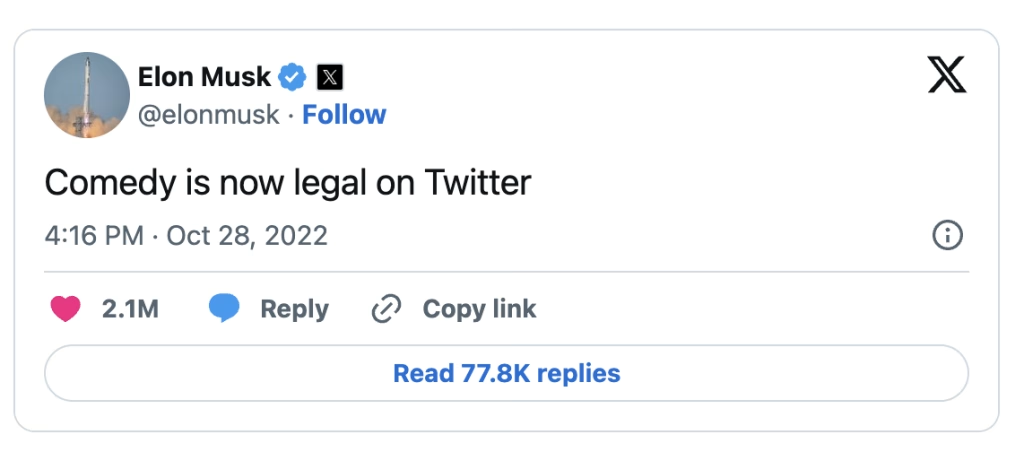
Ironically, within days of that pronouncement, he banned comedian Kathy Griffin from the site, as per NBC News: Comedian Kathy Griffin suspended from Twitter after mocking CEO Elon Musk.
Funny how that works.
Of course, comedy was never illegal on Twitter, and the kinds of speech prohibition that Musk removed were mostly of the racist and hate-speech variety. As Brooking noted at the time, Why is Elon Musk’s Twitter takeover increasing hate speech?
Twitter saw a nearly 500% increase in use of the N-word in the 12-hour window immediately following the shift of ownership to Musk. Within the following week, tweets including the word “Jew” had increased fivefold since before the ownership transfer. Tweets with the most engagement were overly antisemitic. Likewise, there has also been an uptick in misogynistic and transphobic language. This surge in hateful language has been accredited to various trolling campaigns on sites like 4chan and the pro-Trump forum “The Donald.”
Who could have seen that coming?
See also this study, “X under Musk’s leadership: Substantial hate and no reduction in inauthentic activity.”
When it comes to comedy in particular, and leaving aside some of the more complicated examples of “cancellation” in academia or elsewhere, I have never been all that sympathetic to the notion that “wokeness” or “cancel culture” has been stopping comedians from being funny.
The most prominent example of comedic cancellation off the top of my head was Louis C.K., who temporarily had a hard time getting work based on his behavior, not his speech. I know that Dave Chappelle has gotten heat for his joke about trans persons (but not in a way that has stopped him from making a lot of money). The only comedian whom I can think of who was truly canceled is Bill Cosby, but, you know, that was for allegations concerning drugging women and raping them, not so much for the edgy jokes about going to the dentist or giving the kid’s chocolate cake for breakfast.
To my point above, so many of the comedy-linked gripes are linked to the inability to use certain words without getting criticized, usually racist or homophobic slurs. Or, things like this via NBC News: The ‘R-word,’ embraced by Joe Rogan and Elon Musk, inches back into the mainstream.
In a recent episode of his highly influential podcast, Joe Rogan declared what he sees as the latest triumph in the cultural battle over language: the return of the “R-word.”
“Every time I see people that disagree with any that’s happening, any gigantic world events, it’s one of these retarded shows where they’re screaming,” he said April 10 on an episode of “The Joe Rogan Experience,” before he interrupted himself to go on a quick rant about the word.
“The word ‘retarded’ is back, and it’s one of the great cultural victories that I think is spurred on, probably, by podcasts,” he added.
[…]
Tesla CEO Elon Musk now frequently uses the word on X to disparage everyone from a Danish astronaut to Ben Stiller.
Well, then, comedy and the republic itself are saved!
One of the things that many stand-ups seem to think is that they are modern-day philosophers speaking truth to power, and therefore, they don’t think anyone should tell them what to say. But, to be honest, apart from some slurs, it is unclear to me what it is they can’t say (and legally, they can slur away, which is a reminder of the distinction between First Amendment Rights and how the society itself reacts to certain words). The fact that society sometimes pushes back on certain topics is not, in my mind, cancel culture.
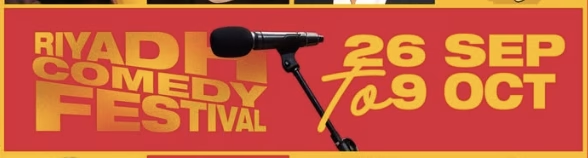
All of this brings us to the Riyadh Comedy Festival that was held about a month ago. A large number of American comedians were paid very large sums of money to perform for the elite of Saudi Arabia. Among the dozens of American comics to appear were Bill Burr and Dave Chappelle, both of whom fancy themselves free speech warriors.
Via Variety: Dave Chappelle Jokes ‘It’s Easier to Talk’ in Saudi Arabia ‘Than It Is in America’ While Performing at Riyadh Comedy Festival.
While headlining Saudi Arabia’s Riyadh Comedy Festival on Saturday (via The New York Times), comedy giant Dave Chappelle deliberated over the do’s and don’ts of free speech in America, deeming it “easier to talk” in the Middle Eastern nation than back home in the States.
“Right now in America, they say that if you talk about Charlie Kirk, you’ll get canceled,” Chappelle said. “I don’t know if that’s true, but I’m gonna find out.”
“It’s easier to talk here than it is in America,” he added.
I mean, I guess as long as you make no jokes about MBS having a journalist murdered and then bonesawed so his corpse could be smuggled out of the embassy, then sure, it is a free speech haven.
Or, you know, the list of topics that comedians had to agree not to talk about. As per the AV Club, Comedian Atsuko Okatsuka posts contract after turning down Riyadh Comedy Festival.
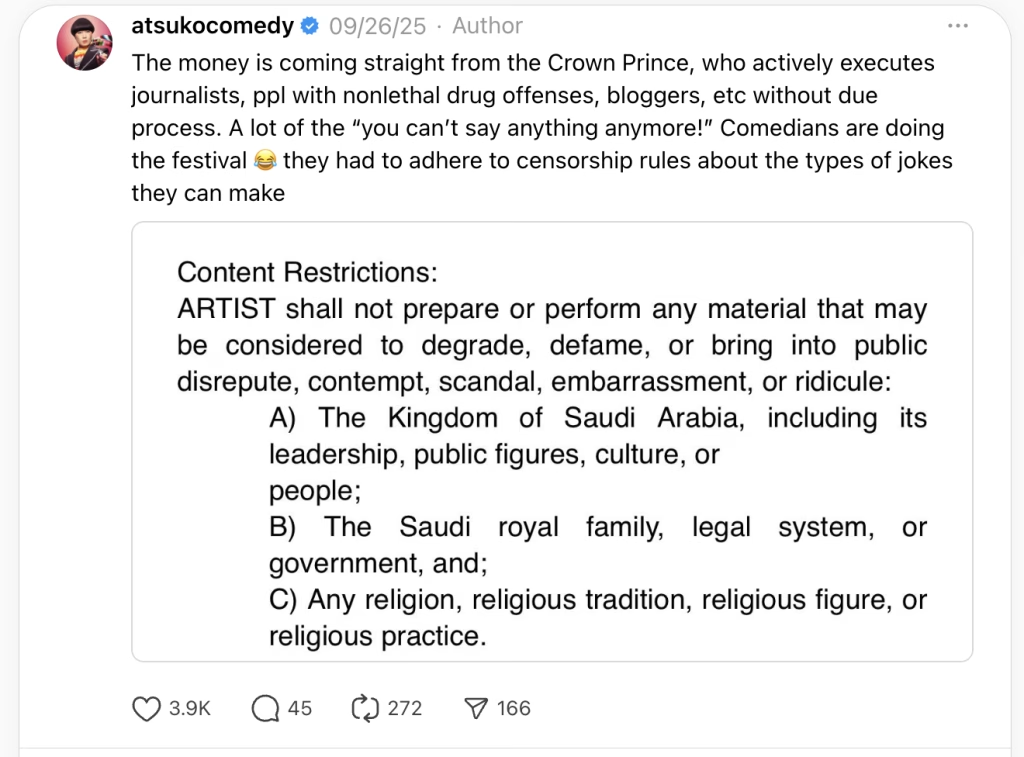
It really takes some gall for Chappelle to act like he is the freest of speech zones on a stage in Riyadh, performing for the elite, knowing that he signed off on that contract.
Chappelle is not alone in being a known Truth Teller who took the check and is defending himself. Via Variety: Bill Burr Defends Riyadh Comedy Festival Gig Amid Backlash: ‘Definitely Top Three Experiences I’ve Had’.
“It was great to experience that part of the world and to be a part of the first comedy festival over there in Saudi Arabia,” Burr said on the Sept. 29 episode of his “Monday Morning Podcast.” “The royals loved the show. Everyone was happy. The people that were doing the festival were thrilled.”
Speaking truth to power, I see.
During the episode, Burr talks about arriving in Riyadh with apprehension due to the years of negative portrayals in Western media. “You think everybody’s going to be screaming ‘Death to America’ and they’re going to have like fucking machetes and want to chop my head off,” Burr said. “Because this is what I’ve been fed about that part of the world.”
Seems an odd thing to agree to do, if you expected some chance your head would be machetted! I guess the check was really good!
But, fret not, they have chain restaurants in Riyadh.
His biggest surprise, came from the restaurants available and from the audience itself, which he described as young, diverse and eager to engage with stand-up comedy.
“Is that a Starbucks next to a Pizza Hut next to a Burger King next to a McDonald’s? They got a fucking Chili’s over here!”
All of this is like the whole Liv Golf bit: I recognize that the checks are huge, but there has to be some recognition of who is signing those checks.
Human Rights Watch: Saudi Arabia: Riyadh Comedy Festival Whitewashes Abuses.
The Saudi government is using the Riyadh Comedy Festival 2025 from September 26 to October 9 to deflect attention from its brutal repression of free speech and other pervasive human rights violations, Human Rights Watch said today. The festival dates include the seventh anniversary of the Saudi state-sponsored murder of the journalist Jamal Khashoggi and takes place just months after Saudi authorities executed a journalist apparently for his public speech.
Some additional examples of what a real free speech zone the Kingdom is.
Human Rights Watch urged the comedians in particular to publicly call for the release of the Saudi human rights defender Waleed Abu al-Khair, who is serving a 15-year prison sentence as a result of his human rights activism. The comedians should also seek the release of Manahel al-Otaibi, a female fitness instructor and women’s rights activist sentenced to 11 years in prison – recently reduced to 5 years – for promoting women’s rights online. They should also raise the lack of accountability in Khashoggi’s murder at the Saudi consulate in Istanbul on October 2, 2018.
In terms of how much they respect a comedian’s ability to comedy (not to mention a specific comedian’s ethics):
Tim Dillon was scheduled to perform but said he was fired after he joked on his podcast about Saudi Arabia’s poor human rights record.
[…]
“I am doing this because they are paying me a large sum of money,” Dillon said on his August 30 podcast. “They are paying me enough money to look the other way.” Dillon said that the Saudi festival was paying him US$375,000 for the one show on October 8, but that other performers were offered as much as $1.6 million. “They bought comedy,” Dillon added. “Do I have issues with the policies towards freedom of speech? Of course I do, but I believe in my own financial wellbeing.”
On September 20, Dillon announced that his performance had been canceled after Saudi authorities were allegedly “unhappy” about his comedic remarks on the treatment of migrant workers and other human rights issues. “I addressed it in a funny way and they fired me,” he said.
It is as if these comedians don’t really understand what they are dealing with here.
So, yes, slinging racist, misogynistic, homophobic, and anti-semitic texts can lead to you losing your job in the United States, and I am more than okay with that, even if the slingers in question assert that they were just joking.
Look, these folks (here’s the list) have every legal right to take Saudi money and be court jesters for the royal family, but I really do not want to hear any of them say one word about cancel culture or how they are free speech warriors who speak truth to power via their comedy.
We have some real free speech challenges in the United States, but those are starting to burble up from federal and state governments that want to limit science and academic speech. That is a different quantum of problem than whether comedians get push back for making trans jokes or whether or not they get dirty looks for using insulting terms for people with mental challenges.









