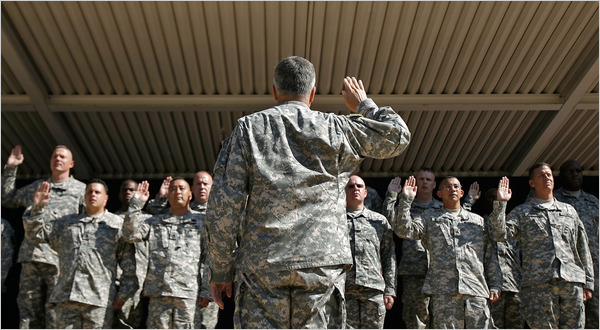

I missed the news last month that Defense Secretary Gates ordered his personal staff to start wearing their service uniforms to work at the Pentagon, reversing a post-9/11 tradition of all-fatigues-all-the-time. Whether desired or not, SECDEF’s move naturally has others nervously following suit, not only at the Pentagon but also in office environments across DoD.
Press Secretary Geoff Morrell was recently asked for clarification and he responded:
To give you the quick history of this, the secretary has for a long time been thinking about making a change in his office. When he came back from Christmas vacation, he asked his military staff to switch out of their BDUs, out of their fatigues, and into dress uniforms, their more appropriate work uniforms.
His thinking was simply that this is the headquarters of the United States military in our nation’s capital. He hosts leaders from around the world. The people we do business with, from across the river, the professionals that come to see us are all dressed in business attire. And he thought it was time for his office to be dressed accordingly.
This is — he understands fully why this building changed in 19 — in 2001 into its fatigues. This building was hit, it was attacked. We were at war. Not only was that the appropriate dress, in the aftermath of that attack, it showed solidarity with the warfighter.
I think we are at a point now where he believes at least that what one dresses in does not necessarily reflect their commitment to the warfighter or, and that there are other ways to demonstrate their solidarity. Frankly it’s by doing everything you can, once you walk in this door every day, to make sure they have what they need to succeed.
This was not a mandate for the building as a whole. This was meant for his staff. If others take notice, as they clearly have, and make adjustments, that is their decision. And I think you’ve seen some offices go about that.
You’ll certainly see the people you deal with in Public Affairs, starting Monday [March 1], dressed in their business or dress attire. And I think you’ll likely see other officers in the building as well. But it was not by fiat. It was not mandated. It’s — they’ve probably taken notice of the change upstairs and re-evaluated their own policies.
I don’t know what the policy was at the Pentagon in the pre-9/11 days but the Army as a whole was moving to all-fatigues-all-the-time as far back as the early 1980s. Even cooks and hospital personnel, who had traditionally worn whites to ensure cleanliness, were sporting BDUs. (Some commenters suggest my experience in this regard was idiosyncratic.) The idea was to inculcate the “warrior spirit” (hooah!) and demonstrate that all soldiers were warfighters.
Regardless, I’m with Gates — and Gulliver — on this one. It makes sense to have soldiers in line units wear utility uniforms to work. But for soldiers who work in an office environment — and especially those who represent the military to the public — service uniforms are more appropriate.
That’s especially true in the DC area, where everyone and his brother’s sporting a suit. I haven’t decided whether showing up to a business meeting in camouflage is more demeaning, insulting, or intimidating. Either way, it’s bad form.
I’m not advocating a return to the ridiculousness of the 1960s, when soldiers weren’t permitted to step out of their cars in fatigue uniforms once off post. But we’ve been at war now for the better part of a decade. We don’t need faux symbolism to make our soldiers feel like warriors.