
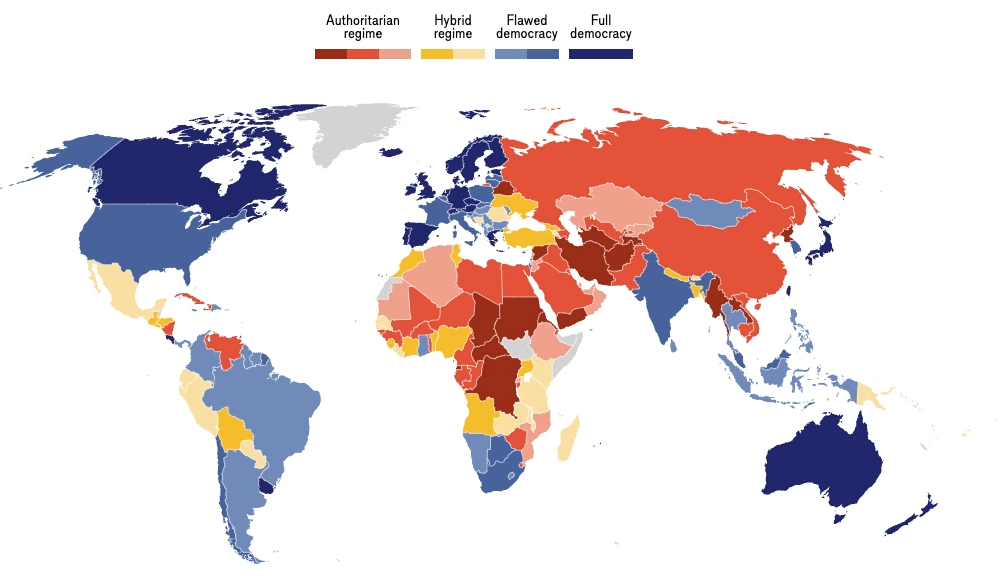
The Economist (“The global democracy index: how did countries perform in 2024?“):
Around half the world’s population live in places that held elections in 2024. Some 1.65bn ballots were cast across more than 70 countries. But while the number of democratic elections in a single year has never been higher, 2024 also brought big challenges. According to the latest democracy index published by EIU, our sister company, on February 27th, global democracy is in worse shape than at any point in the nearly two-decade history of the index.
Since 2006 EIU has scored 167 countries and territories on a scale of zero to ten based on five criteria: electoral process and pluralism, functioning of government, political participation, political culture, and civil liberties. The countries are then grouped into four categories: full democracies, flawed democracies, hybrid regimes and authoritarian regimes.
For the 16th consecutive year, Norway was named the most democratic country in the world, with a score of 9.81. New Zealand and Sweden followed. Afghanistan has been the lowest-ranked country since 2021, scoring just 0.25 points. The biggest change came from Bangladesh, which dropped 25 places. Rebuilding democracy there will be an enormous task after the ouster of Sheikh Hasina, the country’s longtime autocratic ruler. But there is cause for optimism. A temporary technocratic government, led by Muhammad Yunus, a Nobel peace prizewinner, has restored order and stabilised the economy. For those reasons, we named Bangladesh our country of the year in 2024.
[…]
Even Europe—home to nine of the top ten countries in the index—saw some notable declines. France was downgraded from a full democracy to a flawed one. This mostly reflects a deterioration in its confidence-in-government score after president Emmanuel Macron’s snap election in June failed to secure a legislative majority for any single party or bloc. (Four different prime ministers during the course of the year did little to instil confidence either.) Romania was also downgraded after allegations of Russian interference, illegal social-media tactics and campaign-finance violations prompted the constitutional court to annul the presidential election and call for a new vote. In Asia, South Korea dropped out of the full-democracy category after President Yoon Suk Yeol declared—then hastily revoked—martial law, plunging the country into crisis.
America remained a flawed democracy, shifting only slightly from its position in 2023. But it could face bigger problems this year: the first month of President Donald Trump’s second term has already challenged the political independence of the civil service and seen a flurry of executive orders of questionable legal authority.
Mr Trump’s victory in 2024 was part of a broader global backlash against incumbents. The next test for global democracy in 2025 will be how these newly elected leaders choose to govern.
Twenty-five countries, from Norway to Spain, are ranked as Full Democracies. Nine countries (Norway, New Zealand, Sweden, Iceland, Switzerland, Finland, Denmark, Ireland, and the Netherlands) have scores 9 or higher (Norway is at 9.81, so all have some room for improvement). France, at 7.99, is the highest ranked Flawed Democracy. The United States, at 7.85, is third–behind Malta and ahead of Chile.
The breakdowns of how each rating was given is not made even in the full report, which requires filling out a form and asking them to send even for subscribers.
They do note this:
Risk of the president seeking retribution, using the Department of Justice and the Federal Bureau of Investigation to go after political enemies, which would also erode checks and balances. Civil liberties
of immigrants, migrants, other minorities and protesters also at risk.
Which some might argue as less than democratic.









