
WaPo (“Washington braces for a government shutdown — as DOGE cuts continue“):
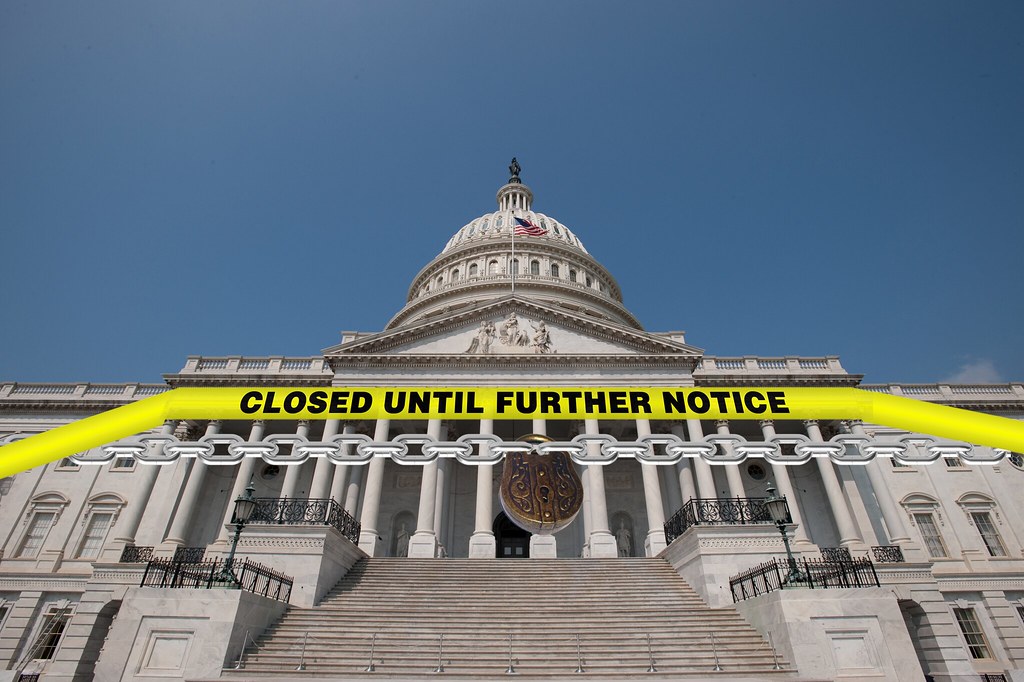
Government shutdown deadlines — and even full-on shutdowns — aren’t new for Washington, but this time, with federal funding set to run out Saturday after midnight, no one knows quite what to expect.
A drive by President Donald Trump and billionaire Elon Musk, who oversees the U.S. DOGE Service, to unilaterally shrink the government has seen tens of thousands of federal workers dismissed or opting for deferred resignations. That means some of the disruption that a shutdown can provoke for federal workers or citizens who need government services is already here.
The administration’s push for cuts has also scrambled lawmakers’ negotiations, with Democrats — who in recent years have sought to keep the government open at all costs — opposing funding legislation as part of what they call a last-ditch bid to stop Trump’s attempts to exert more control over spending.
Meanwhile, Republicans — who have forced Washington to the brink of shutdowns several times recently in pursuit of budget cuts — are in charge of Congress and the White House and have lobbied their members to keep the government open.
And it’s still not clear what parts of the government would close in a shutdown: The White House budget office removed Biden-era guidance on shutdown plans from its website earlier this week. A spokesperson did not return requests for comment about how much of the government would remain operational during a shutdown.
On Thursday evening, the White House website that houses shutdown preparation instructions instead led to a page with an error message.
There’s no precedent most officials can recall for a shutdown fight that’s effectively about whether the government has the power to shut itself down.
“For nearly two months, President Trump and Elon Musk have been shutting down our government piecemeal, illegally shuttering programs, agencies, and now attempting to close entire departments,” Sen. Chris Coons (D-Delaware) said Wednesday. “The House Republican bill enables Trump’s and Musk’s devastating and unconstitutional cuts that have reduced our government’s ability to protect public health and safety, made it harder for seniors to get their Social Security checks and created an opening for China by dismantling our foreign aid partnerships.”
But a shutdown, some experts say, could play into the hands of the Trump administration and give White House officials broader latitude to reduce the scope of government. It could also offer a test for Trump and Musk’s arguments that huge swaths of the bureaucracy are wasteful and unnecessary — and wouldn’t be missed if they closed down and never reopened.
“Whatever your problem is,” Rep. Tom Cole (Oklahoma), chairman of the House Appropriations Committee, warned Democrats on Tuesday, “whatever your concern is, it’s going to be worse in a government shutdown.”
Josh Marshall reports that the American Federation of Government Employees, the largest federal employees union, is urging Democrats to force a shutdown rather than sign on to the CR. This is a shocking development as AFGE has always dreaded shutdowns in the past. Their reason for reversing course in this instance? We’re essentially already in a shutdown.
Under the current CR, federal workers are being treated no better than they will be if government funding ceases Friday night. Yes, it is true that workers who have not yet been fired are at least drawing a paycheck—for now. But it H.R. 1968 becomes law—a measure that ignores the administation’s brazen refusal to carry out duly enacted laws of Congress and further erodes Congress’ power of the purse—AFGE knows that DOGE will dramatically expand its terminations of federal workers and double down on its campaign to make federal agencies fail because there will be nothing left to stop the Administration for the balance of Fiscal Year 2025, if ever.
Thus far, it looks like the Democratic leadership in the Senate concurs.
Of course, there is also the possibility that the shutdown will be used to demonstrate that the vast number of federal workers are “non-essential” and can therefore be done away with permanently.








