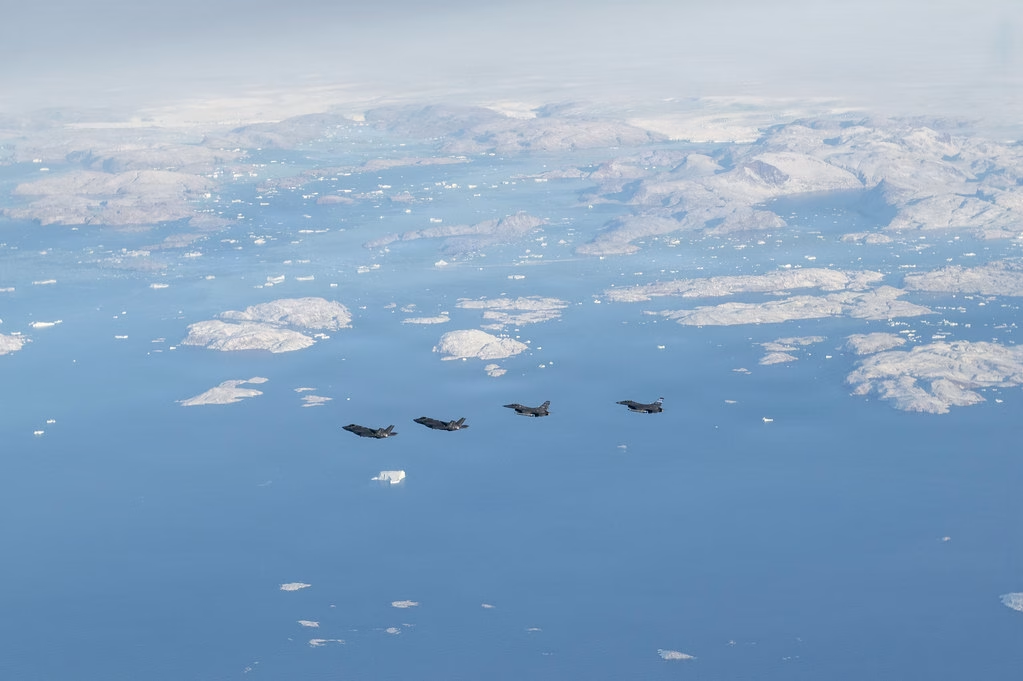
Reuters (“Trump links Greenland threat to Nobel Peace Prize snub, EU eyes trade retaliation“):
U.S. President Donald Trump linked his drive to take control of Greenland to his failure to win the Nobel Peace Prize, saying he no longer thought “purely of Peace” as the row over the island on Monday threatened to reignite a trade war with Europe.
Trump has intensified his push to wrest sovereignty over Greenland from fellow NATO member Denmark, threatening punitive tariffs on countries which stand in his way and prompting the European Union to weigh hitting back with its own measures.
The dispute is threatening to upend the NATO alliance that has underpinned Western security for decades and which was already under strain over the war in Ukraine and Trump’s refusal to protect allies which do not spend enough on defence.
It has also plunged trade relations between the EU and the U.S., the bloc’s biggest export market, into renewed uncertainty after the two sides painstakingly reached a trade deal last year in response to Trump’s swingeing tariffs.
In a written message to Norway’s Prime Minister Jonas Gahr Stoere that was seen by Reuters, Trump said: “Considering your Country decided not to give me the Nobel Peace Prize for having stopped 8 Wars PLUS, I no longer feel an obligation to think purely of Peace, although it will always be predominant, but can now think about what is good and proper for the United States of America.”
[…]
EU leaders will discuss options at an emergency summit in Brussels on Thursday. One option is a package of tariffs on 93 billion euros ($108 billion) of U.S. imports that could automatically kick in on February 6 after a six-month suspension.
Another option is the “Anti-Coercion Instrument” (ACI), which has never yet been used and which could limit access to public tenders, investments or banking activity or restrict trade in services, in which the U.S. has a surplus with the bloc, including in digital services.
The EU said it was continuing to engage “at all levels” with the U.S. but said the use of its ACI was not off the table.
The EU’s efforts at dialogue are likely to be a key theme of the World Economic Forum in Davos, where Trump is set to deliver a keynote address on Wednesday in his first appearance at the event in six years.
German Finance Minister Lars Klingbeil and French Finance Minister Roland Lescure, meeting in Berlin, pledged a united, clear, European response to any additional U.S. tariffs.“Germany and France agree: we will not allow ourselves to be blackmailed,” Klingbeil said at the German finance ministry, where he was hosting his French counterpart.
British Prime Minister Keir Starmer called for calm discussion between the allies, adding that he did not believe Trump was considering military action to seize Greenland.
NYT national security reporter David Sanger (“Trump Has an Offramp on Greenland. He Doesn’t Seem to Want It.“):
As the struggle for control of Greenland intensifies — and with it, the question of whether the Atlantic alliance will suffer a mortal wound — two raw geopolitical realities have come into focus.
The first is that all the members of the North Atlantic Treaty Organization underinvested in Arctic security for years, as melting glaciers, aggressive Chinese and Russian navies and critical undersea communications cables made one of earth’s coldest landscapes ripe for renewed superpower conflict.
The second is that President Trump has no intention of seeking a common solution to this long-brewing problem.
Instead, he has deliberately opened what could become the largest rift in the nearly 77-year history of the alliance, one that led the German vice chancellor to declare over the weekend that European nations “must not allow ourselves to be blackmailed” by the largest power in the group.
[…]
What makes this crisis both remarkable and unnecessary is that it appears so deliberately manufactured by Mr. Trump himself. As an opening position, he has made clear he is not interested in diplomatic compromises that would almost certainly achieve his stated defense aims: More U.S. bases to monitor Chinese and Russian shipping, and the expansion of his still-nascent “Golden Dome” missile defense project.
He has shown no interest so far in looking for diplomatic offramps, or the kind of defense partnerships that NATO has long fostered. Every time the Europeans offer solutions — everything short of outright American ownership of the Danish territory — Mr. Trump turns them aside, demanding all 836,000 square miles of Greenland, even if most of it is covered in ice sheet.
In fact, the sheer size of it appears to be part of the lure. The fact that most of the territory is uninhabitable does not seem to bother Mr. Trump. It is the ultimate real estate prize: a territory about three times the size of Texas, and bigger than Alaska, which is around a mere 665,000 square miles.
If Mr. Trump prevails, he will have pulled off the largest land acquisition in American history, even larger than Secretary of State William H. Seward’s negotiation in 1867, when he bought Alaska from Russia for about 2 cents an acre.
[…]
He does have an easier option. A treaty between the United States and Denmark, signed in 1951 at the end of the Truman administration, gives the United States broad rights to reopen the 16 or so military bases that it once had on Greenland.
They were shuttered because Washington thought the era of strategic competition for the Arctic ended when the Soviet Union collapsed. It did not want to pay for frozen bases. So they were left to the winds and the ice: A tour of a few of the old facilities last summer revealed that the long Greenland winters had blown out the windows of the surviving houses and command centers. Runways were broken up into chunks, and overgrown.
But for a few billion dollars — far less than it would cost to buy Greenland outright — the United States has the right to build deep ports, long runways, radar stations and launch sites for missile defense interceptors. It just has not asked. As one senior Danish official put it archly, the country is ready to say yes — which may be why Mr. Trump does not want to raise the issue.
Reason‘s Ilya Somin (“Trump’s Plan to Seize Greenland is Simultaneously Evil, Illegal, and Counterproductive“):
Donald Trump’s plan to seize Greenland has the rare distinction of simultaneously combining grave injustice, massive illegality, and extreme counterproductive stupidity. The same is true of his more recent effort to impose tariffs on eight European countries opposing the plan.
Let’s start with first principles. As the Declaration of Independence states, government should be based on the “consent of the governed.” No real-world government is fully consensual. But a US conquest would make the government of Greenland less consensual than it is now. Polls indicate some 85% of Greenlanders oppose annexation by the US, while only 6% support it. In the 2025 Greenland election, the overwhelming majority of them voted for parties that support either independence or continued rule by Denmark.
Forcible annexation could perhaps be justified if it were the only way to stop some kind of severe oppression. But there is nothing like that in Greenland. Nor is there any reason think that US rule would be significantly better in terms of protecting various human rights than the current combination of Danish rule and extensive regional autonomy.
[…]
In addition to being unjust and illegal, the plan to seize Greenland is also incredibly stupid and counterproductive. The main official rationale is the supposed need to protect Greenland from seizure by Russia and China. But those countries have no forces in the region that could possibly take it. Moreover, in the unlikely event that a genuine threat were to materialize, an existing agreement with Denmark already allows the US to station as many troops in Greenland as it needs for defense. In the event of attack, the two nations could also call on the assistance of the other NATO states.
If Trump really wanted to counter Russia, he would join with other NATO allies in backing Ukraine. If Russia is defeated in Ukraine, or even just remains bogged down there, it cannot pose much of a threat to Greenland or any other NATO territory. Instead, Trump has been betraying Ukraine and undermining NATO by threatening an ally’s territory. Such moves actually help Russia and our other enemies, rather than hinder them.
An attack on Greenland would predictably alienate the allies, and severely undermine the alliance, if not destroy it completely. The loss of our most important allies would weaken the US and strengthen our enemies far more than owning Greenland could possibly benefit us. Denmark itself is a longtime steadfast ally, and sent some 10,000 troops to support us in Afghanistan. If we betray a close, longstanding ally in such an egregious way, other allies will see they cannot count on us, and will draw the obvious conclusions.
Another possible rationale for Trump’s move is obtaining Greenland’s mineral wealth. But we can far more easily obtain access to it through the simple mechanisms of trade and investment, to which Denmark and Greenland are open. In any event, any economic or strategic gain here is far outweighed by the immense harm of alienating all our allies.
l must confess that, until he doubled down this week, I lumped President Trump’s obsession with Greenland in with his early insistence on making Canada the 51st state: a wild, perplexing notion that he would eventually abandon. For reasons Sanger and Somin note, there is essentially no upside to U.S. “ownership” of Greenland and plenty of downside.
I suspect Sanger is right that Trump’s primary motivation here is to go down in history for vastly expanding U.S. territory. Indeed, it would slightly eclipse the 1803 Louisiana Purchase as the largest such acquisition. It’s as much gut instinct as it is reasoning. As he noted in a recent NYT interview, “Ownership is very important. Because that is what I feel is psychologically needed for success.”
Alas, that this move would needlessly shatter NATO for no real security gain may well be a feature, not a bug, in Trump’s mind. He has long seen the alliance as a protection racket that pays insufficient dividends.
In his first administration, Trump let seasoned advisors talk him out of such things. There is apparently no one left whom he’ll listen to.