
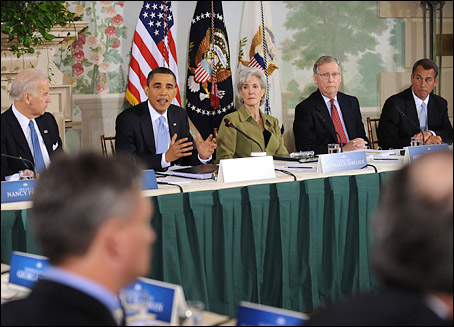
 When President Obama invited Republican Congressional leaders to join him for a televised health care summit, they reasonably feared it was “a trap” in which the contrast between the contrast between a smooth talking Commander-in-Chief and Podunk legislators would make them look small. Clearly, Obama intended it as a PR gambit that would showcase him at his best and bully the Republicans into making concessions in order to appear reasonable.
It doesn’t seem to have worked out that way.
Like most Americans, I had more pressing things to do with my time than watch a seven hour gabfast. Earning a living, for example, took precedent. But the journalists whose job it is to report on these things and help establish the Conventional Wisdom seem to agree that the Republicans came out just fine.
WaPo’s Chris Cillizza pronounces an odd mix of Winners — Tom Coburn, Obama, the process, the Senate, Paul Ryan, and C-SPAN — and Losers — Harry Reid, John McCain, genuine discussion, the public option, and the cable networks.
Politico‘s Glenn Thrush saw no clear winner. And that, because we’re grading on a curve, means the GOP won.
President Barack Obama’s Blair House health care summit was billed as political theater — but it was so dull in parts, it’s hard to imagine anyone would demand a repeat performance.
And boring never looked so beautiful to House and Senate Republicans.
Seven thick hours of substantive policy discussion, preening and low-grade political clashes had Hill staffers nodding at their desks, policy mavens buzzing — and participants declaring the marathon C-SPAN-broadcast session a draw.
But in this case, the tie goes to Republicans, according to operatives on both sides of the aisle — because the stakes were so much higher for Democrats trying to build their case for ramming reform through using a 51-vote reconciliation tactic.
“I think it was a draw, which was a Republican win,” said Democratic political consultant Dan Gerstein. “The Republican tone was just right: a respectful, substantive disagreement, very disciplined and consistent in their message.”
The Atlantic‘s Marc Ambinder, who is also somehow CBS’ chief political consultant, agrees.
The political world watched the proceedings at Blair House looking for theatre: instead, a policy fight broke out. This time, both sides came armored, and there was no referee. It was a wash — and the tie goes to the Republicans.
The key question on the table was not whether Democrats and Republicans could come up with ways to compromise; it was whether the White House could move public opinion in a way that helps Nancy Pelosi get the votes she needs to pass the Senate bill in the House. That’s unlikely.
[…]
Indeed, Republicans were successful when the focus of the debate was on process — the details of the deals that Democrats and the White House struck with key states and the (seeming) lack of transparency. The Democrats have an answer to this: if you want to find a pure debate on a pure bill, you’ll have to look to…another universe entirely, because this is how legislation gets done.
But the Democratic answer is callous, and Republicans know it: this debate is not about a weapons system, it’s about a fifth of our economy, it’s about life and death — and deals that take health care goods from one state and transfer them to another just don’t play.
Slate‘s John Dickerson splits the difference. Apparently, both Obama and the Republicans won, which means the Democrats lost. Except, of course, Obama. Who won.
If the White House health care summit was political theater, here’s a 30-second review: President Obama won. So did congressional Republicans. Democrats in Congress need another act. This is not because Obama is such a better speaker and advocate for the legislation than his allies, though he is. It’s because Democrats didn’t get much political benefit from the event.
Obama ran for office promising to reach out to the other party. He said he would try to find areas of common agreement, and when his opponents had a legitimate philosophical disagreement, he would not question their motives. He did all of that in the session. Obama was not the crazy liberal caricature of GOP attacks during the seven-hour iron-bottom discussion. (Which may itself have been bad for the health of the people in the room.)
Republicans came out ahead for the same reason: They did not look like hell-bent obstructionists. This isn’t to say that they tried to meet the president halfway. They didn’t even try to meet him a quarter of the way. Repeatedly they called on him to start over. The president tried to get the room to focus on areas of agreement, and though several Republicans—notably Sen. Tom Coburn and Rep. Dave Camp—worked in that spirit, several others (hello, Reps. John Boehner and Eric Cantor) did not.
[…]
This is why it wasn’t a good day for congressional Democrats. According to strategists involved in 2010 races, fence-sitting Democrats needed to see Obama change the political dynamic. He needed to show how health care reform could be defended and how Republicans could be brought low. He did neither. White House aides and the president himself said he was going to press Republicans for how their plans would work, but he did that only twice—and mildly. There was no put-up-or-shut-up moment.
Obama debated Republicans vigorously and with precision—but it looked like a debate among people with actual philosophical differences, which in part it was. After an in-the-weeds debate about how the Congressional Budget Office accounted for premium increases, it became clear that the debate was between Democrats who want to set minimum standards for coverage and Republicans who want the market and individual choice to rule. The Democratic plan is more expensive but covers more people. The Republican plan is cheaper and doesn’t.
As it played out, the event didn’t look like one reasonable person aligned against a company of hooting morons. As Obama said during the lunch break: “The argument Republicans are making really isn’t that this is a government takeover of health care, but rather that we’re insuring the—or we’re regulating the insurance market too much. And that’s a legitimate philosophical disagreement.” Obama continued to affirm this view by saying things like this: “Neither of these proposals is radical. The question is which one works best.”
Of course, the only opinion that really matters is that of David Gergen. He’s like the provost or something:
The folks in the White House just must be kicking themselves right now. They thought that coming out of Baltimore when the President went in and was mesmerizing and commanding in front of the House Republicans that he could do that again here today. That would revive health care and would change the public opinion about their health care bill and they can go on to victory. Just the opposite has happened.
HotAir‘s AllahPundit about sums it up, though, with this:
Obama’s problem today was that he couldn’t fly solo; he tried to, speaking for more minutes at the meeting than either the Democrats or Republicans did, but surrounding him with sad sacks like Reid and Harkin was bound to dilute the effect.
All in all, I’d say that the real winner were those of us who didn’t spend seven hours watch.









