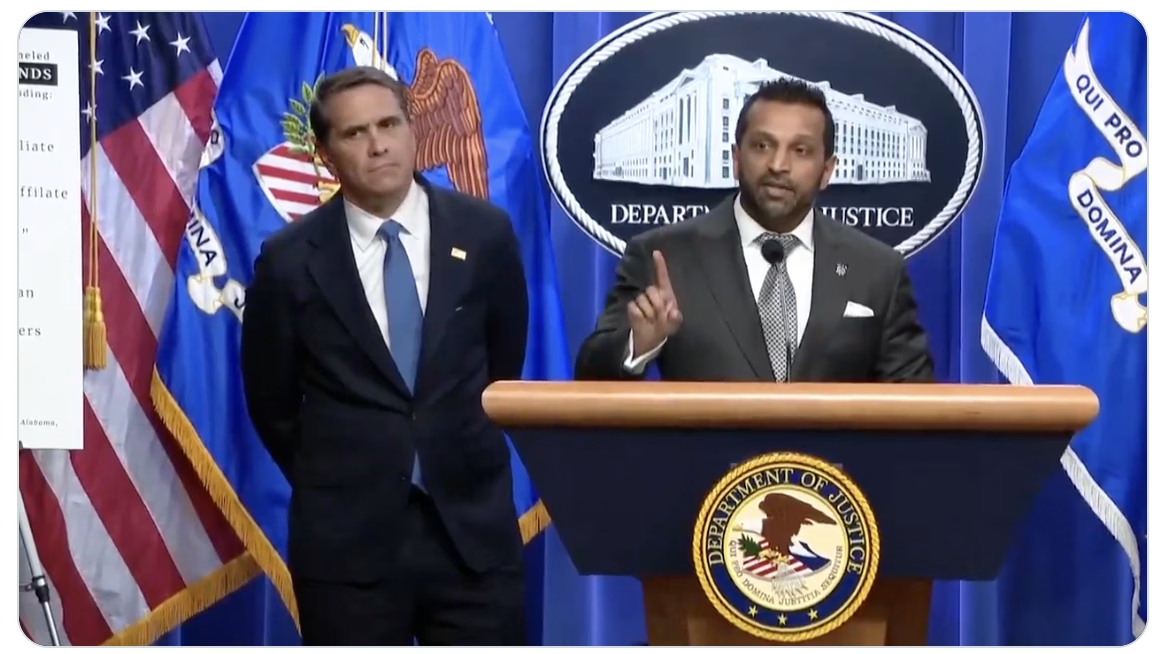

As we wait for the Senate to act, or even announce that there’s a deal, the House GOP leadership has decided to pursue its own version of a final deal:
House Republican leaders on Tuesday will try to move their own bill to open the government, lift the debt ceiling and enact a host of health-care related policies that they hope the Senate will accept.
In a closed-party meeting Tuesday morning, House GOP leadership announced a plan to reopen the government until Jan. 15 and lift the debt ceiling until Feb. 7. The legislation would also delay Obamacare’s tax on medical devices for two years; cancel health-insurance subsidies for members of Congress, the president, vice president and the cabinet; and beef-up income verification requirements for Affordable Care Act subsidies.
This bill will likely have to pass with nearly all Republican votes.
The House plan comes as Senate leaders work to craft their own bipartisan plan. The two bills have similarities: The government-funding and debt ceiling expiration dates are the same, and both bills stiffen income verification requirements for individuals to receive Obamacare subsidies.
But the Senate bill creates a bicameral negotiating committee, while the House’s bill does not. The House plans to include a delay of the medical device tax and language to cancel Obamacare subsidies for politicians — both are missing from the Senate’s bill. The House’s bill — and not the Senate’s — stops Treasury from using extraordinary measures to prevent default. The Senate’s bill also cancels a tax on insurance plan, in a concession to unions – that is not in the House’s bill.
The House proposal immediately complicated the timeline in the Senate, where Republicans were supposed to hold a morning caucus for Senate Minority Leader Mitch McConnell (R-Ky.) to brief his members on the Senate plan. That was delayed until the afternoon in the wake of news from the lower chamber.
Senate Majority Leader Harry Reid (D-Nev.) met with McConnell on Tuesday morning after the Senate opened. As he left the GOP leader’s office, Reid was asked if he had a reaction to the House’s plan to move a separate bill. Reid replied: “I will, but not right now.”
In opening the Senate on Tuesday morning, Reid continued to sound optimism about the Senate’s own discussions.
“There are productive negotiations going on with the Republican leader. I’m confident we will be able to reach a comprehensive agreement this week,” Reid said ahead of Tuesday’s party caucus meetings.
Speaker John Boehner and his leadership team had no choice but to move their own bill, aides say. The opposition to the Senate’s bill was stiff. In the House Republican conference meeting Tuesday, leadership put up a slide that read “Senate Jam.” At the beginning of the meeting, Republicans sang “Amazing Grace,” according to sources present.
House Budget Chairman Paul Ryan (R-Wis.), seen by many as the most respected policy mind in the party, rejected what should have been the most appealing portion Senate’s plan Tuesday morning. Asked about the budget conference committee that the Senate bill sets up, Ryan said, “I think you need to do more than that — a budget resolution isn’t enough to solve the problem.”
On its face, this may sound like bad news because it seems to divert from the Senate bill in several important respects and, of course, tosses the entire issue of elements of the Affordable Care Act back into the mix. While one of those elements concerning the medical device tax would seem to have bipartisan support in the Senate, reports out of that body indicate that it had been removed from the final deal that Reid and McConnell will take to their members later today because it was believed to too difficult to get through the Senate. The other portions of what seems likely to become the House bill would also seem to have difficulties making it through the Senate. At the same time, though, its worth noting that this proposal does largely accept the framework of what we know about the Senate plan, most specifically those concerning the extension of government funding and the debt ceiling. This potentially means that we’re looking at the final stages of a resolution rather than a true setback.
It’s not too hard to see how this could play out and still lead to resolution within the next 48 hours. It could start out tonight with the House passing its version of a final deal, something that can easily happen in that body but would be far less likely in the Senate given their procedural rules. At that point, the bill goes to the Senate where Reid, utilizing some of the new procedures designed to avert filibusters I wrote about this morning, strips out the offending language from the House bill and replaces it with the deal he worked out with McConnell. That bill then goes back to the House where Boehner, faced with an impending deadline and no other options, can make a plausible case to his caucus that they’ve tried everything they could and its time to do what needs to be done. Yes, there will be some portion of the GOP caucus that will vote “No” in any case, but there should be more than enough Republican votes in favor, along with the Democrats, to allow the bill to pass easily. It would require some long nights in both chambers of Congress today and tomorrow, but it could theoretically all be done before the day ends on Wednesday, or at the very latest by sometime early on Thursday.
Update: The House plan appears to be following apart.
That’s quite obviously the optimistic view of how things are going, but it seems entirely plausible. Whether reality plays out in this manner remains to be seen.