Adam Nagourney offers a “bruising scenario” by which Hillary Clinton could still pull out the Democratic nomination. It’s not a particularly novel one; indeed, it’s the one that Clinton has been banking on for weeks: the superdelegates put her over the top.
There are about 800 of them, and they are going be weighing two main arguments: Mr. Obama’s contention that the Democratic rank-and-file has expressed its will and superdelegates shouldn’t overturn it, and Mrs. Clinton’s brief that she offers the party the best chance to defeat Senator John McCain, the Arizona Republican, this fall.
Mr. Obama’s side of the argument has become almost unassailable, while Mrs. Clinton’s is, at the least, open to debate. Mrs. Clinton’s best hope now is that Mr. Obama, as a candidate, suffers a political collapse akin to what has happened to the subprime mortgage market, a view shared by aides in both campaigns.
While this is presented as something akin to the apocalypse, recall that this is precisely the role envisioned by party elders when they gave themselves this role. If there’s a clearcut favorite among the nominating electorate, the superdelegates merely ratify the outcome of the primaries and caucuses. If not, then they use their influence to pick the candidate they believe best serves the party’s interest. Certainly, if Obama somehow become obviously inviable between now and the convention, the party wouldn’t want him as their standard bearer.
Nagourney posits that the fallout from the controversy over Obama’s pastor, Jeremiah Wright’s, racially charged comments could do the trick. Or that landslide wins by Clinton in Pennsylvania, Indiana, and Puerto Rico would demonstrate that Obama can’t win blue collar whites or Hispanics.
At the same time, however, the fact that Obama has more delegates and has won more states has hardly escaped the superdelegates.
Superdelegates are, by nature, political animals. They appreciate the potential political price if they are perceived as overturning the will of voters, and blocking what so many Democrats view as a historic candidate. They are also hungry to win the White House and, in many cases, more committed to the success of the Democratic Party than to the fortunes of any specific candidate. They surely will pause if polls two months from now show Mr. McCain with a sudden and sizable lead over Mr. Obama.
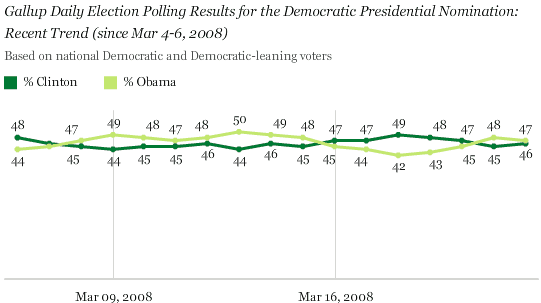
This, however, is unlikely. A Gallup poll released yesterday seems to indicate that the Wright controversy had little lasting impact. Obama has moved from a 44-48 deficit to a 47-46 lead in the head-to-heads with Clinton. In a hypothetical matchup with McCain, he’s gone from a 46-44 lead to a 44-47 deficit while Clinton has gone from a 47-45 lead to a 45-47 deficit.


All these are variations within the margin of error. Unless something happens to break these trends dramatically in Clinton’s favor, the superdelegates are likely to go mostly to Obama. If there’s an Obama collapse, they’ll step in and hand the nomination to Clinton. Which, again, is precisely what they are supposed to do when no clear winner emerges from the primary process.