
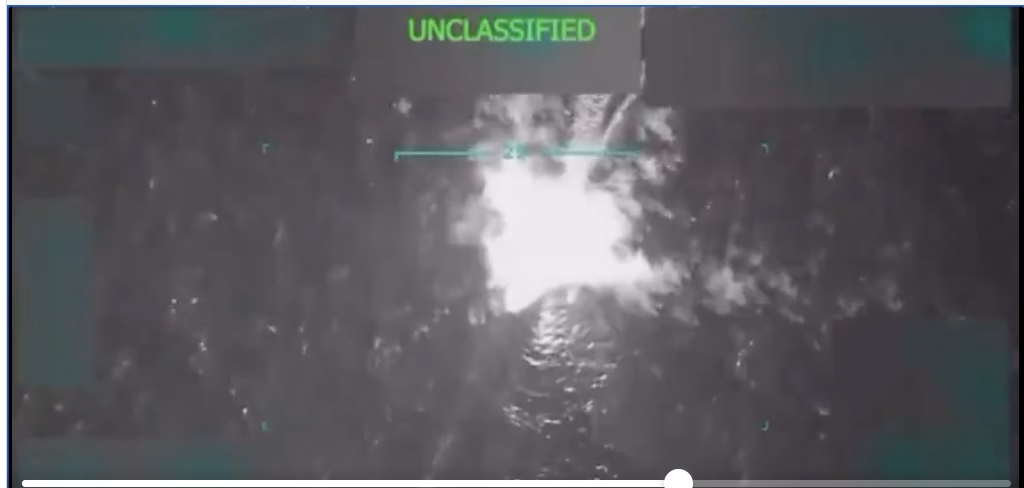
For previous entries, click here.
I was going to include this essay by Tom Nichols in my tabs post, but there were several things that I think need highlighting. I will note by way of preface that the tabs post contains several other stories relevant to this one, including underscoring that Trump is lying about fentanyl being a justification for these attacks.
At any rate, I commend Nichols’ piece in full: A Rogue Nation on the High Seas. Nichols summarizes the legal context as follows.
If the boats were carrying drugs (something Trump hasn’t proved) and if the boats were full of terrorists (something Trump has asserted but without providing names or evidence) and if the boats were headed directly for a U.S. port (which Trump cannot show), then Trump would still be in the wrong to destroy them without warning.
Further, if John Yoo thinks you are going too far, perhaps people should sit up and pay attention.
The president’s actions and rationalizations flunk the smell test both for international and American law. You don’t have to take my word for it: The former George W. Bush–administration lawyer John Yoo weighed in on this a few days ago. (Yoo came up with the legal justification for using “enhanced interrogation techniques”—also called “torture”—against captured terrorists after 9/11.) “There has to be a line between crime and war,” Yoo told Politico a few days ago. “We can’t just consider anything that harms the country to be a matter for the military. Because that could potentially include every crime.”
The emphasis on that last sentence is mine. The ongoing blurring of the military’s role in law enforcement is troubling (to put it mildly).
Let’s not fall asleep to the fact that Trump and his allies keep throwing out a very broad rhetorical net over their adversaries, equating the “Radical Left” with political violence (see here, for example) and also describing specific persons he wants targeted as “the radical left.” Again, Stephen Miller called the entire Democratic Party a “domestic extremist organization” just a few weeks ago.
At any rate, back to Nichols, but to add to what I was just highlighting.
None of this seems to bother Trump or his circle. Almost two weeks ago, Vice President J. D. Vance posted on X: “Killing cartel members who poison our fellow citizens is the highest and best use of our military.” (I think, having taught hundreds of them, that most military officers would say that defending America and the Constitution is their highest duty, not being the world’s most brutal vice cops.) When one X user replied that what Trump is doing is a war crime, Vance, a graduate of Yale Law School, shot back: “I don’t give a shit what you call it.”
This is a disturbingly cavalier attitude towards extrajudicial killings. Indeed, to quote Nate Berlatsky from one of the links in the tabs post,
Vance and his fans are cheering not despite the fact that their president is terrorizing innocents, but because he is. Or, to put it another way, MAGA believes that all Venezuelans, foreigners, and/or all non-white people, are by definition second class humans at best and guilty of being outsiders and traitors to MAGA at worst.
This is the logic of fascism. And while that logic is often deployed abroad, it’s also inevitably rolled out at home. Trump and Vance are making it clear that they consider it their right, and their pleasure, to murder anyone, anywhere, for any reason or for no beyond a passing whim. That’s an ugly message to Venezuelans. It’s an ugly message to the UN and to America as well.
Ugly, indeed.
Side note: if the Trump administration and its allies don’t want to be likened to fascists, then they should stop acting like fascists.
Back to Nichols.
A more worrisome problem here is that Trump’s illegal orders to kill drug smugglers could acclimate the American public to the sinister idea that the military is the president’s personal muscle and that it must do whatever he says. Earlier this week, he declared “antifa”—a loose affiliation of people who identify themselves as “anti-fascists”—to be a “major terrorist organization.” But because “antifa” isn’t a single group with a headquarters and identified leaders, Trump could apply the label to anyone he thinks opposes him. The president has now claimed he can kill terrorists at will, and he has designated many of his American opponents as terrorists.
The Supreme Court majority, in its Trump v, United States decision, didn’t seem very worried about Justice Sonia Sotomayor’s hypothetical objection that the president, bolstered by absolute immunity, could order the military to assassinate a political rival. But if he can order the Navy to operate as a presidential hit squad on the high seas, any number of grim hypotheticals could become reality sooner than Americans might expect.
This is worth noting: Trump has zero reason to fear legal retribution for ordering the killing of people on the high seas. After all, that falls within his official duties and, therefore, the immunity ruling covers him. But it is chilling to note that Sotomayor’s warning already sounds even more plausible nine months into Trump’s term. Indeed, it arguably has come to pass: Trump sees Venezuelan drug traffickers as his enemies, so he has had them killed with impunity.
But, you know, don’t call them fascists or authoritarians, right?









