
Eric Cantor, who will take office as the House Majority Leader on January 3rd, is voicing support for a proposed Constitutional Amendment that would drastically alter the relationship between the Federal Government and the States:
Incoming House Majority Leader Eric Cantor is part of a class of Republicans who say they want to change the country fundamentally — and to that end, Cantor isn’t dismissing a plan by legislators in his home state of Virgina to blow up the Constitutional system and replace it with one that would give state governments veto power over federal laws.
For several weeks now, conservative legal circles have been buzzing with Virginia House Speaker Bill Howell’s plan to amend the Constitution so that a 2/3 vote of the states could overturn overturn any federal law passed by the Congress and signed by the President. Howell first floated the idea in a September Wall Street Journal op-ed he co-wrote with Georgetown University law professor Randy Barnett.
“At present, the only way for states to contest a federal law or regulation is to bring a constitutional challenge in federal court or seek an amendment to the Constitution,” the pair wrote. “A state repeal power provides a targeted way to reverse particular congressional acts and administrative regulations without relying on federal judges or permanently amending the text of the Constitution to correct a specific abuse.”
Howell plans to kick off the repeal amendment push by bringing a bill calling for a Constitutional Convention to the floor of the Virginia legislature this January. If he can get 2/3 of the states to go along with calling for a Constitutonal Convention, then that would trigger one of the two amendment processes under Article Five of the Constitution.
Libertarian-leaning law Professor Randy Barnett came up with this idea two years ago, and at the time argued that floating the amendment was a way for the states to force the Federal Government to rein itself in:
In response to an unprecedented expansion of federal power, citizens have held hundreds of “tea party” rallies around the country, and various states are considering “sovereignty resolutions” invoking the Constitution’s Ninth and Tenth Amendments. For example, Michigan’s proposal urges “the federal government to halt its practice of imposing mandates upon the states for purposes not enumerated by the Constitution of the United States.”
While well-intentioned, such symbolic resolutions are not likely to have the slightest impact on the federal courts, which long ago adopted a virtually unlimited construction of Congressional power. But state legislatures have a real power under the Constitution by which to resist the growth of federal power: They can petition Congress for a convention to propose amendments to the Constitution.
Article V provides that, “on the application of the legislatures of two thirds of the several states,” Congress “shall call a convention for proposing amendments.” Before becoming law, any amendments produced by such a convention would then need to be ratified by three-quarters of the states.
An amendments convention is feared because its scope cannot be limited in advance. The convention convened by Congress to propose amendments to the Articles of Confederation produced instead the entirely different Constitution under which we now live. Yet it is precisely the fear of a runaway convention that states can exploit to bring Congress to heel.
In essence, Barnett argued that states can use the threat of a Constitutional Convention to force Congress to propose an Amendment to the states for ratification. This method worked to some effect in the early part of the 20th Century when Congress finally acted on what became the 17th Amendment after thirty-one states had passed resolutions calling for a Constitutional Convention to consider such an Amendment. Barnett contends that it could work again.
More recently, though, Barnett seemed to have abandoned the idea of using the amendment as a threat, and now argues that it should actually be adopted:
The Repeal Amendment should not be confused with the power to “nullify” unconstitutional laws possessed by federal courts. Unlike nullification, a repeal power allows two-thirds of the states to reject a federal law for policy reasons that are irrelevant to constitutional concerns. In this sense, a state repeal power is more like the president’s veto power.
This amendment reflects confidence in the collective wisdom of the men and women from diverse backgrounds, and elected by diverse constituencies, who comprise the modern legislatures of two-thirds of the states. Put another way, it allows thousands of democratically elected representatives outside the Beltway to check the will of 535 elected representatives in Washington, D.C.
Congress could re-enact a repealed measure if it really feels that two-thirds of state legislatures are out of touch with popular sentiment. And congressional re-enactment would require merely a simple majority. In effect, with repeal power the states could force Congress to take a second look at a controversial law.
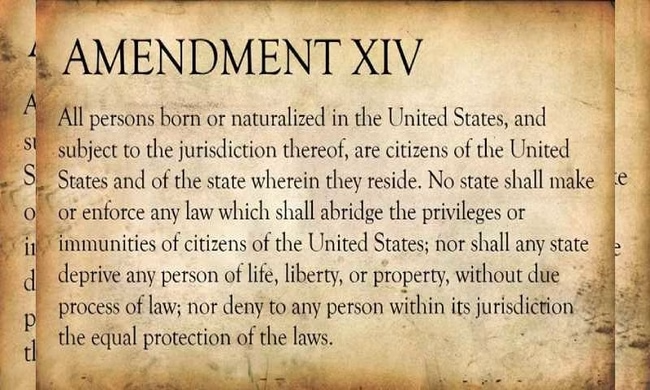
Americans revere their Constitution but have also acted politically to improve it. The 13th and 14th Amendments limited the original power of states to violate the fundamental rights of their own citizens, while the 15th and 19th Amendments extended the right to vote to blacks and women. The 21st Amendment repealed another “progressive” reform: the 18th Amendment that empowered Congress to prohibit alcohol.
The Repeal Amendment alone will not cure all the current problems with federal power. Getting two-thirds of state legislatures to agree on overturning a federal law will not be easy and will only happen if a law is highly unpopular.
There are several objections that could be made to the amendment, including the fact that it would alter the relationship between the states and the Federal Government in a way that even the Founders themselves never contemplated. For example, even though it has long been the rallying cry of the so-called “state’s rights” crowd, there is absolutely no support for the argument that the Constitution contains any power allowing the states to nullify a Federal law they deem to be unconstitutional. In fact, James Madison himself rejected the very idea during the controversy over the Alien and Sedition Acts, which occurred only a few years after he had participated in the drafting of the Constitution. Granting the states the power to overturn a Federal law, whether for policy or Constitutional reasons, would do more to bring down the Federal structure of the American government than even the Civil War tried to do.
The other problem with Barnett’s proposal is pointed out by his Volokh Conspiracy co-blogger Ilya Somin:
I am far less optimistic than he is about the likelihood that state governments will support such a massive reduction in federal power. Randy writes that “States have nothing to lose and everything to gain by making this Federalism Amendment the focus of their resistance to the shrinking of their reserved powers and infringements upon the rights retained by the people.” In reality, however, many state governments have a great deal to lose because they receive massive quantities of federal subsidies (equivalent to some 20-30% of their total budgets; see Table B-86 here) that would mostly be cut off by Section 3 of Randy’s proposed amendment. The states got some $450 billion in federal funding in 2008, and are likely to get even more this year. Right now, most states are very happy to take federal stimulus money, and many would like to get even more. State governments also often support federal regulation of private activity. John McGinnis and I discuss the reasons why state governments often favor broad federal authority in greater detail in this article. If the states really did have “nothing to lose” from imposing tight constraints on federal power, they probably would not have allowed the latter to grow to its current bloated size in the first place.
You need to look no further for evidence in support of Somin’s argument than the news coverage of Governors, Mayors, and other local officials who paraded to Washington in the weeks after Obama’s Inauguration to ensure that they got their piece of the stimulus pie. For the most part, these local and state leaders want federal money because, without it, their citizens would have to bear to full cost of all those state programs they’ve implemented — and that would lead to fiscal, and political, disaster for the powers that be.
There’s a final problem with Barnett’s plan, though, and it involves the method by which would amend the Constitution. Article V does allow for a Convention of the states if Congress refuses to act on a proposed amendment, but it would be a manifestly stupid and dangerous idea . Throughout the years, a Constitutional Convention has been proposed as a means of passing the ERA, a federal budget amendment, a term limits amendment, a line-item veto amendment, and, most recently an amendment to ban flag burning. there is no such thing as a Constitutional Convention that is limited to only one purpose. Once such a convention is called and convenes, everything is on the table. In fact, history will note that the Convention of 1787 which resulted in the U.S. Constitution was, in fact, initiated as a convention to amend the Articles of Confederation. Little to the Continental Congress know that it would be amended out of existence.
Former Chief Justice Warren Burger warned of the dangers of a Constitutional Convention in 1983:
I have also repeatedly given my opinion that there is no effective way to limit or muzzle the actions of a Constitutional Convention. The convention could make its own rules and set its own agenda. Congress might try to limit the convention to one amendment or to one issue, but there is no way to assure that the convention would obey. After a convention is convened, it will be too late to stop the convention if we don’t like its agenda. The meeting in 1787 ignored the limit placed by the confederation Congress “for the sole and express purpose.”
With George Washington as chairman, they were able to deliberate in total secrecy, with no press coverage and no leaks. A constitutional Convention today would be a free-for-all for special interest groups, television coverage, and press speculation.
Our 1787 Constitution was referred to by several of its authors as a “miracle.” Whatever gain might be hoped for from a new Constitutional Convention could not be worth the risks involved. A new convention could plunge our Nation into constitutional confusion and confrontation at every turn, with no assurance that focus would be on the subjects needing attention.
Burger, of course, was exactly right then and he’s exactly right now.
It’s worth noting, as Burger does, the historical context in which the 1787 Convention came to be:
On January 21, 1786, the Virginia Legislature, following James Madison‘s recommendation, invited all the states to send delegates to Annapolis, Maryland to discuss ways to reduce these interstate conflicts.[1] At what came to be known as the Annapolis Convention, the few state delegates in attendance endorsed a motion that called for all states to meet in Philadelphia in May 1787 to discuss ways to improve the Articles of Confederation in a “Grand Convention.”[1]
Instead of discussing improvement to the Articles of Confederation, though, the delegates quickly moved to the creation of an entirely new system of government that had no resemblance to the then-current national government and, when they were done, instead of complying with the amendment procedure provided for in the Articles, which would have required approval by Congress and unanimous consent of all thirteen state legislatures, they provided for a ratification process that completely bypassed Congress and the states. And they did that because they knew there was no way the new Constitution would have been approved by all thirteen states.
The Articles of Confederation, of course, were a flawed document and it’s unlikely that the United States would have survived as a unified nation for very much longer had they remained in place. So, in some sense, Madison and the others at Philadelphia did the right thing.
But, as Burger says, we were lucky and there’s no reason to believe we’d be similarly lucky a second time. No matter how salutory a proposed Amendment might be, a Constitutional Convention is far too dangerous to risk, and Cantor is irresponsible for suggesting that it might be a good idea.
Update: Welcome Instapundit readers. Two thoughts. First, I’ve written a follow-up piece on the Repeal Amendment that you ought to check out. Second, I think there’s some confusion about the “destroy the Constitution” line I used in the title. as I noted above, that refers more to the idea of calling a Constitutional Convention than to the Amendment itself, although I think there are serious problems with the Amendment too.