
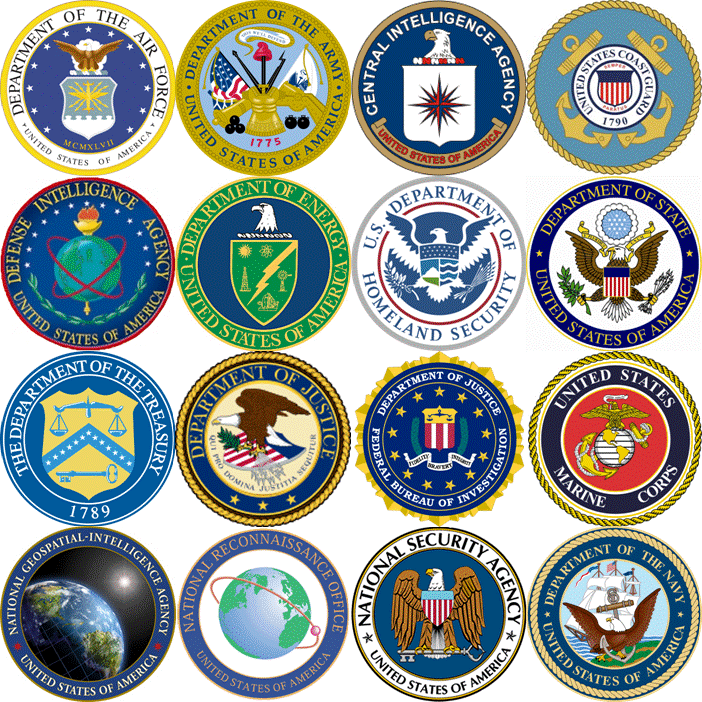
 Former UN Ambassador John Bolton argues that we need to get the bureaucracy out of intelligence if we are to adequately assess the threats facing the country.
Although the U.S. intelligence community (IC) has been stung by failures relating to the Christmas terrorist attack, these failures are symptomatic of far larger problems. In analyzing the ongoing Iranian and North Korean nuclear weapons programs, both the IC and policy makers are guilty of politicizing intelligence, exactly the behavior harshly criticized during the Bush administration.
Now, however, the politicization threat dwells inside the IC, especially in the Director of National Intelligence (DNI) bureaucracy. Policy officials move in and out of intelligence jobs as if those jobs were interchangeable, carrying all their existing policy biases. Even worse, intelligence officers increasingly disdain to hide their philosophical proclivities, which have colored their intelligence analysis in years past. And, like generals refighting the last war to correct their mistakes, the IC is reacting against charges it overstated the threat of Iraqi weapons of mass destruction by understating the threat of Iranian and North Korean weapons programs. So much for the wall of separation between policy and intelligence.
Ill-concealed policy preferences dominated the now-discredited 2007 National Intelligence Estimate (NIE) on Iran’s nuclear weapons program. So eager were the NIE’s drafters to forestall the use of force against Iran that they distorted the intelligence, ignored contrary evidence, and overstated their conclusions.
[…]
The Christmas terrorist attack demonstrates that we need more effective communication and analysis within the IC. Achieving this goal does not require more centralization of authority, more hierarchy, and more uniformity of opinion. The IC’s problem stems from a culture of anonymous conformity. Greater centralization will only reinforce existing bureaucratic obstacles to providing decision makers with a full range of intelligence analysis.
The problem is often not the intelligence we collect, but assessing its implications. Solving that problem requires not the mind-deadening exercise of achieving bureaucratic consensus, but creating a culture that rewards insight and decisiveness. To create that culture we should abolish the DNI office and NIEs.
Eliminating the DNI should be accompanied by reversing decades of inadequate National Security Council supervision of the intelligence function. The council is an awesome instrument for presidential control over the IC, but only if the national security adviser and others exercise direction and control. Sloughing off responsibility to the bureaucracy embodying the problem is a failure of presidential leadership, and unfortunately gives us exactly the IC we deserve.
Contemporary NIEs (and other IC products) reflect the bureaucracy’s lowest-common-denominator tendencies and should be abolished. Each intelligence agency should be able to place its analysis of data into a competitive marketplace of classified ideas—this will help determine which is the superior product.
While Bolton’s assessment of the problem — bureaucratic consensus yields a CYA mentality and discards brilliant ideas that are either outliers or risky — is correct, his solution does little to solve it. We had these same problems without a DNI, after all; indeed, that’s why we have a DNI.
And it’s well and good to say we shouldn’t have an NIE, since it’s necessarily going to be a namby pamby collective report. But Bolton’s alternative is to present the president with a dozen or more namby pamby collective reports. Perhaps that will be better for assessing blame afterwards — some agencies will be closer to right than others — but it will make it much harder to make decisions.
Nor is it clear what the NSC is going to do about all of this. The people sitting in that room are some of the best of the best. But they’re ultimately representatives of the agencies that sent them.









