
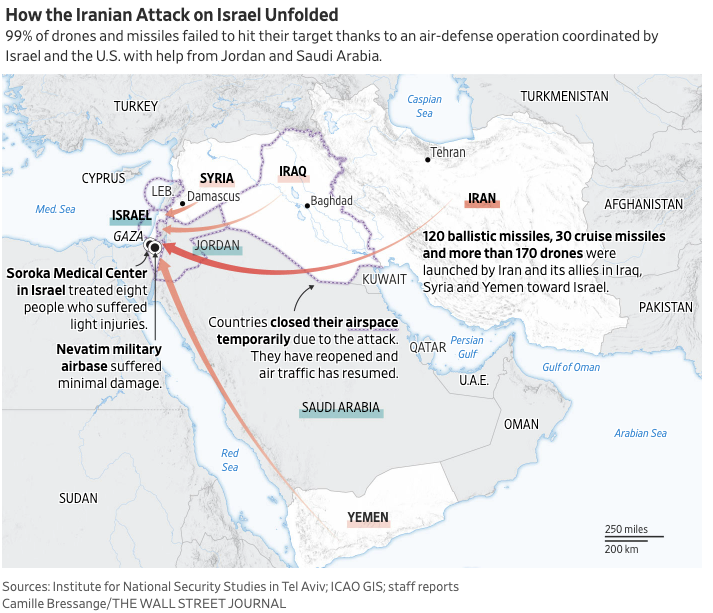
The early speculation on Iran’s attack on Israel was that it was a shot across the bow for the domestic audiences that was intended to fail in order to avoid massive escalation. That may well be mistaken.
SEMAFOR‘s Jay Solomon (“Iran sought mass casualties in Israel strike, U.S. officials say“):

Iran’s weekend aerial attack on Israel was designed to cause mass casualties and infrastructure damage, senior U.S. officials said, an assessment that complicates deliberations on how to respond to Tehran and its military allies in the coming weeks.
The Biden administration on Sunday hailed a unified defense of Israel that included U.S., U.K. and French air power and allied Arab states, such as Jordan. Their anti-drone and anti-missile capabilities, combined with Israel’s Iron Dome air defense system, shot down 99% of the more than 300 munitions Tehran and its proxies fired into the Jewish state from Iran, Iraq, Syria and Yemen on Saturday.
Senior U.S. officials said neutralizing the assault was a strategic victory for Israel and its partners, and opens a window to de-escalate tensions in a Middle East region already on edge from Israel’s six-month war in the Gaza Strip. Iran’s operation came in response to Israel’s April 1 attack on an Iranian diplomatic mission in Damascus that killed two Iranian generals.
“With the support of a number of partners, including the U.K. and France, the United States enabled Israel to spectacularly defeat this unprecedented attack,” a senior White House official said on Sunday. “[The Iranians] were clearly intending to destroy and to cause casualties. That was their intent.”
Iranian diplomats and military officials said on Saturday that they weren’t seeking to launch new strikes, provided there were no Israeli reprisals. “The matter can be deemed concluded,” Tehran’s United Nations mission said in a statement.
But Israeli government officials said that Tehran had crossed a clear red line by attacking Israel directly from Iranian soil for the first time in history. They also said the nature of the targets — believed to be major civilian areas and military infrastructure —required a response if their country is to restore deterrence against Iran and its regional allies.
Yaroslav Trofimov, the Chief Foreign-Affairs Correspondent for WSJ (“Analysis: Israel Repelled Iran’s Huge Attack. But Only With Help From U.S. and Arab Partners.“) adds:
Saturday’s Iranian strike on Israel was huge by any standard. Tehran launched more than 170 explosive-laden drones, around 120 ballistic missiles and about 30 cruise missiles, according to Israel. The damage could have been catastrophic. As it turned out, almost all were intercepted.
That success was due to a combination of Israel’s sophisticated air-defense system and critical assistance provided by the U.S. and other Western and Arab partners. American, British and Jordanian warplanes played an especially important role in downing drones. Most of the Iranian drones and missiles were destroyed before they even reached Israeli airspace.
Whether Israel and its supporters can replicate that performance under the conditions of an all-out war—this weekend’s salvo from Iran, clearly telegraphed in advance, was the opposite of a surprise attack—is an open question, as is Israel’s ability to defend itself without outside help.
That is a key consideration as Israel and the U.S. consider responses to what is a new strategic reality, created by Iran’s first direct military attack on Israeli territory since the Islamic revolution of 1979. Israel’s war cabinet met in Tel Aviv on Sunday as the country’s leaders weighed their options, and Western officials said they believed Israel’s response could come quickly, as soon as Monday.
Striking back hard on Iranian soil could invite far more devastating retaliation. But not responding at all, or too weakly, could also erode deterrence, making Israel and others more vulnerable to future Iranian barrages.
“Iran has started a new phase. It has stopped hiding behind proxies and has now become exposed to a direct attack from Israel,” said Nadav Pollak, a former Israeli government analyst teaching at Reichman University. “Going forward, Israel is not going to be able to sit quietly and intercept everything.”
Interceptors, particularly the Arrow and Patriot systems used against ballistic missiles, are extremely expensive and are limited in quantity. The U.S. Congress, by stalling the military aid package for Israel, Ukraine and Taiwan, has created an additional complication.
Saturday’s attack, which Tehran says was carried out in retaliation for a suspected Israeli strike on April 1 that killed seven Islamic Revolutionary Guard Corps officers, including two generals, at an Iranian diplomatic mission in Damascus, has used up only a tiny fraction of the Islamic Republic’s vast arsenal of drones and missiles.
Crucially, Tehran has also kept in reserve its Lebanese proxy force, the Hezbollah militia, which has thousands of missiles and rockets. And, while only a handful of Iranian missiles got through on Saturday, causing minor damage to Israel’s Nevatim air base, the Iranian military has drawn valuable intelligence from observing how Israeli and U.S. air defenses operate.
“Iran was testing the missile-defense system, the resolve of the regional countries, the resolve of the United States,” said Jonathan Schanzer, a researcher at the Foundation for Defense of Democracies in Washington. “Out of all of this comes a great risk. When two powerful parties engage in direct hostility, no one knows where this thing goes.”
The commander of the IRGC, Hossein Salami, portrayed the Saturday barrage as creating a new strategic equation: Every Israeli attack on Iranian interests in the region will be met with a direct Iranian attack on Israel. This is, of course, a red line that Israel, which has been fighting against Iranian proxies for decades, cannot accept.
As it considers its response, however, Israel must also weigh the interests of its Arab partners, such as Jordan, Saudi Arabia and the United Arab Emirates. Despite popular anger over the killing of tens of thousands of Palestinians during Israeli military operations in Gaza, Jordan and other partners helped Israel fight off Iranian missiles and drones on Saturday.
“Our regional partners stepped up despite six months of very significant tension between them and Israel, and between them and the United States as they begged the United States to do something to restrain the Israelis,” said Steven Cook, a Middle East analyst at the Council on Foreign Relations.
Cook said that no matter how much countries in the region may dislike Israeli Prime Minister Benjamin Netanyahu, they dislike Iran’s government more.
Solomon adds his own analysis:
Iran’s attack brought into plain sight a conflict with Israel that’s played out largely in the shadows in recent decades. But as Tehran’s military reach and capabilities grow — including the near mastering of nuclear weapons technologies — Israeli military planners are debating whether any further delay in confronting Tehran directly will come at Israel’s peril.
[…]
Israel has watched Iran vastly grow its network of military proxies and partners — called the Axis of Resistance — to virtually encircle the Mediterranean country. The power of these armies has become brutally clear in the six months since the Palestinian military group Hamas, with Iranian money and arms, invaded southern Israel and killed 1,200 people. Iranian allies in Yemen, Lebanon, Iraq and Syria have sprung to life to back Hamas, often through strikes on Israeli and American targets. U.S. defense officials said these militias also took part in Saturday’s attack.
The sophistication of the Iranian axis’ weapons and tactics have also vastly improved. Saturday’s attack included ballistic and cruise missiles, as well as one-way attack drones that Iran has mastered building in recent years, and exported to allies globally. Iran and its most powerful regional ally — the Lebanese militia, Hezbollah — have also grown battle-hardened backing Syrian President Bashar al Assad in his war against internal opponents.
Current and former Israeli officials said this weekend that the prospect of a future Iranian attack using nuclear or chemical weapons-tipped missiles and drones shows the threat Tehran poses to their country’s long-term future. So while a counter strike might not happen this month, it will come at some point, they said.
[…]
Some foreign policy experts who’ve engaged with Iran questioned whether the country’s leadership was really seeking to inflict significant destruction in Israel. They noted that Tehran gave warnings for more than a week that Iran’s military intended to strike, and this included communications to the U.S. through Arab and European partners.
“Official and unofficial US-Iran back channel diplomacy…helped prevent this crisis from spiraling out of control,” wrote Suzanne DiMaggio of the Carnegie Endowment for International Peace, who has led back-channel discussions with Iran in recent years.
The evidence here is decidedly mixed. On the one hand, it’s quite likely that the Israel defenses—augmented by substantial external support—were more robust than Iran forecast. On the other, Iran did in fact warn of the strikes ahead of time and left assets in reserve. It’s plausible that Iran intended much more damage than was actually done and yet primarily intended this as a test run.
What is clear is that Iran and the United States have repeatedly demonstrated through their actions over a substantial period of time that they very much want to contain the conflict to nuisance levels. Neither has the slightest interest in crossing the threshold into all-out war.
It’s considerably less clear whether the Netanyahu government shares that reluctance. From their perspective, Iran is at war with Israel and has been for decades. They’re growing more powerful year by year and almost certainly have the capacity to become a nuclear power whenever they choose. I wouldn’t be surprised in the least if Israel ignored Biden’s warning and decided the time to dispense with the threat was at hand.








