
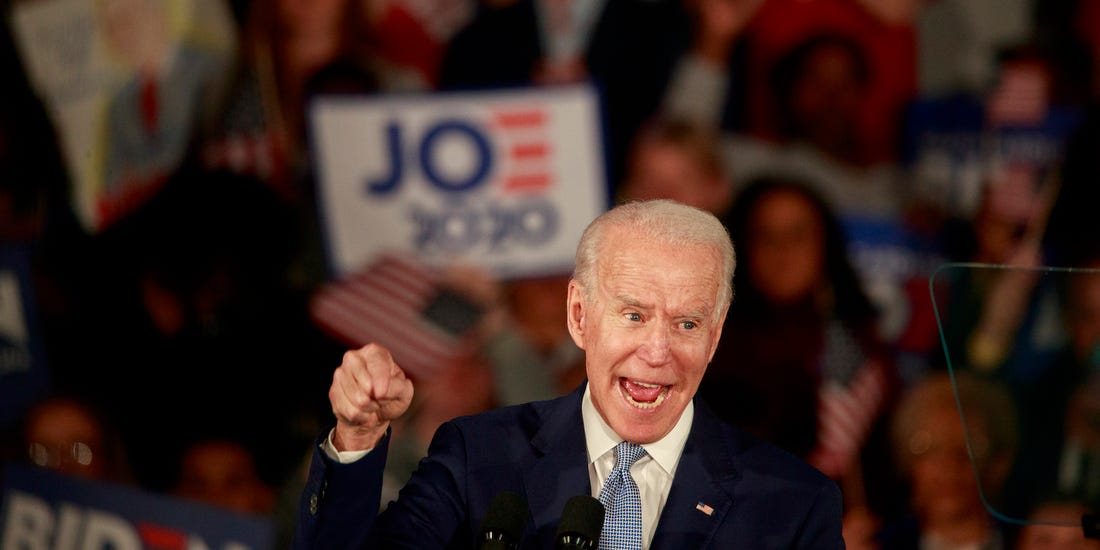

While a brokered convention has been the fever dream of pundits since the launch of the modern primary system, it was a real possibility this cycle. Indeed, the combination of multiple well-financed candidates and changes to the delegate rules made it seem likely. The last several forecasts from Nate Silver and the FiveThirtyEight gang had it far more likely that no one would win a majority than that either Bernie Sanders or Joe Biden would—and no other candidate had so much as a 1% chance.
But the fact that Tom Steyer, Pete Buttigieg, and Amy Klobuchar all dropped out before Super Tuesday and threw their support to Biden changed the landscape. He won some races, most notably Warren’s home state of Massachusetts and Klobuchar’s home state of Minnesota, that nobody thought he could. That not only catapulted him to the top of the delegate race but prompted Mike Bloomberg and Elizabeth Warren to throw in the towel.
Now, Silver and company have radically changed their forecast:

In an accompanying post, they explain:
We’d encourage you to approach the forecast with a bit of caution for the next few days until we have new polling and a better sense of what the post-Super Tuesday landscape looks like. There are several uncertainties to keep in mind:
Many states, especially California, are not yet done counting their votes. In California, the results could shift significantly based on late-returned mail ballots. Under the state’s rules, ballots only need to have been mailed out by election day, so millions of votes are literally still in the mail.
Two candidates, Sen. Elizabeth Warren and former New York Mayor Michael Bloomberg, have just dropped out, and while the model makes some educated guesses about where their support will go, it may be wrong about that.
Super Tuesday itself could have a substantial effect on the polls — most likely in the form of a bounce for Biden. The model, again, makes educated guesses about the size of these bounces. But those guesses may not be right: Biden got a much bigger South Carolina bounce than is typical for that state, for example; while Sanders got little, if any, bounce after winning Nevada when the model expected him to get one.
Making matters trickier, it’s also not entirely clear what the race was like prior to Super Tuesday because Biden’s ascent in the polls was quite rapid and there were few national polls during this period.
With that said, even if there’s some uncertainty here — perhaps a bit more of it than the model lets on — things don’t look good for Sanders. He has several compounding problems:First, he’s already behind by around 70 delegates, according to our estimates, based on returns in each state as currently reported. That deficit could get worse because there are some signs that late-returned mail ballots in California will help Biden — a reflection of the fact that Biden surged in the race in the final few days before Super Tuesday.
As mentioned, Biden will probably get a bounce in the polls as a result of his Super Tuesday wins. The model’s guess (accounting for its projected Super Tuesday bounce for Biden and the effects of Bloomberg and Warren dropping out) is that he’s currently ahead by the equivalent of 6 or 7 points in national polls. So although momentum could shift back toward Sanders later on, it may get worse for him in the short run.
Some of Sanders’s best states (California, Nevada) have already voted, and the upcoming states generally either aren’t good for him or have relatively few delegates. In fact, given how broadly Sanders lost on Super Tuesday — including in northern states such as Minnesota, Massachusetts and Maine — it’s hard to know where his strengths lie, other than among young progressives and Hispanics, who are not large enough groups to constitute a winning coalition in most states. Conversely, it’s easy to identify places where Sanders will likely lose badly to Biden. Our model has Biden winning a net of about 85 delegates over Sanders in Florida on March 17, where Sanders’s polling has been terrible, and a net of about 35 delegates in Georgia, which votes on March 24.There aren’t that many delegates left after March. Some 38 percent of delegates have already been selected. And by the time Georgia votes in two-and-a-half weeks, 61 percent of delegates will already have been chosen. So even if Sanders did get a big, massive momentum swing late in the race, it might not be enough to allow him to come back, with only about a third of delegates still to be chosen.
Finally, even if Sanders does come back, it might merely be enough to win a plurality rather than a majority of delegates. We project that roughly 150 delegates — or about 4 percent of the total of 3,979 pledged delegates available — belong to candidates who have since dropped out or to Rep. Tulsi Gabbard, even after accounting for the fact that statewide delegates are reallocated to other candidates once a candidate drops out.2 That creates an additional buffer that will make it harder for Sanders to win a majority.
So basically, Sanders has to come back quickly when the momentum is currently against him in a bunch of states that are not very good for him — or it will be too late. It’s not impossible. But the chances are low. The model gives Biden an 88 percent chance of winning a majority of pledged delegates, with most of the remaining outcomes being “no majority” rather than a Sanders majority. It also gives Biden a 94 percent chance of winning a plurality of pledged delegates, and Sanders a 6 percent chance.
And it doesn’t look like Sanders going to get any help from Elizabeth Warren.









