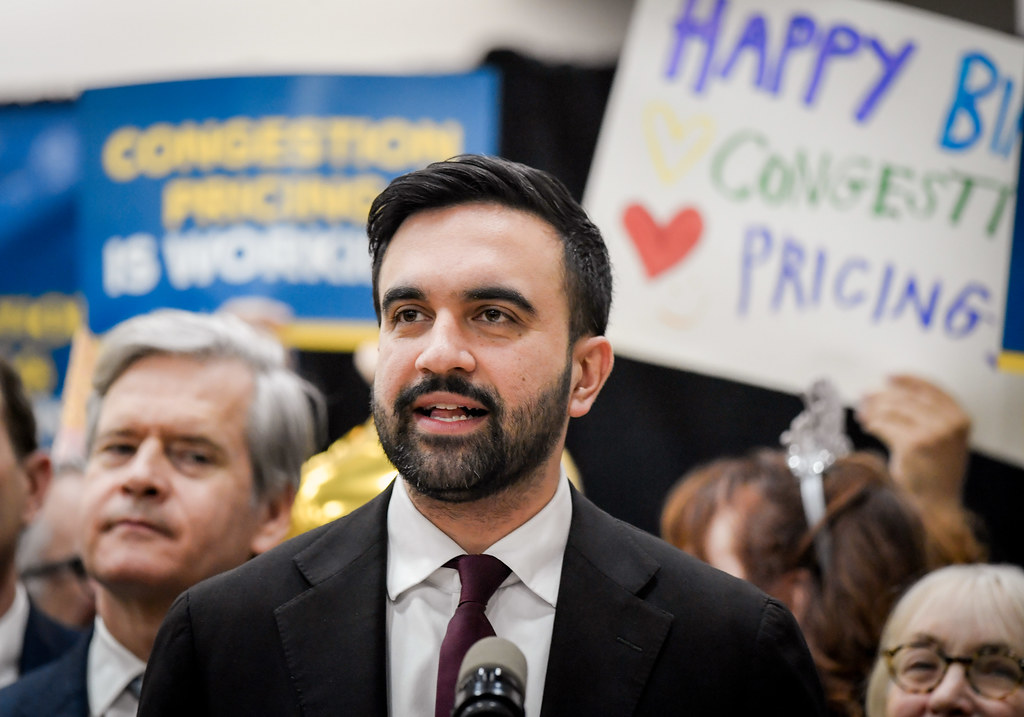
Governor Kathy Hochul, Mayor Zohran Mamdani, and MTA Chair & CEO Janno Lieber attend a rally at McBurney YMCA on West 14th St. to commemorate the first anniversary of the implementation of the Central Business District Tolling Program (CBDTP) on Monday, Jan 5, 2026.
“Zohran Mamdani” by MTA Photos is licensed under CC BY 4.0

Libertarian Socialism?

New York’s leftist mayor is . . . cutting red tape?

6

Comments

The Guardian (“‘I’m over the moon’: New York’s small business owners rejoice as Mamdani cuts red tape“):

Red Scare? The democratic socialist mayor of New York City spent this week talking about red tape.

On Tuesday, Zohran Mamdani – the politician at the center of a revived rightwing panic about socialists and purported communists winning elections across America – posted a video on X of himself putting a sheet of paper with the phrase “RED TAPE” into a paper shredder. Other pieces of paper, with phrases like “cumbersome fees and fines” and “a permit you need just to serve ice-cream”, were shredded too. The video, set to Wu Tang Clan’s If Time Is Money, shows Mamdani joining a handful of city officials and small business owners throwing the resulting paper shreds into the air like confetti.

“New York’s small business owners have said it over and over: endless paperwork and the uncertainty of dealing with City government has made getting their stores up and running too difficult,” Mamdani wrote on X, announcing a package of 50 policy changes aimed at easing the financial burden of fines, fees and regulations on mom-and-pop shops across the five boroughs.

At a press conference in the Bronx, Mamdani listed some of the onerous policies getting the axe. Bodega owners will no longer need a separate license to sell the same products outside the store – like fruit and flowers – as inside. Restaurants will no longer need a “superfluous” frozen dessert permit to sell ice-cream on top of the permit already required to sell food. Barber shops will no longer have to renew their permit every year, instead doing so every three years. Street fair vendor permit fees will be reduced, restaurant inspections will be sped up, and equipment registration fees will be eliminated for a year.

Ending burdensome regulations would seem the opposite of socialism: getting government out of the way, rather than exerting greater control of the economy. It was a big part of Reagan Republicanism (although, in fairness, Jimmy Carter did quite a bit of it, too). For that matter, Matt Yglesias was pushing for this kind of thing in his Juicebox Mafia days and it’s perfectly in line with the “Abundance” agenda being pushed by Ezra Klein and Derek Thompson.

I was led to believe he was a hardcore communist bastard who would emulate Pol Pot. Perhaps this is just a distraction from the coming reign of terror, prison camps, and genocide? The smirking bastard.

6 responses to “Libertarian Socialism?”

  1. I heard the term “sewer socialism” applied to Mandani. Which I like a lot. I never believed that mayors of cities, small and large, need to opine on national events. Sticking to the basics of running a city will let a political career go much farther.

    4
  2. Ending burdensome regulations would seem the opposite of socialism: getting government out of the way, rather than exerting greater control of the economy.

    It doesn’t, really.

    Perhaps the biggest idea behind Marxism/socialism is that the ruling class, whether feudal land owners or capitalist factory owners, use their control of the state to create favorable economic conditions for themselves that are irredeemably unfair to the lower classes.

    Which means that under democratic socialism (or Euro-style social democracy – which are basically the same thing) the state should function as a counterweight to the unfair and undeserved economic dominance of the economically dominant group to the benefit of the common (and economically disadvantaged) people.

    Another way of looking at this is that both capitalists and democratic socialists want free markets. The significant difference, however, is that capitalists primarily want free markets for capital, while democratic socialists primarily want free markets for consumers.

    (Capitalists, for instance, love monopolies, as long as it’s them who are the monopolists.)

    Making it more difficult for restaurants to sell ice cream does not benefit consumers in any conceivable way. It does benefit other ice cream sellers, though.

    And while the average ice cream seller hardly fits the image of the archetypical capitalist, it certainly does appear that ice cream sellers somehow managed to use the local government to restrict competition in a way that does not benefit consumers at all. (Or perhaps it’s just a weird coincidence. But even so, rules that do not benefit consumers should be abolished as a matter of principle.)

    Which means that it is not strange at all that Mamdani is interested in cutting red tape that benefits certain companies but not consumers, while at the same time wanting to impose the kind of red tape that benefits consumers but might also harm companies.

    In fact, I am quite sure that Mamdani is demonstrating ideological consistency.

    2
    1. @drj All of which is a good reminder that capitalism is not the same thing as pure free markets! And that the spectrum is not to be judged solely on “size” or “limits” on government.

      2
      1. One thing that I find striking about the current Trump administration is the extent to which it is pro capital (as long as it is his own or his buddies’ capital) while simultaneously undermining market freedom for eveybody else.

    2. @drj I’m being partially tongue-in-cheek here. But democratic socialism is typically about more governmental rules, not deregulation.

      The Democratic Socialists of America website is both specific and vague on their agenda:

      Our vision pushes further than historic social democracy and leaves behind authoritarian visions of socialism in the dustbin of history.

      We want a democracy that creates space for us all to flourish not just survive and answers the fundamental questions of our lives with the input of all. We want to collectively own the key economic drivers that dominate our lives, such as energy production and transportation. We want the multiracial working class united in solidarity instead of divided by fear. We want to win “radical” reforms like single-payer Medicare for All, defunding the police/refunding communities, the Green New Deal, and more as a transition to a freer, more just life.

      Their recently-released platform, which isn’t easily discoverable from the main page, is pretty radical, even from a Western European perspective:

      You have no debt. You don’t need health insurance. You don’t pay a mortgage or have a landlord, because comfortable housing is a human right. Your retirement is publicly funded. Food, education, energy, medicine, and transportation aren’t for-profit businesses; they are common goods and utilities.

      This particular set of reforms isn’t necessarily in conflict with that, but is much more at home in a libertarian agenda.

Leave a Reply

This site uses Akismet to reduce spam. Learn how your comment data is processed.