Kentucky Governor Matt Bevin, who seems to have clearly lost his bid for a second term, still has not conceded the race to apparent victor Andy Beshear and instead asked the Kentucky Secretary of State to conduct a recanvass of the vote that seems unlikely to significantly change the outcome of the election:
Matt Bevin isn’t going quietly.
Kentucky’s Republican governor is broadly casting doubt on the results of Tuesday’s election, with the unofficial tally showing him trailing Democrat Andy Beshear by just over 5,000 votes, or about four-tenths of a percentage point.
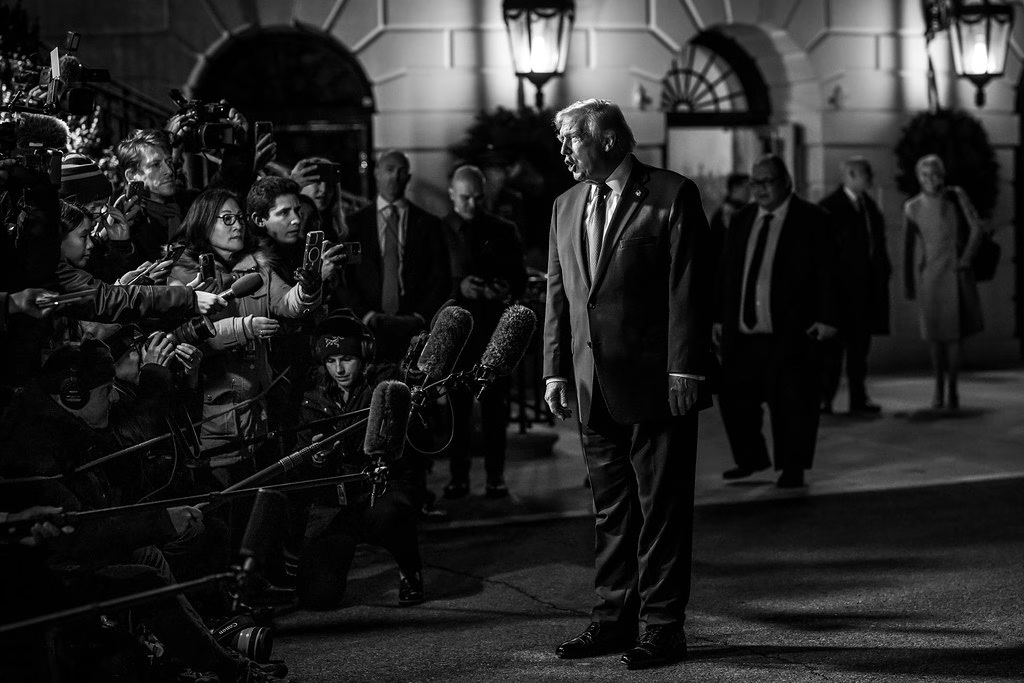
Speaking before reporters Wednesday night in Frankfort, the state capital, Bevin said his campaign would be seeking an official recanvass of the results — but it is also compiling evidence of “irregularities” in the voting process to be investigated.
“What we know is that there really are a number of irregularities,” he said, adding that “there’s more than a little bit of history of vote fraud in our state.”
Without providing details, Bevin cited “thousands of absentee ballots that were illegally counted,” reports of voters being “incorrectly turned away” from polling places and “a number of machines that didn’t work properly.” He said his campaign would provide more information as it is gathered, and he did not take questions from reporters.
“We simply want to ensure that there is integrity in the process,” Bevin said at the close of his statement. “We owe this to the people of Kentucky.”
Beshear, who declared victory Tuesday night, is eager to move on and seal his lead in the vote count. At a Wednesday morning press conference in Louisville, where both candidates spent election night, Beshear said he was formally launching his transition team, with only about a month to go until the scheduled Dec. 10 inauguration.
“We’re confident in the outcome of the election, but today is about moving forward,” Beshear said. “The election is over. No one else is going to cast a vote. It ended last night.”
The Associated Press has declined to call the contest, citing the relatively tight margin and Bevin’s protest.
The recanvass means Kentucky’s 120 counties will check their voting machines and absentee ballots to ensure they were counted correctly, but they will not examine individual ballots. Secretary of State Alison Lundergan Grimes said the recanvass will be conducted on Nov. 14.
The Lexington Herald-Leader explains what happens next:
Now that Bevin has formally requested a recanvass, county boards of election will meet November 14 at 9 a.m. to recheck vote totals from each machine in every county. They will also re-tabulate absentee ballots.
While recanvasses are not uncommon in close elections, it’s extremely unlikely a recanvass would change vote totals by more than a few votes.
“Recanvasses hardly ever shift vote totals,” said Josh Douglas, an elections law professor at the University of Kentucky. “You’re talking about maybe a couple of votes statewide.”
Democrats were quick to declare the election over and say Beshear had won fair and square. House Minority Floor Leader Rocky Adkins, D-Sandy Hook, said it was time to put politics aside and move forward.
“He needs to present [the irregularities] to the public,” Adkins said. “Lets see them. I thought it was unusual during his speech last night to say he had proof of that.”
As noted, it’s highly unlikely that a recanvass will result in the kind of change in the vote totals that could lead to a change in the outcome of the election. The most recent example of that came just three years ago in the Democratic primary between Hillary Clinton and Bernie Sanders. After the votes were counted on Primary Night, a mere 1,924 votes separated the two candidates, far fewer than the gap between Bevin and Beshear. This led the Sanders campaign to request a recanvass. After that recanvass was conducted, the gap between Clinton and Sanders had not changed by a single vote. We can expect that the outcome of a Bevin-Beshear recanvass will be roughly the same.
The same is likely to be true of a recount should Bevin request one. If he were to do so, he must file a petition in the Circuit (trial) Court in the state capital in Frankfort by next Tuesday, before the recanvass has taken place. Bevin would be responsible for the costs of such a recount since Kentucky law has no provision for an automatic recount. The recount would be conducted by the Judge assigned to the case and, while appealable, would be considered final once completed.
Historically speaking, though, the odds of a recount changing the outcome when the gap between the two candidates is more than 5,000 votes is somewhere between slim and none. Typically, a recount will pick up the missing or incorrectly counted ballots for one candidate or the other that will change the vote totals for the candidates, but it is rare that such a process ends up finding as many votes as Bevin would need to find —roughly 5,150 votes — to change the outcome of the election.
Beyond these options, Bevin could try more radical ways to challenge the election through either a formal election contest or petitioning the state legislature to investigate the election and, if necessary, pick the next Governor. Both of these are radical steps, though, and apparently unprecedented in Kentucky history. Additionally, in order to move forward with such a challenge, Bevin is going to have to do more than make vague and unsubstantiated claims about voting irregularities. Unless he can come up with such evidence he needs to concede this race and let Governor-Elect Beshear proceed forward with the transition so he can take power in December as mandated by law.