The Washington Post Editorial Board (“The times demand serious economic ideas. Harris supplies gimmicks.“):
Vice President Kamala Harris’s speech Friday was an opportunity to get specific with voters about how a Harris presidency would manage an economy that many feel is not working well for them. Unfortunately, instead of delivering a substantial plan, she squandered the moment on populist gimmicks.
Americans are clearly still anxious and angry about the high cost of groceries, housing and even $5.29 Big Macs. While the inflation rate has cooled substantially since the 2022 peak, an ostensible Biden-Harris administration accomplishment, prices remain elevated relative to the Trump years. So it’s a real political issue for Ms. Harris. One way to handle it might be to level with voters, telling them that inflation spiked in 2021 mainly because the pandemic snarled supply chains, and that the Federal Reserve’s policies, which the Biden-Harris administration supported, are working to slow it. The vice president instead opted for a less forthright route: Blaming big business. She vowed to go after “price gouging” by grocery stores, landlords, pharmaceutical companies and other supposed corporate perpetrators by having the Federal Trade Commission enforce a vaguely defined “federal ban on price gouging.”
Never mind that many stores are currently slashing prices in response to renewed consumer bargain hunting. Ms. Harris says she’ll target companies that make “excessive” profits, whatever that means. (It’s hard to see how groceries, a notoriously low-margin business, would qualify.) Thankfully, this gambit by Ms. Harris has been met with almost instant skepticism, with many critics citing President Richard M. Nixon’s failed price controls from the 1970s. Whether the Harris proposal wins over voters remains to be seen, but if sound economic analysis still matters, it won’t.
Ms. Harris’s housing plan is built on a slightly firmer foundation. In urging construction of 3 million new homes over the next four years,she puts her finger on the essence of the housing-affordability problem: insufficient supply. She offers clever tax incentives to help make it happen. But her proposed $25,000 in down payment assistance for first-time home buyers stimulates the demand side, which risks putting upward pressure on prices. Such a measure might make sense if Ms. Harris paid for it by eliminating other demand-side housing subsidies, such as the mortgage interest deduction, a roughly $30 billion annual drain on federal revenue that benefits many wealthy Americans — but she does not.
[…]
Her ideas would cost money, yet she insisted in her speech that she would hold to President Joe Biden’s pledge not to raise taxes on any household earning $400,000 or less annually. That excludes 80 percent of taxable income, and does not take into account the recent surge in families earning over $400,000. The Harris campaign says it plans to raise revenue to cover these costs but did not provide specific offsets in its economic plan rollout. Without them, Ms. Harris’s full plan would add $1.7 trillion to federal deficits over a decade, according to the Committee for a Responsible Federal Budget, a nonpartisan budget watchdog.
To be sure, every campaign makes expensive promises that will never come to pass, especially with a divided Congress. Remember Mr. Biden’s pledge to make community college free? Even adjusted for the pandering standards of campaign economics, however, Ms. Harris’s speech Friday ranks as a disappointment.
AP (“What do marijuana, the death penalty and fracking have in common? Harris shifted positions on them“):
As California’s attorney general, Kamala Harris successfully defended the death penalty in court, despite her past crusade against it.
As a new senator, she proposed to abolish cash bail — a reversal from when she chided San Francisco judges for making it “cheaper” to commit crimes by setting bail amounts too low.
And now, as vice president and the Democratic presidential nominee, Harris’ campaign insists that she does not want to ban fracking, an oil and gas extraction process, even though that was precisely her position just a few years ago when she first pursued the White House.
Politicians often recalibrate in the face of shifting public opinions and circumstances. Across two decades in elected office and now seeking the presidency for the second time, Harris has not hesitated to stake out expedient and — at times — contradictory positions as she climbed the political ladder. Harris’ litany of policy reversals is opening her to attacks by Republicans and testing the strength of her pitch to voters as a truth-teller who is more credible than former President Donald Trump.
Her shifts, including on matters that she has framed as moral issues, could raise doubts about her convictions as she is reintroducing herself to the public after taking the reins of the campaign from President Joe Biden, who last month dropped out of the race.
In addition to reversing course on fracking and cash bail, Harris has changed tack on issues including health care (she supported a plan to eliminate private health insurance before she opposed it), immigration and gun control.
So, on the one hand, this is entirely fair. Her economic proposals are more pandering than serious and policy positions crafted to appeal to Californians have been recalibrated for a contest in which three Rust Belt states hold the surest path to victory.
For that matter, it’s natural that Harris is being subjected to scrutiny. Despite (or because of) having been Vice President for the last three-and-a-half years, she’s essentially a cipher. Her 2019 bid for the Democratic nomination landed like a lead balloon and she was handed the 2024 nomination without having to campaign for it.
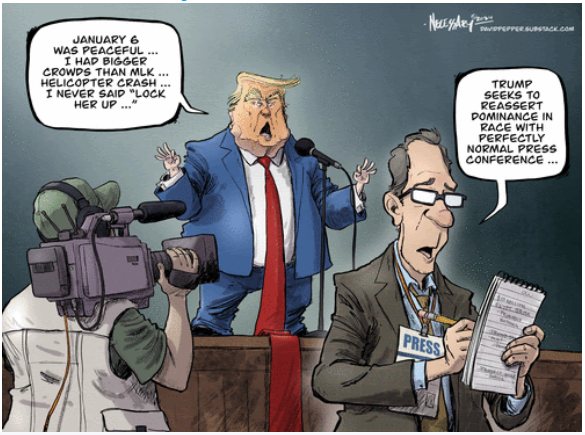
At the same time, it’s rather bizarre to hold Harris to the standard of a serious candidate for President while her opponent’s incoherent ramblings are mostly ignored* because, well, that’s Trump being Trump. Granting that Trump’s incoherence isn’t exactly new news, it makes for an absurd double standard.
Almost exactly a quarter-century ago, then-Texas Governor George W. Bush debuted the phrase “the soft bigotry of low expectations” in a speech to the Latin Business Association.
Some say it is unfair to hold disadvantaged children to rigorous standards. I say it is discrimination to require anything less—the soft bigotry of low expectations. Some say that schools can’t be expected to teach, because there are too many broken families, too many immigrants, too much diversity. I say that pigment and poverty need not determine performance. That myth is disproved by good schools every day. Excuse-making must end before learning can begin.
The press corps—and indeed, much of the American public—is essentially doing this with Trump. While I don’t believe that he is capable of performing at a higher level (more on that in a separate post), it’s not at all unreasonable to judge him against the standards that we would literally any other candidate for the presidency.
*In fairness, the AP report does eventually point out that Trump has flip-flopped on many issues as well. But the headline and first several paragraphs are likely all or more than most will read and, even if one got to that point in the report, the priming effect is already in place.