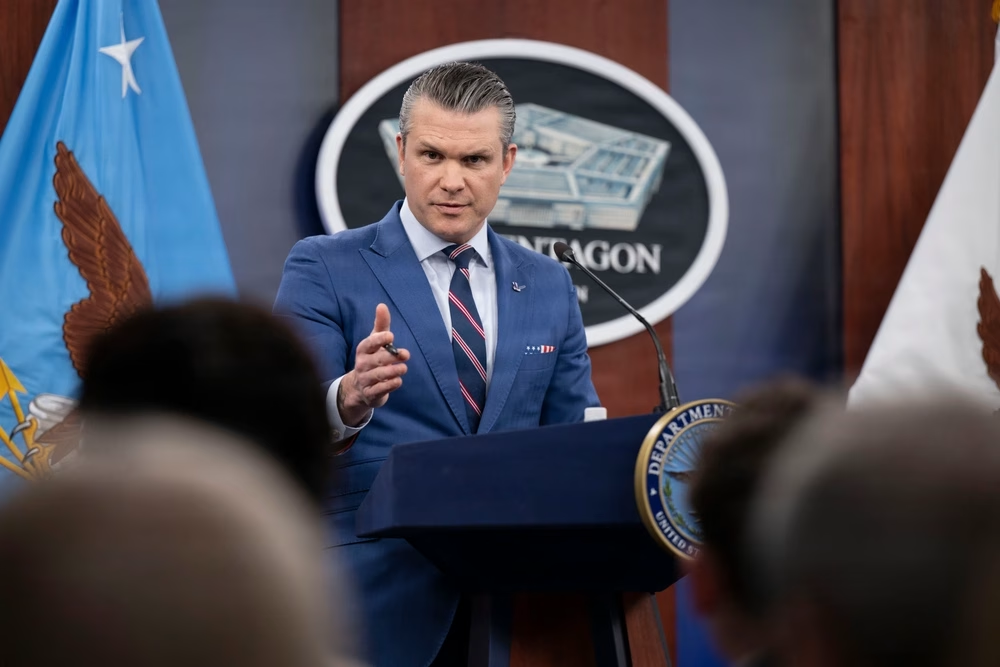
WaPo Exclusive (“Military leaders warn Hegseth against extending Iran war operations“):
Several U.S. military leaders have advised Defense Secretary Pete Hegseth that prolonging large-scale operations against Iran is unsustainable and risks weakening their ability to confront threats elsewhere, including the U.S. homeland, according to people familiar with a recent assessment prepared for the Pentagon chief.
The warnings — detailed for Hegseth by the heads of the Army, Navy and Air Force and the four-star commanders overseeing U.S. operations throughout Europe, Asia and Latin America — appear in the Aug. 14 edition of the Secretary of Defense Orders Book (SDOB), these people said. They described the assessment to The Washington Post on the condition of anonymity because the document is classified.
[…]
As President Donald Trump has pressured Tehran to reopen the Strait of Hormuz and accept several U.S. provisions for ending the stalemated conflict, he has been adamant that all options remain available to him — including further military action. Consequently, U.S. Central Command, the headquarters responsible for prosecuting the Iran war, has kept a force of more than 50,000 troops on alert for months in case the president orders additional attacks.
The Aug. 14 orders book directs some troops deployed in the Middle East to remain there through September and some others into 2027, said those familiar with the document. The prospect of extending those forces further compelled military leaders to voice their concern, these people said.
Leaders of the U.S. European Command, the U.S. Pacific Command and the U.S. Southern Command, along with the Navy’s top admiral, responded with what is characterized in the SDOB as a “non-concur,” those familiar with the assessment said — meaning they disagree with the secretary’s order to extend their forces but will execute it nevertheless.
The geographic combatant commands overseeing U.S. operations in Europe, Asia and Latin America have had their ships, aircraft and other equipment pulled away to support the Iran conflict. This has limited their ability to conduct missions and ensure proper training, those familiar with the assessment said. The Navy, in particular, has had to stretch its capacity to keep up with wartime demands.
Army and Air Force leadership concurred with Hegseth’s desire to extend their deployed forces, but each emphasized that doing so would come with significant risk, these people said.
Overall, the tenor from the military leadership is that the ongoing Iran operation, having reached the six-month mark, has been “too much for too long,” said one person familiar with the assessment.
[…]
It’s common for commanders to discuss risk, said the one person familiar with the recent assessment. But the outlook now is “more dire” overall, this person explained, adding that certain generals and admirals were more expansive and frank than is usual in telling Hegseth they disagreed with orders to keep providing equipment and personnel when the operation’s trajectory remains uncertain.
[…]
Adm. Samuel Paparo, the chief of Pacific Command, disagreed with the level of support he was ordered to continually provide, including an aircraft carrier strike group and naval destroyers, those familiar with the assessment said.
[…]
Adm. Daryl Caudle, the chief of Naval Operations, provided Hegseth with the dimmest picture, saying in the SDOB that the Navy cannot sustain its current level of support for the Iran conflict because there is no anticipated end date, those familiar with the assessment said.
It is the job of senior uniformed military leaders to assess risk to force and risk to mission and advise civilian policymakers, including the Secretary of Defense, accordingly. It is the prerogative of the Secretary to override their advice, judging the risk worth taking in order to achieve policy objectives. As the eminent civil-military relations scholar Peter Feaver pithily put it, civilians “have a right to be wrong.”
While the SDOB and specific numbers on manning and equipment levels are classified, that the Iran War is taking a significant toll on our deployed troops, deferring maintenance on critical equipment, expending hard-to-replace munitions, and putting a strain on the welfare of deployed troops is no secret. Ultimately, that’s a call President Trump and his appointees get to make.
It’s notable that, going back to President Obama’s 2011 “pivot,” the CENTCOM area of responsibility has ostensibly not been the primary focus of the United States’ national strategy. That is decidedly the case with the Trump administration’s 2025 National Security Strategy and 2026 National Defense Strategy, both of which mention Iran only in the context of the glorious success of Operation MIDNIGHT HAMMER. The homeland and Western Hemisphere writ large are given as the first priority, followed by Asia and then Europe.
As to the Middle East,
America will always have core interests in ensuring that Gulf energy supplies do not fall into the hands of an outright enemy, that the Strait of Hormuz remain open, that the Red Sea remain navigable, that the region not be an incubator or exporter of terror against American interests or the American homeland, and that Israel remain secure. We can and must address this threat ideologically and militarily without decades of fruitless “nation-building” wars. We also have a clear interest in expanding the Abraham Accords to more nations in the region and to other countries in the Muslim world.
But the days in which the Middle East dominated American foreign policy in both long-term planning and day-to-day execution are thankfully over—not because the Middle East no longer matters, but because it is no longer the constant irritant, and potential source of imminent catastrophe, that it once was. It is rather emerging as a place of partnership, friendship, and investment—a trend that should be welcomed and encouraged. [emphases added]
Thus far, the war has resulted in the Strait of Hormuz closing and the weakening of our deterrence against China. Whether it is fruitless remains to be seen.