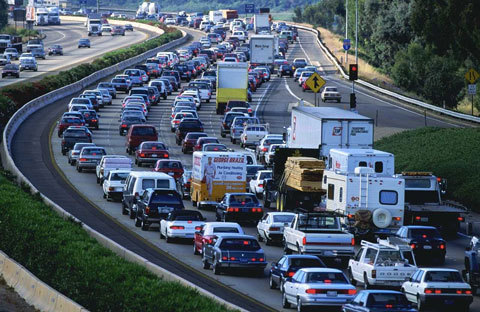
 Matt Yglesias points to David Brooks’ assertion that “The daily activity most injurious to happiness is commuting” in order to tout a congestion pricing tax.
Brooks doesn’t pivot from this into any real policy specifics. But the upshot of the commuting point is very clear—we should charge people a fee to drive on crowded roads at peak hours. If you look at it in strict dollars and cents terms, the policy looks great. A relatively small fee can eliminate large economic losses due to congestion, and then the fee can finance useful public services or reductions in other taxes. But when you add in the fact that commuting time makes people miserable, you can see that the social gains from congestion pricing in our most-trafficked metro areas would be extremely large.
If there’s anything people hate more than being stuck in traffic it’s being stuck in traffic while paying higher taxes for the privilege. (Having been stuck in traffic jams on expensive toll roads, I can offer anecdotal support for something that’s intuitively true.)
Now, obviously, the point of congestion pricing is to cajole people to shift their driving habits and ease said congestion. But the reality is that most people don’t have the flexibility to do much about their commuting time.
If you’re poor enough that, say, a $5 tax will dissuade you from driving during the rush hour, then you’re likely just going to wind up staying at the office later. Without additional compensation, most likely. And, no, you can’t go out an have a beer or something because it would cost you decidedly more than $5.
Ah, you say, you could take public transportation! But, presumably, people who can’t afford a congestion pricing tax would already be doing that, since it’s almost certainly far cheaper than driving and parking.
Well, how about flex scheduling? Some of us have the luxury. Most people don’t. Especially low wage workers in the service industry, who can’t exactly telecommute.
UPDATE: To be clear, I don’t have strong views one way or the other on the overall merits of congestion pricing. My gut instinct is that all such schemes basically stick it to people who can’t afford to pay for convenience rather than addressing larger communal problems but that’s sometimes inevitable. I just object to the idea that the way to make something less miserable is to slap a tax on it.