I wrote most of this post before my post, entitled Centering My Thoughts on Kirk’s Assassination. If any reader is interested in my basic thoughts on the entire situation, that is the place to start.
There are many guilty parties in the rise of political violence. But to our minds, among the biggest culprits are the universities. In the same way that madrassas radicalize jihadis, America’s campuses are among the places in the U.S. most hostile to disagreement and debate. Where they preach “inclusion,” they actually practice exclusion—shouting down speakers they disagree with, for instance. Where they promote “diversity,” they actually enforce a uniformity of thought, denying tenure to dissenters.
Here is where I note in passing that Weiss and her colleagues all have college degrees, and somehow managed to escape without being turned into Marxist zombies.
But the real issue here is that the statement about hostility to debate does not stand up to scrutiny.
Kirk’s entire business model was predicated on Turning Point USA chapters on college campuses and, more importantly, touring college campuses himself to engage in interchange, in public, with students.
I don’t think madrassas allow Southern Baptist clubs to be formed by their students, nor do they allow traveling Evangelical preachers to swing by for a public forum.
As Moynihan notes:
Kirk built his political organization, Turning Point, via a series of chapters on college campuses. Kirk and Turning Point mastered a new political economy of campus conservatism. Members used debate with controversial speakers who generated attention. They also engaged in sophomoric stunts and had members who trafficked in overt racism.
Kirk and Turning Point were a pain in the ass for universities, a source of disquiet. Nevertheless, universities largely welcomed — or at least tolerated — Kirk, and allowed his organization to operate on their campuses. Kirk died at a university-organized event, part of a Fall tour of university campuses. He was engaged in a peaceful discussion in front of a thousands of students when he was killed by someone not affiliated with the campus. It is impossible to square these facts with the claim that “America’s campuses are among the places in the U.S. most hostile to disagreement and debate.”
Emphasis mine. What else is there to say?
Kirk was not only able to visit these campuses, but he also sold tickets to his events and used video from the events as fodder for his social media, which is also part of his business.
So, rather than being banned from campus, he was able to leverage visits to campus to make a living.
You know, like how jihadi madrassas work.
I would note that a lot of this plays into a post from G. Elliot Morris at Strength in Numbers, People are more likely to support partisan violence when they think the other party does too.
when leaders express support for partisan violence, followers are likely to adopt that belief. Some will even act on it.
But the other thing that will inevitably happen if these surrogates keep saying Democrats are the “Party of Murder” and need to be destroyed is that Republicans will inevitably think of the Democrats as more violent than they are in reality. The share of Republicans who think most Democrats support partisan violence will increase sharply.
According to this paper I link to in my Friday column […] political violence is a psychological arms race, with neither side wanting to be caught flat-footed against the opposition. Nobody wants to bring a pen to a gunfight. This is a natural instinct when you come to view your political opponents as an opposing tribe threatening to wipe you out. People are saying, “Hey, well, if they want to hurt me, I might as well hurt them back.”
In other words, citizens take cues from leaders. If leaders tell their followers that the other side is violent, those followers are more likely to believe a threat exists. The more people see a threat, the more likely they are to react to their opponents with violence, including preemptive violence.
The study also showed that if you correct misperceptions about the other side, support for violence decreases.
In the experimental study on violence linked above, scholars tested support for partisan violence before and after one group of respondents received information about how many people in the opposition party also supported it. As established, most people dramatically overestimate that percentage.
But what happens if you then correct survey respondents on their misperception? Compared to a control group that got no corrective message, support for partisan violence was between 40% and 80% lower among the treated group (that got the corrective statement).
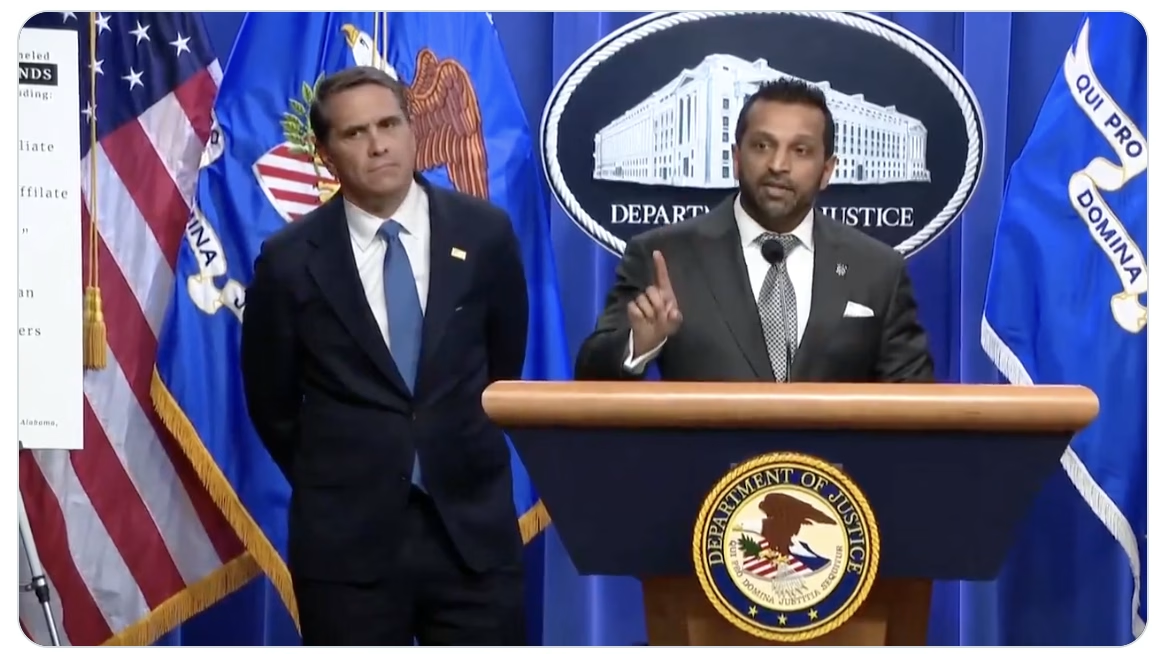
This is why things like Trump’s initial speech (and continuing rhetoric) are a massive problem. It’s why having the AG, the VP, and talking heads on Fox News accusing “the left” of violence is a problem. And it is why attacking universities like they are intolerant places that radicalize students into becoming violent is a dangerous lie.
Or why pieces like this by Breccan F. Thies in The Federalist are abhorrent: We Can Give No Clemency To The Assassination Left.
Let’s start with the fact that there is no “assassination left.” While yes, it is possible to find people on social media who have said some awful things in support of Kirk’s murder, the reality is that, as best as I can tell, the entire force of elected Democratic politicians has condemned the killing. And even “liberal” networks like MSNBC have been quick to overcorrect for possibly bad reactions due to what people on their air say (see the firing of Matthew Dowd).
As Elliot notes in his post, social media distorts the way we look at each other, but the responsible thing for people with huge platforms like Donald Trump, JD Vance, Pam Bondi, and Jesse Watters, to take a breath before making vague, catch-all claims about “the left.”
Some of the outrage from the Federalist piece underscores both how bad leadership makes all this worse, as well as the way in which ambiguous social media posts can deepen divides.
The spreaders of this rhetoric are not fringes of the far left. These are the rank-and-file, and we know that because Democrat members of Congress jeered at the idea of a moment of silence in the moments after Kirk’s death on the House floor.
This notion is derived from the included tweet from Representative Ronny Jackson (R-TX):
If you watch this clip, which I did twice and then some, what you will see is roughly a minute of the entire chamber observing a moment of silence and Speaker Johnson asking why a member from Colorado was seeking recognition, and then some disruption takes place. Here’s the deal with the tweet: you can’t tell what is going on, and the first 53 seconds of the clip utterly undercut what Jackson claimed was in the clip. It does not justify what Thies wrote about the incident.
Sharing a country with people like this is untenable. It is too late to turn the temperature down. Without resorting to violence, Americans need to pursue complete and total dominance of those who would cheer Kirk’s death, egg on more violence, and justify it away later.
Here we have Jackson spreading a narrative that is then picked up by right-wing writers, who then mix it with the emotion of the moment to turn up anger against other Americans who are not responsible for what one man did.
I did more research than Thies did and can provide more context than Jackson did. What happened was that after almost a full minute of reverent, silent prayer, Representative Boebert (R-CO) stood up and stated that “silent prayer gets silent results” (take that, God!)* and requested someone pray aloud for Kirk. This is what caused the hubbub on the floor. But, of course, Fox News decided to add a bit more fuel to the fire and showed the clip from the point, which ignored the silent prayer that preceded it. The prayer that no one objected to.
I would note, to his credit, that Paul did not take the bait. Note, too, that Paul noted having been on college campuses with Kirk (you know, those places that don’t allow people to speak).
Thies has a solution.
Trump already called for a Racketeer Influenced and Corrupt Organizations Act (RICO) investigation into far-left billionaire George Soros for funding “agitation” — or worse. While Soros is well-known to have a network of organizations that attempt to subvert American society, the depth of this issue obviously does not stop at Soros.
The groups, communication systems, networks, logistical programs, and the rest need to be uncovered and eradicated, root and branch. They need to be treated as terrorist organizations. As Blaze Media host Auron MacIntyre said, we need “lists, names, raids, action, no excuse.”
The FBI needs to identify, subvert, and prosecute all Antifa and similar cells, and work with social media companies under threat of a criminal charge.
There is something utterly nauseating about calling for “lists, names, raid, action, no excuse,” especially when the supposed perfect illustration of the problem is a lie about what happened on the House floor.
Keep in mind: this was written with no knowledge of motive or of any evidence of any kind of broad threat. But the rhetoric from top members of the Republican Party has been to foment this exact kind of response.
So, yes, it concerns me when this rhetoric gets localized into specific groups, like university faculty. It is a way to guarantee more violence. And Thies attacks universities in the piece, and also a subheading in the piece declares, “Democrats Are The Party Of Political Assassinations.”
It seems important to recall that there has been political violence perpetrated against Democrats as well (Minnesota State Representative Melissa Hortman and her husband were killed, and another State Senator and his wife were shot). And there was this event at the US Capitol on January 6, 2021, that was decidedly not a Democratic affair, but was instead an insurrection mounted to stop the election process.
And there are things like this that rather undercut the notion that the Republicans are peaceniks.

I would note, too, if you don’t want to be accused of acting and sounding like a fascist, that perhaps the first, best step is to not act and sound like a fascist.
To return, as I do far more than I wish was the case, to Stanley’s How Fascism Works, we see that clear attempt at the politics of Us v. Them. Republicans and many of their media allies are rushing to take this moment of national tragedy and blame it on the other side.
The bit about what happened on the House floor is a combination of unreality (the description does not fit what happened, whether we are talking about Jackson, Thies, or FNC) and FNC is clearly acting propagandistically with the way it edited and reported what happened.
And the ongoing attacks on universities fit directly into the notion of anti-intellectualism.
And, of course, there is the law and order angle.
These are all chapters in Stanley’s book, as I noted here.
We are in a very bad moment in our national history and it is beyodn disgusting that the administration and many of its media allies are willing to exploit a murder in this way.
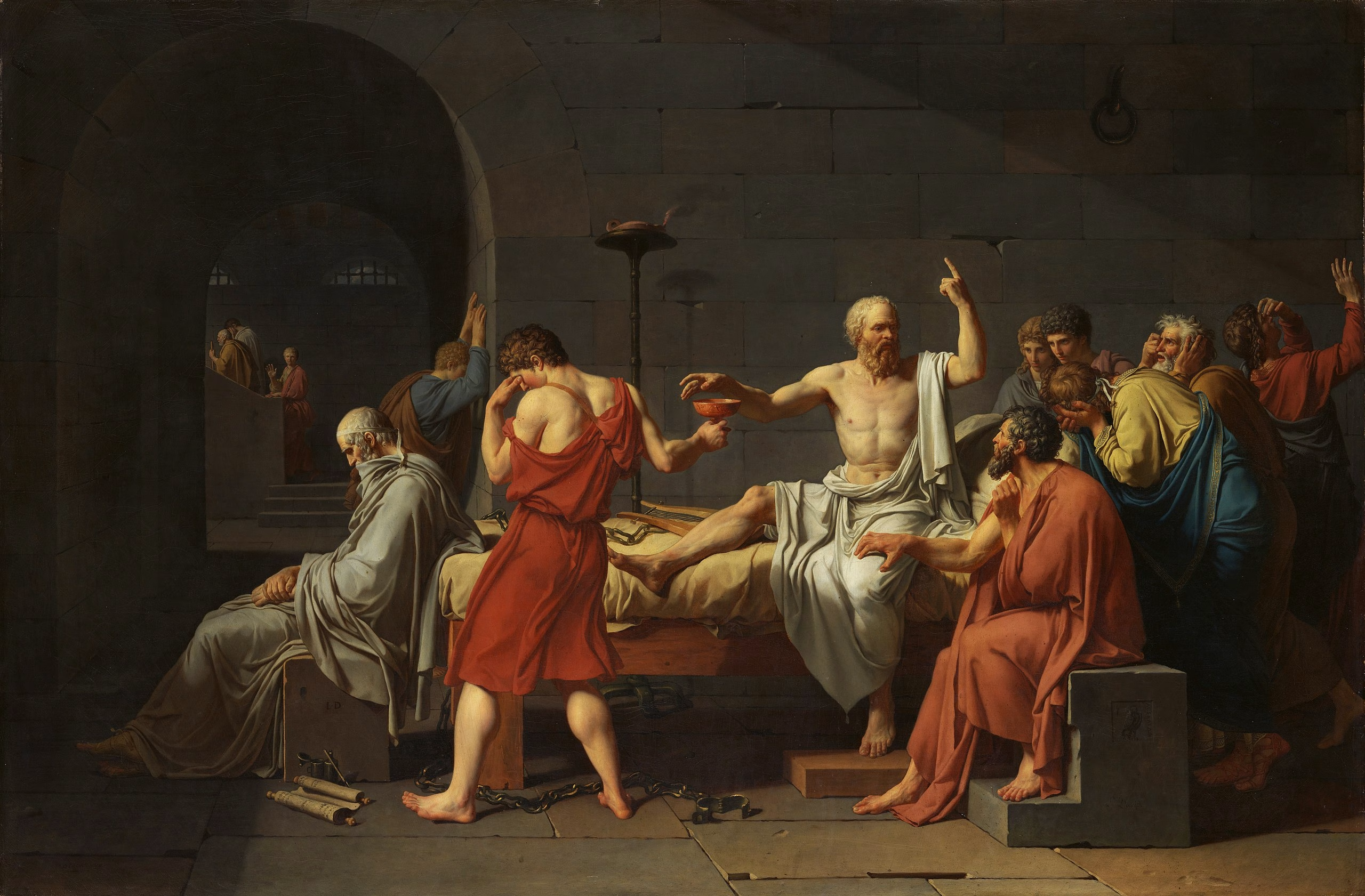
I remind us all, again, that Socrates was executed for the sin of corrupting the youth because he taught things that challenged the accepted orthodoxy. I think this story needs to be front of mind as we hear right-wing agitators attack higher education.
A dangling note worth mentioning: As it pertains to university campuses and whether or not a lot of what we have seen in recent years really is the left being intolerant, I would recommend (also via Moynihan) this piece by Henry Farrell at Crooked Timber from 2023: Conservatives on campus.
The big shift from the bespectacled bowtie model of campus conservatism to the frenzy of Turning Point USA and rampaging groypers wasn’t a reaction to Wokism-Out-of-Control, as Hoffman maintains. It was a product of a national level shift in the organizational political economy on the right, as national conservative groups perceived possible political advantage from stirring stuff up more on campus. This doesn’t mean that outraged reactions from left students aren’t part of the story. It means instead that they feed an independently existing organizational machine that wants them to be outraged, and will go to increasingly extreme lengths to make sure that they are outraged. Quoting Binder and Kidder:
“provocations are often very much part of the design … Elliot Kaufman, a former conservative activist from Stanford University, for example, acknowledged in an op-ed for National Review that “The left-wing riots were not the price or the downside of inviting Yiannopoulos—they were the attraction.””
There may well have been some attempts by left-leaning groups to use the heckler’s veto against right-leaning groups. But the degree to which these groups have sought to generate that response via provocation is worth keeping in mind.
*Dare I note Matthew 6:5: ““And when you pray, you must not be like the hypocrites. For they love to stand and pray in the synagogues and at the street corners, that they may be seen by others. Truly, I say to you, they have received their reward.”