
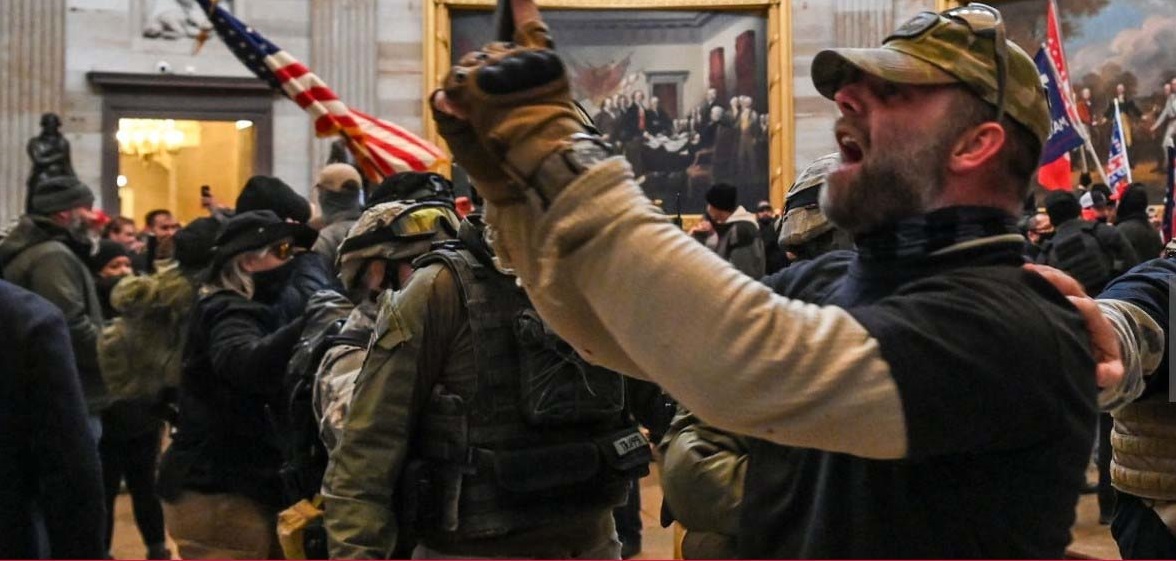

While most of us expected President Trump to pardon those convicted of nonviolent offenses for their part in the Capitol Riot, most were stunned when his clemency* included even the leaders of the Proud Boys and Oath Keepers, who were convicted of seditious conspiracy. Even his Vice President was adamant that wouldn’t happen as recently as a week ago. Yet, despite warnings otherwise, it appears the backlash from Republican leaders will be minimal.
Aaron Blake, NYT (“The GOP’s stunning response to Trump pardoning those who assaulted police“):
When the idea of pardons for Jan. 6 defendants first circulated, the pushback from Republican senators was pretty swift. And even the few who entertained the idea drew a line at pardoning the violent ones.
“I think there is a stark difference between acts of violence and peaceful protest,” Sen. Ted Cruz (R-Texas) said, calling acts of violence “qualitatively different” and “unacceptable from any political perspective.”
“To seek a pardon of these people would be wrong,” Sen. Lindsey Graham (R-South Carolina) told Fox News. “I think it would destroy President Trump, and I hope we don’t go down that road.”
Graham even said that such a move “reinforces violence.”
But now that President Donald Trump has gone there and granted clemency to every Jan. 6 defendant — including those who assaulted police — the response from Republicans has been strikingly muted. And some are even giving Trump a nod of approval, a remarkable episode that shows how Trump gradually lures his party to vouch for the previously unthinkable.
Few GOP lawmakers ventured voluntary statements on the matter after Trump on Monday night issued clemency. When they were asked about it Tuesday, a handful of critics emerged.
Among the most outspoken was former Senate majority leader Mitch McConnell (Kentucky), who told Semafor: “No one should excuse violence. And particularly violence against police officers.”
Sen. Bill Cassidy (Louisiana) offered similar comments, telling reporters, “People who assault police officers, if they do the crime, they should do the time.”
“I’m disappointed to see that, and I do fear the message that is sent to these great men and women that stood by us,” Sen. Lisa Murkowski (Alaska) said, referring to the Capitol Police officers who were assaulted.
Sen. Thom Tillis (North Carolina) added: “Anybody who is convicted of assault on a police officer, I can’t get there, at all. I think it was a bad idea.”
Plenty of other Republicans didn’t seem to want to engage or offered muted responses.
Senate Majority Leader John Thune (South Dakota) said he was not “looking backwards” and claimed the blanket pardons were actually done on a case-by-case basis. Sen. Susan Collins (Maine) indicated she was unfamiliar with the pardons but would disagree with them if they were for violent offenders. Sen. John Cornyn (Texas) emphasized that it was Trump’s prerogative.
But perhaps most remarkably, some even approved:
Sen. Ron Johnson (Wisconsin) told Fox News that he didn’t want to pardon violent offenders but that the Justice Department’s handling of the cases made him fully supportive.\
Sen. Tommy Tuberville (Alabama) said that he was “100 percent” for all of the pardons and that the defendants had served enough time. When pressed on those who assaulted police, Tuberville said that was “not acceptable” but that he “didn’t see” the video.
Sen. Jim Banks (Indiana) added that it was a “disgrace how all of these people were treated” and said that because Trump had previewed his plans and won the election, his action was justified.
In fact, Trump didn’t firmly signal a desire to pardon violent Jan. 6 defendants, either before or after the election; at one point, he even suggested he was focused on nonviolent offenders. Also, polling has shown Americans pretty strongly opposed the idea of pardons more broadly, and especially pardons for those who assaulted police.
McConnell and the handful of other dissenters are, alas, Susan Collinsing. They will say the right thing but, when it comes time to do anything about it, they’ll fall in line.
Outside the Republican conference, anger is more widespread.
NYT (“‘A Betrayal, a Mockery’: Police Express Outrage Over Trump’s Jan. 6 Pardons“):
When inmates are released from federal prison, the Justice Department places a call to their victims, notifying them that the defendant who attacked them is now free. On Tuesday, the phones of U.S. Capitol Police and D.C. police officers were buzzing nonstop.
For Aquilino A. Gonell, a former Capitol Police sergeant, the automated calls began on Monday evening and continued into Tuesday morning after President Trump issued a sweeping legal reprieve to all of the nearly 1,600 defendants, including those convicted of violent crimes, in the Jan. 6, 2021, attack on the Capitol.
Between 7:03 a.m. and 9:37 a.m., Mr. Gonell received nine calls from the Justice Department about the release of inmates.
Mr. Gonell, who was assaulted during the attack and retired because of the injuries he suffered, was as outraged and distraught as he was shortly after the violence.
“It’s a miscarriage of justice, a betrayal, a mockery, and a desecration of the men and women that risked their lives defending our democracy,” he said of the nearly 1,600 pardons and 14 commutations.
More than 150 police officers from the two agencies were injured during the assault on the Capitol by a pro-Trump mob four years ago. Some were hit in the head with baseball bats, flagpoles and pipes. One lost consciousness after rioters used a metal barrier to push her down as they marched to the building.
Now many of those officers described themselves as struggling and depressed in response to Mr. Trump freeing their attackers.
[…]
Still, some of the officers who were victims that day are pledging to fight on.
“For anyone who cares about truth and respect for law and law enforcement, his pardons are an unspeakable outrage,” said Patrick A. Malone, a lawyer for seven officers who sued Mr. Trump over the attack.
“The officers I represent will not forget!” Mr. Malone said.
Harry Dunn, one of the most outspoken officers who protected the Capitol on Jan. 6, spent Monday and Tuesday checking in with his former colleagues.
“Everybody’s angry and sad and devastated,” said Mr. Dunn, who has left the Capitol Police.
One officer, Mr. Dunn said, went to bed after a long shift only to be awakened by an automated voice mail from victim services informing him of the release of a Jan. 6 defendant.
“Every officer who testified in court is now getting these automated calls that, ‘Hey this defendant is being released,’” Mr. Dunn said. “The number of calls people are getting, it’s unbelievable.”
Axios (“Police union that endorsed Trump blasts Jan. 6 pardons“):
President Trump’s near-total pardon of Jan. 6 rioters was denounced by the Fraternal Order of Police, the largest police union in the U.S., and the International Association of Chiefs of Police on Tuesday.
The groups said they’re deeply discouraged by pardons and commutations made by both the Biden and Trump administrations of individuals convicted of killing or assaulting law enforcement officers.
The groups said in a statement they firmly believe those convicted of such crimes should serve full sentences.
“Allowing those convicted of these crimes to be released early diminishes accountability and devalues the sacrifices made by courageous law enforcement officers and their families,” per the statement.
“When perpetrators of crimes, especially serious crimes, are not held fully accountable, it sends a dangerous message that the consequences for attacking law enforcement are not severe, potentially emboldening others to commit similar acts of violence,” the unions said.[…]
The Fraternal Order of Police endorsed Trump in 2016, 2020 and 2024.
That they endorsed the man who instigated the riots over a former prosecutor is beyond me. Leopards, faces, and all that.
A couple of our commentators yesterday apparently weren’t watching the news on January 6, 2020. Thankfully, NPR has a summary (“Trump gave pardons to hundreds of violent Jan. 6 rioters. Here’s what they did.“
Matthew Graves led the office that prosecuted all of the Jan. 6 cases. He told NPR, “there’s no wiping out the public record, there’s no undoing these prosecutions.”
Over 1,100 people had already pleaded guilty or been convicted at trial, and sentenced in connection with these cases. Most had finished their punishments, except for those who were serving longer sentences for engaging in violence at the Capitol, Graves said.
“The actions taken by the President disproportionately benefit the most violent among the mob,” Graves said.
The FBI under its previous director, Trump-appointee Christopher Wray, called the Jan. 6 attack an act of domestic terrorism. The Department of Justice estimated that more than 140 police officers were injured by the pro-Trump mob. Officers have described injuries from the attack including cracked ribs, traumatic brain injuries, smashed spinal discs and a heart attack. In several cases, officers have said they’re still coping with post-traumatic stress from the hourslong violent assault.
Rioters used bats, flags, chemical sprays, poles and stolen police shields and batons to beat officers. Several rioters were convicted of charges for carrying loaded firearms in the melee. In the four years after the insurrection, prosecutors brought charges against more than 1,500 people. Many of those charged said that they stormed the U.S. Capitol specifically because they believed Trump supported their actions. Most defendants pleaded guilty to the charges they faced. Prosecutors obtained guilty verdicts in nearly all of the cases that went to trial.
[…]
Here are some of the people convicted of violence on Jan. 6, who received “full, complete and unconditional” pardons from Trump:
David Dempsey was convicted of repeatedly assaulting police officers with pepper spray, a metal crutch and wooden and metal poles. “For over one hour, defendant David Dempsey viciously assaulted and injured police officers,” federal prosecutors wrote. Metropolitan Police Department Detective Phuson Nguyen testified that after Dempsey pepper sprayed him, he was knocked down, and “I thought that’s, you know, where I’m going to die. And in my head, you know, I was thinking about my family at that point before anything else.” Dempsey was sentenced to 20 years in prison.
Julian Khater pleaded guilty to pepper spraying Capitol Police Officer Brian Sicknick in the face. Later that night, Sicknick collapsed and was rushed to the hospital. He died the following day. According to the Washington, D.C. medical examiner, Sicknick’s death was due to “natural causes” — two strokes — but “all that transpired played a role in his condition.” Sicknick’s mother, Gladys, spoke at Khater’s sentencing hearing. “Lawlessness, misplaced loyalty to a deranged autocratic ideal, and hate killed my son,” she told the court. “And I hope you are haunted by your crimes behind bars. Whatever jail time you receive is not enough in my eyes.” Khater was sentenced to more than six years in prison.
Christian Matthew Manley pleaded guilty to assaulting police with two cans of bear spray, and throwing an empty canister at officers. Manley then threw a metal rod at officers. Federal judge Tanya Chutkan told Manley at his sentencing hearing that, “there has to be an understanding that participating, taking up arms against law enforcement, taking up arms to basically try and overthrow the government, is going to be met with severe punishment.” Manley was sentenced to more than four years in prison.
Patrick Edward McCaughey III was convicted of using a police riot shield to “crush” Metropolitan Police Officer Daniel Hodges in a metal doorframe, leaving Hodges trapped, bleeding and crying for help from his fellow officers. “If I was there much longer being assaulted in such a way, I knew that it was very likely I wouldn’t be able to maintain my consciousness,” Hodges testified. “Your actions on January 6 were some of the most egregious crimes that were committed that day,” federal judge Trevor McFadden told McCaughey before sentencing him to more than seven years in prison.
Ryan Nichols pleaded guilty to pepper spraying police officers and urging rioters through a bullhorn to storm the building. “This is not a peaceful protest,” he yelled, according to prosecutors. “If you have a weapon, you need to get your weapon!” Later that night, Nichols recorded a video of himself calling for a second American Revolution and stating, “if you want to know where Ryan Nichols stands, Ryan Nichols stands for violence.” Nichols was sentenced to more than five years in prison.
Christopher Quaglin was convicted at trial of “viciously assaulting police officers for hours,” according to federal prosecutors. “On at least a dozen occasions, Quaglin stood face-to-face with officers as he screamed at, pushed with outstretched arms, punched, swatted, and
slapped officers; pushed bike racks into officers; and even choked one officer to the ground,” prosecutors stated. Quaglin was sentenced to 12 years in prison.
Daniel Rodriguez pleaded guilty to using a stun gun and “plunging it” multiple times into a police officer Michael Fanone’s neck, in the words of prosecutors, leading Fanone to scream out in pain. “During those moments, I remember thinking that there was a very good chance that I would be torn apart or be shot to death with my own weapon,” Fanone testified to Congress. Rodriguez was sentenced to more than 12 years in prison.
Peter Schwartz was convicted of stealing pepper spray from police officers, distributing the canisters to other rioters and “indiscriminately” spraying law enforcement, according to prosecutors. Court documents from the Justice Department described him as a “a welder by trade and a felon who has racked up numerous convictions for drugs, weapons, and violence over the last three decades.” The day after the riot, he allegedly posted on Facebook, “What happened yesterday was the opening of a war. I was there and whether people will acknowledge it or not we are now at war.” Schwartz was sentenced to more than 14 years in prison.
But, sure, their imprisonment constituted “a grave national injustice that has been perpetrated upon the American people.”
*It wasn’t clear from the early news reports but the 14 convicts connected to the Oath Keepers and Proud boys were not pardoned; they merely had their sentences commuted. While they’re being released from prison, their felony convictions stand. For now at least.









