
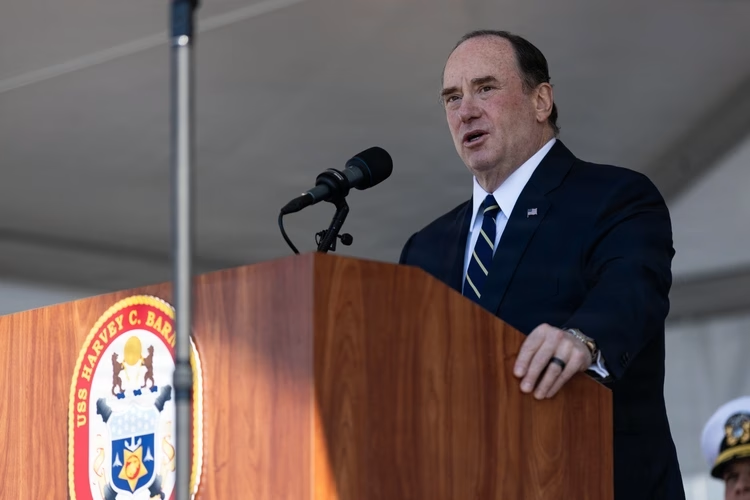
NYT (“Navy Secretary Is Fired as Infighting Roils Pentagon“):
Navy Secretary John Phelan was fired on Wednesday after months of infighting with senior Pentagon leaders and disagreements over how to revive the Navy’s struggling shipbuilding program.
Mr. Phelan is leaving the Pentagon and the Trump administration effective immediately, wrote Sean Parnell, the Pentagon’s chief spokesman, in a terse statement.
In his role leading the Navy, Mr. Phelan had championed the “Golden Fleet,” a major investment in new ships including a “Trump-class” battleship. But Mr. Phelan’s leadership was marred by feuds with senior leaders in the Pentagon, including Defense Secretary Pete Hegseth and Deputy Defense Secretary Stephen Feinberg, Pentagon and congressional officials said.
Mr. Phelan is the first service secretary to leave the administration, though he is the second one to clash with the defense secretary. Mr. Hegseth also has butted heads with Army Secretary Daniel P. Driscoll over promotions and a host of other issues. Mr. Hegseth fired the Army’s chief of staff, Gen. Randy George, earlier this month.
The Navy secretary has no role overseeing deployed forces, and Mr. Phelan’s firing is not likely to have significant implications for the conduct of the Iran war or U.S. Navy operations to blockade Iranian ports or open the Strait of Hormuz. As the Navy’s top civilian leader, his main responsibility is to oversee the building of the future naval and Marine Corps force.
But the tumult could make it harder for the Navy to replenish its stock of Tomahawk missiles and high-end air defense systems, which have been in heavy use in Iran.
Tensions had been simmering for months between Mr. Phelan and his two bosses — Mr. Hegseth and Mr. Feinberg — over management style, personnel issues and other matters.
Mr. Feinberg, in particular, had grown increasingly dissatisfied with Mr. Phelan’s handling of the Navy’s major new shipbuilding initiative, and had been siphoning off responsibility for the project from him, said the congressional official, who spoke on the condition of anonymity to discuss personnel matters.
Mr. Phelan, a White House appointee, also had a contentious relationship with his deputy, Under Secretary Hung Cao, who is more aligned with Mr. Hegseth, especially on some of the social and cultural battles that have defined the defense secretary’s tenure, the officials said.
[…]
Last fall, Mr. Hegseth fired Mr. Phelan’s chief of staff, Jon Harrison, who had clashed with senior officials throughout the Pentagon. The unusual move highlighted the broader tensions between Mr. Hegseth and Mr. Phelan.
Still, the timing of Mr. Phelan’s firing caught some Pentagon and congressional officials off guard. On Wednesday, Mr. Phelan was making the rounds on Capitol Hill, talking to senators about his upcoming annual hearing with lawmakers to discuss the Navy’s budget request and other priorities.
“Secretary Phelan’s abrupt dismissal is troubling,” Senator Jack Reed of Rhode Island, the top Democrat on the Armed Services Committee, said in a statement Wednesday night. “In the midst of President Trump’s war of choice in Iran, at a moment when our naval forces are stretched thin across multiple theaters, this kind of disruption at the top sends the wrong signal to our sailors and Marines, to our allies, and to our adversaries.”
[…]
Bryan Clark, a naval analyst at the Hudson Institute, said that Mr. Phelan was “driving the Navy in a different direction” than what Mr. Hegseth and Mr. Feinberg wanted.
“He was championing initiatives like the battleship and frigate that don’t align with where the D.O.W. leadership is taking the military, which is toward submarines, stealth aircraft, unmanned systems and software-driven capabilities like electronic warfare and cyber,” Mr. Clark said in an email, using the abbreviation for Department of War, as the administration calls the Defense Department.
Mr. Phelan also clashed with Mr. Hegseth over personnel issues in the Navy and Marine Corps, a former senior military official said. Mr. Hegseth has directed service secretaries to scrub the social media accounts of general- and admiral-level promotion candidates to ensure they are not deemed too “woke” by Mr. Hegseth’s standards, the official said.
WaPo (“John Phelan forced out as Navy secretary after 13 months“) adds:
Five officials said that Phelan, a billionaire art collector and fundraiser for President Donald Trump’s reelection campaign, was forced out after repeated clashes with both Hegseth and Feinberg over his management of shipbuilding and a variety of other issues. One administration official, who like some others spoke on the condition of anonymity because of the issue’s sensitivity, said Phelan was asked to step down.
[…]
Navy Undersecretary Hung Cao, a Navy veteran and former candidate for House and Senate seats in Virginia, will become the service’s acting secretary, Parnell said in his announcement. Hegseth has preferred Cao for the role for some time, officials said.
[…]
The disputes between Phelan, Hegseth and Feinberg are part of a broader pattern of infighting that has occurred during Hegseth’s tenure leading the Pentagon. The defense secretary also has clashed repeatedly with Army Secretary Dan Driscoll over Hegseth’s moves to fire some generals and block others from promotion.
Parnell, in a statement earlier this month, claimed that Hegseth “maintains excellent working relationships with the secretaries of every military service branch.” But numerous officials said that is not the case.
“They’ve been out to get Driscoll and Phelan for a long time now,” one U.S. official familiar with the issue said Wednesday night.
[…]
The administration had grown increasingly frustrated at the lack of progress from Phelan’s office in turning around the American shipbuilding industry, a priority of Trump’s, three U.S. officials said. One of them said that many of the Navy’s programs were behind schedule, and that Phelan had failed to make major changes or progress while in the role.
Feinberg had taken greater control over some shipbuilding programs, in an unusual sign of the Pentagon’s top leadership becoming directly involved in the service’s marquee purchases. There was a sense that Navy leadership was resisting the Trump administration’s intended direction for the service and that contributed to Phelan’s removal, the official said, noting that others should interpret the secretary’s removal as a warning.
Hunter Stires, who served as maritime strategist to Navy Secretary Carlos Del Toro during the Biden administration, said that Phelan committed a “grave strategic as well as political error” this week by signaling his openness to outsourcing production of the Navy’s warships to shipyards abroad.
“Everything’s on the table,” Phelan said during an appearance at the Sea-Air-Space conference outside Washington, according to the Navy Times. “We just need to look at it, understand it, understand the implications behind it and decide if we think that makes sense or not.”
Stires said the comments “directly undercut” a bipartisan strategy for shipbuilding championed by the Trump administration that aims to incentivize shipbuilders to invest in modernizing and expanding U.S. shipyards. Phelan’s exit, Stires said, “should be read as a stark and welcome signal that outsourcing U.S. naval construction is and must remain a nonstarter.”
There also was tension between Hegseth and Phelan after Hegseth directed the Navy secretary in December to determine whether Sen. Mark Kelly (D-Arizona), a retired Navy captain, should face repercussions for appearing in a video that advised service members of their duty not to follow illegal orders, officials familiar with the matter said.
Hegseth had Phelan review whether Kelly’s involvement in the video should merit any action by the Pentagon. Phelan provided his recommendation to Hegseth in mid-December, though the Navy did not disclose publicly what he advised. Hegseth later announced the Pentagon was escalating the review into a full command investigation, which was later blocked by a federal court. The Defense Department has said it intends to appeal the decision.
WSJ (“Pete Hegseth Fires Navy Secretary John Phelan“) adds:
Phelan’s firing comes after a rocky tenure under Hegseth and Feinberg, including tension over Phelan’s close relationship with Trump, according to three people familiar with the internal discussions. Phelan regularly chats with Trump at his Mar-a-Lago club, just down the street from his own Florida home, and told lawmakers last year that he exchanges texts with the president about shipbuilding in the middle of the night.
The top Pentagon leaders were particularly annoyed last fall when Phelan pitched the idea for a modern battleship directly to Trump, bypassing Hegseth, the people said.
Since then, Hegseth and Feinberg have worked to undermine Phelan by creating a new czar for submarine acquisition—a portfolio that typically sits within the Navy—who reports directly to Feinberg, the people said.
[…]
The firing comes in the middle of the Navy’s biggest conference of the year, after Phelan spent the past few days pitching defense industry and the media on the Navy’s top priorities. It also comes the day after the Pentagon rolled out the details of its budget request to Congress, including $65.8 billion for shipbuilding.
To the extent Hegseth and his service secretaries have different visions for the Department, his should either prevail or the President should remove him. Presumably, despite Phelan’s close relationship with the President, Trump sided with Hegseth.
As to the shipbuilding program, there is simply no way that it was going to be turned around in the thirteen months he held the post. We long ago gutted our shipyards and have a massive shortage of skilled workers that is likely to get worse before it gets better, as most of that workforce is nearing retirement age. To the extent his focus was on the “wrong” kind of vessels, that’s again a policy dispute that seems to have been settled in favor of those higher in the chain of command. (While I haven’t quite sussed out how the Pentagon operates under the Trump 47 team, the Deputy Secretary traditionally runs the day-to-day operation of the building, while the Secretary handles higher-level policy matters.)
All that said, the degree of turmoil and turnover at the highest levels of the Department, a mere fifteen months into the administration, is highly unusual, to say the least. I’ve never seen anything like it.









