
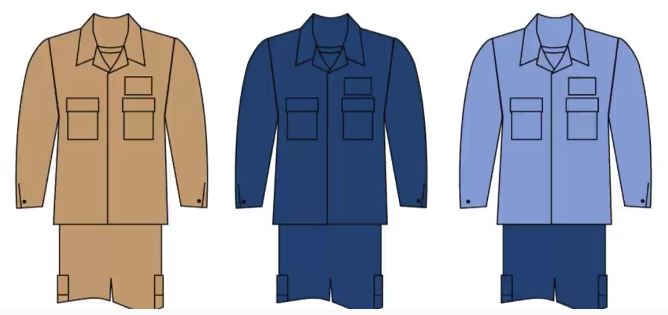

One of the oddities of military culture is the constant tinkering with the uniform. The Army has come under heavy fire for multiple changes to both its camouflage and service uniform since the commencement of the fight in Afghanistan–and appears set to reintroduce a variant of the World War II era “pinks and greens.” Not to be outdone, the Navy, which eliminated the vast majority of the uniforms in its sea bag a few years ago in favor of truly hideous ones like the much-ridiculed “blueberry” camouflage, is at it again.
Military Times (“Khakis at sea? The Navy’s plan for a new operational uniform“):
The Navy is developing a new two-piece, command-issued uniform that could bring khakis back to sea for the first time in years.
Hundreds of sailors will be participating in the initial round of wear tests for the uniform that Navy officials are calling the “Maritime Two-Piece Fire-Retardant Variant.”
The new uniforms could eventually replace the Navy’s coveralls as an operational uniform, both on ship and at shore-based operational commands for some, but not all sailors.
The set of getups will include a khaki variant for chiefs and officers.
For sailors E-6 and below, the Navy will test two variants. One set will feature dark blue shirt and pants, colors similar to the existing coveralls, and the other will feature a light blue shirt and dark blue pants, a contrasting color scheme reminiscent of the traditional dungaree uniform.
Why? Why, uniform envy, naturally.
The design comes after sailors in focus groups voiced overwhelming interest in a two-piece similar to the Coast Guard’s operational dress uniform.
“This was sailor driven and came out of focus groups in Norfolk and San Diego, encompassing roughly 250 sailors from all communities,” said Capt. Mark Runstrom, director of Fleet Supply Operations and Services at U.S. Fleet Forces Command.
Runstrom said 84 percent of those sailors said the Navy should pursue a two-piece fire-retardant uniform.
The focus groups also found that sailors want a uniform they can wear while commuting to and from work, which Navy officials say will likely be permitted with the new two-piece.
A return to an all-khaki, at-sea working uniform is bound to be popular with officers and the chiefs mess, who complained loudly in 2010 when the Navy put all ranks in the Navy Working Uniforms, or NWUs.
The logical mind would naturally inquire, Why not just adopt the Coast Guard uniform, then? The report doesn’t say but one presumes that, well, because it’s a Coast Guard uniform.
There’s a constant tension in these decisions between function, tradition, and distinctiveness. The uniform—especially fatigue and other work uniforms—needs to be reasonably comfortable and serve whatever operational functions required of it. At the same time, there’s a powerful drive to have it invoke the uniform worn by previous generations within that service. And, of course, Marines want to look different from soldiers and sailors want to look different from airmen and Coast Guardsmen. It’s actually shocking that we managed to go decades with everyone wearing essentially the same khaki, olive drab fatigue, and woodland camouflage utility uniforms.








