
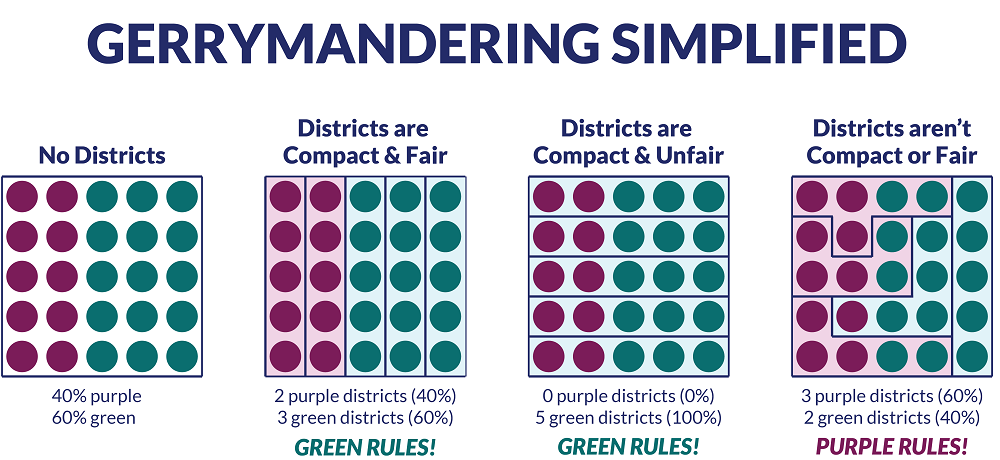

Regular readers may remember that, a little over two years ago, the highly Democratic state legislature in New York rejected the Congressional maps drawn by the independent commission, substituting a wildly gerrymandered one instead. A few months later, though, the state’s highest court struck down that map, putting a more representative set of districts in play for the 2022 election.
In a plot twist, that court has overturned its previous ruling, potentially allowing another highly-skewed map the be used for the 2024 election. If that happens, it’s quite possible that it will decide the next Speaker of the House.
POLITICO (“New York’s high court just blew up the fight for control of the House“):
New York’s high court gave Democrats a big leg up in the dogfight for control of the House of Representatives.
The court on Tuesday vacated the ultra-competitive court-drawn congressional map used in the midterms, ordering the map to be redrawn. That process is ultimately controlled by Democrats, so the ruling opens the door for Empire State Democrats to gerrymander the districts, ousting several Republicans in one swoop.
[…]
We already know what such a Democratic gerrymander could look like — just look at the one they drew last time.
Democratic lawmakers drew a map last year that could have netted them as many as 22 of the state’s 26 seats. Instead, the court-drawn map had several competitive districts and resulted in a delegation of 15 Democrats and 11 Republicans.
Democrats this time could draw lines to edge out some Republican incumbents to try to guarantee some pickups — the all-GOP delegation on Long Island is probably sleeping less soundly tonight, as is Staten Island’s Nicole Malliotakis; the Hudson Valley’s Mike Lawler and Marc Molinaro; and central New York’s Brandon Williams.
Even a few surefire wins could help erase the hole Democrats nationally are facing after Republicans drew a potent gerrymander in North Carolina that will all but guarantee the GOP picks up three or four seats there.
Of course, the lines aren’t everything. Even with the court-drawn districts, President Joe Biden carried 20 of the state’s 26 districts by at least 4.5 points. But Democrats lost five of those 20 Biden districts.
It’s highly unusual to get a second bite at redistricting in a 10-year cycle. So what happened?
Simply, the judges changed.
All seven of the judges on the New York Court of Appeals, the highest court in the state, are Democratic appointees — both for the 2022 decision that led to the court-drawn lines and for Tuesday’s ruling reopening the process. Both decisions were decided 4-3.
But one seat changed. While six judges effectively ruled the same way both times, a seventh judge — in this case, a temporary replacement — was the deciding vote. She sided with the three dissenters in the 2022 case to make a new majority this year.
This is, well, not how it’s supposed to work.
Alas, it’s likely a good thing. As noted in my December 2021 post, “Unilateral Disarmament on Gerrymandering,”
My strong preference would be for bipartisan commissions to draw district lines that are based as much as possible on natural communities rather than naked partisan advantage or incumbent protection. But it makes no sense for one of two political parties to play the game that way while the other is doing everything the law will allow to gain an advantage.
And, as I detailed more fully in a commissioned piece for the New York Daily News in response to the 2022 court decision (“New York’s Gerrymandering Disarmament“) that’s exactly the situation.
The problem is that increasingly, the two parties are playing by different rules. In recent years, there has been a movement toward having electoral maps drawn by nonpartisan commissions, so that voters choose their representatives rather than the representatives choosing their voters. That’s a positive step. Alas, states run by Democrats, including California, New Jersey, Virginia and Washington, are much more likely to have adopted the practice, while Republican-controlled states are doubling down on gerrymandering. This is compounded by the tendency of Democratic-majority states to make voting easier while Republican-led states seek to make it harder, with a disparate impact on poor and minority would-be voters, who disproportionately favor Democrats.
Indeed, while New York Democrats gleefully rigged the game in their favor when given the chance, the opportunity only came because a deadlocked bipartisan commission charged with drawing unrigged maps failed to satisfy its constitutional responsibilities and the Legislature then ran with the ball. As we learned Wednesday, the 2014 amendment to the state’s Constitution that created this commission also prohibits the Legislature from partisan gerrymandering through the back door.
Meanwhile, Republican-controlled states like Texas, North Carolina and Florida are unchecked by these sorts of measures and are doing everything in their power to maximize their advantage. Even though these states are increasingly “purple,” you wouldn’t know it by their GOP-heavy congressional representation.
My strong preference is for all states to make voting easier and elections meaningful by having competitive districts. (Actually, I would rather eliminate districts entirely, but that’s not on the horizon.) It would maximize participation and representation. It would also be fairer to the fastest-growing voter type, the independent.
When only a Republican or only a Democrat can win a contest, the election is effectively decided in the party primary — and thus by the most ideological and motivated voters. That’s not only undemocratic but inevitably leads to bad governance, as politicians increasingly serve only their party base and move further to the extremes.
At the same time, though, it makes no sense for Democrats to hamstring themselves by rules their Republican opponents aren’t playing by. Doing so not only disadvantages them in individual contests but exacerbates an inherently skewed system.
Republicans already have a significant built-in advantage in the Senate, where each state gets two members regardless of population, and a modest one in the House. This carries over into presidential elections, through the mechanism of the Electoral College, giving us Republican winners in 2000 and 2016 in contests where Democrats won millions more votes. Republicans leveraging all the tools at their disposal to gain additional seats while Democrats opt for fairness stacks the deck even further.
This is made all the more urgent in light of the “Stop the Steal” movement and the Capitol riots. The Republican Party has increasingly decided that it can’t win fair elections and must therefore do everything in their power to rig the game. And, sadly, won’t accept losing even then.
That the New York Court of Appeals reversed their own ruling based on nothing more than a change in judges is, well, unorthodox. But, on balance, a better outcome given the circumstances.









