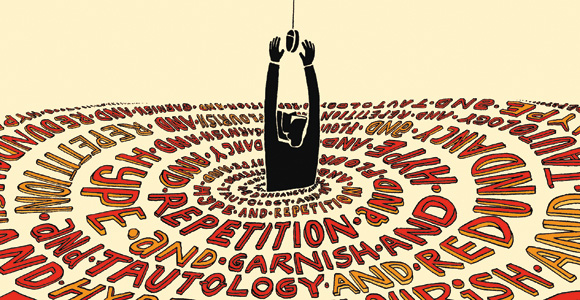
In a devastating takedown, Michael Kinsley argues that one reason print journalism is struggling is that its writing is “encrusted with conventions that don’t add to your understanding of the news” whereas we on the Web “get to the point.” Among these are the inverted pyramid style, use of quotations that say nothing newsworthy, and hype language that adds nothing to the story.
Once upon a time, this unnecessary stuff was considered an advance over dry news reporting: don’t just tell the story; tell the reader what it means. But providing “context,” as it was known, has become an invitation to hype. In this case, it’s the lowest form of hype—it’s horse-race hype—which actually diminishes a story rather than enhancing it. Surely if this event is such a big, big deal—”sweeping” and “defining” its way into our awareness—then its effect on the next election is one of the less important things about it. There’s an old joke about the provincial newspaper that reports a nuclear attack on the nation’s largest city under the headline “Local Man Dies in NY Nuclear Holocaust.” Something similar happens at the national level, where everything is filtered through politics. (“In what was widely seen as a setback for Democrats just a year before the midterm elections, nuclear bombs yesterday obliterated seven states, five of which voted for President Obama in the last election …”)
An amusing tendency Kinsley notes repeatedly is the use of quotations — frequently of people the reader has never heard of — whose only purpose is to make an editorial comment the journalist wanted to make but isn’t allowed to because of “objectivity.” The hint that you’re reading one of those is that more words are used identifying the person making the quote than there are in the quote itself.
My least favorite, though, is the longwinded anecdote at the beginning of all-too-many news stories.
[T]hose you’ll-never-guess-what-this-is-about, faux-mystery narrative leads about Martha Lewis, a 57-year-old retired nurse, who was sitting in her living room one day last month watching Oprah when the FedEx delivery man rang her doorbell with an innocent-looking envelope … and so on. (The popularity of this device is puzzling, since the headline—”Oprah Arrested in FedEx Anthrax Plot”—generally gives the story away.)
Kinsley attributes this to a revolt against the inverted pyramid style, which required the most important information up front. I’ve always presumed it’s because most reporters were English majors and frustrated novelists.