As I have watched Zohran Mamdani’s ascent, I have found two things very appealing. One is that he is smart and thinks well on his feet. I realized, watching a clip the other day, that he reminds me of when I first started paying attention to Pete Butttegieg–just smarter and more articulate than a typical politician and able to speak in a way that doesn’t sound cliched. The second is that he has a clear and positive vision for governing. He actually wants to do things that improve the lives of citizens.
Now, he is not my ideologically perfect fit. I am skeptical, for example, for a number of reasons that rent control is a good idea. But it seems worth noting that it isn’t like the notion of rent control is something he is seeking to implement, but rather is a policy that dates back to the 1940s.
The other major planks, free buses, public childcare, and publicly run groceries, hardly strike me as a communist revolution. The devil is, as with all public policy, in the details, especially funding.
I would have voted for Mamdani had I lived in NYC. At a bare minimum, the other choices were a disgraced, arrogant sex pest whose closing argument was based on fear-mongering about Trump taking over the city, a gimmick candidate, and the corrupt outgoing mayor. As such, what other option did one have apart from abstention?
To dovetail with a previous post on this topic, I have doubts that Mamdani will be able to pull off his goals, and I also think that pundits, both on the left and right (broadly defined), will draw too many conclusions from the win. This is not to say, by the way, that there are no lessons to learn from his campaign, nor that there will not be lessons to learn from his time in office.
I will note this, in terms of a lesson from his campaign: his rhetoric is affecting the current occupant of the White House.
For anyone unaware, “affordability” has been Mamdani’s watchword.
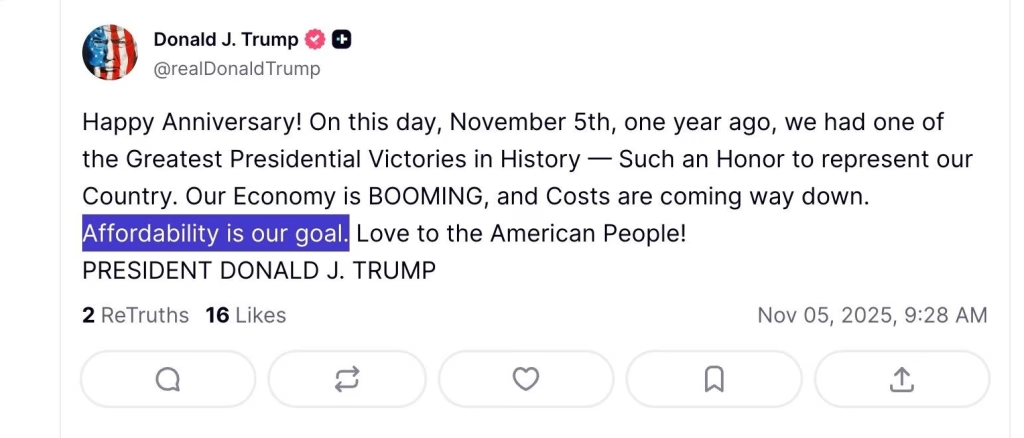
So, look, we wait and see about how all this plays out. The mayoralty of NYC is a hard job, and so we shall see what Mamdani can do with it. I am, I think understandably, skeptical that he will be able to accomplish his stated goals, but he now has the opportunity to try.
A lot of this made me think about what past mayors of NYC have done after their time in office. On paper, being mayor of NYC should be a springboard to state, if not national, office. It is the case in Latin America, for example, (Mexico and Colombia come to mind), where being the mayor of Mexico City or Bogotá is a springboard to more prominent jobs, to include the presidency (recognizing that Mamdani, as an immigrant, cannot aspire to being POTUS).
It is interesting to me that none of the mayors of NYC in my lifetime have gone on to elected office after their time in Gracie Mansion. It is true that Rudy Giuliani ran in the 2008 Republican primary, and Michael Bloomberg ran in the Democratic primary in 2020, as did Bill De Blasio (both briefly in their own ways). None came close to their party’s nomination. De Blasio made a brief run at Congress in 2022 as well.
Here’s the list in reverse chronological order.
- Eric Adams (2022-2025): prediction: Fox News Contributor.
- Bill de Blasio (2014-2021): failed congressional and presidential nomination runs.
- Michael Bloomberg (2002-2013, 3 terms): failed run at presidential nomination.
- Rudy Giuliani (1994-2001, 2 terms): failed run at presidential nomination.
- David Dinkins (1990-1993): did not pursue a further political career.
- Ed Koch (1978-1989, 3 terms): no further political pursuits, but did have two years as the judge on The People’s Court.
- Abraham Beame (1974-1977): no post-mayor political career.
- John Lindsay (1966-1973, 2 terms): failed presidential nomination bid.
It is striking that none of the mayors in this period were able to translate that office into any additional political success, even ones who achieved a sort of celebrity status (Koch, Giuliani, and Bloomberg).
I think this speaks to the specificity of the New York City political context. Being Mayor definitely elevates one’s profile, but history dictates that it is not an especially good springboard for additional office. This also suggests that translating the unique political brew of winning and governing in NYC is not, even in the abstract, likely for statewide or national politics. I think it also speaks to how hard the job is.
None of that says anything about whether or not Mamdani can get free buses in NYC, but it does provide a context for whether his win is a pathway for Democrats nationwide.