I saw the headline “Poll Finds Little Support for Obama” on memeorandum and, of course, clicked out of curiousity. It turns out to have been a poll in Oklahoma, where John McCain has a comfortable 56-24 lead. That’s not exactly surprising. If it was even close in Oklahoma, we’d be looking at an absolute rout.
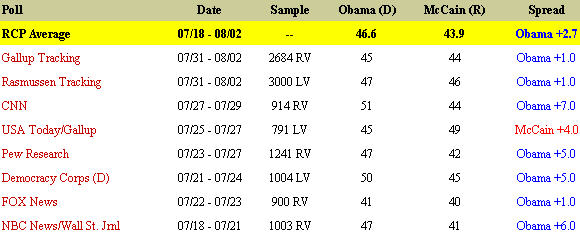
What’s more interesting, though, is that despite a bad couple of weeks for McCain and Obama’s rock star reception on his world tour, the numbers are actually tightening in McCain’s favor. Look at the most recent iterations of the national polls aggregated at RealClearPolitics:

The trend lines provide a better visual:

Note that the sense of dramatic variation is a function of scale: Obama’s numbers have ranged from 43 percent to 49 percent and McCains from 40 percent to 47 percent over the last eight months.
Here are the poll averages in the so-called Battleground States:

They all remain absolute toss-ups; only Michigan even shows signs of leaning to one candidate.
Despite this closeness in the national polls and the Battleground States, Obama is clearly ahead. ElectralVote.com has the Elecotral College going Obama 316 – McCain 198 – Ties 24 with Missouri and Virginia being exactly tied. Nate Silver at FiveThirtyEight has it Obama 303, McCain 235 with the main difference being he gives McCain Florida whereas EV.com gave it to Obama. Both sets of numbers are skewed by the inclusion of numerous states “barely” leaning toward a candidate.
Silver, a Democratic political analyst, has an interesting piece in today’s LAT entitled “Why McCain is Still in It.” He argues that, while his party has a substantial lead in party identification, its coalition is much more difficult to corral.
The breadth of the Democratic Party base was revealed during the primary campaign, when more than 35 million voters split their votes between Hillary Rodham Clinton and Obama across every conceivable racial, religious and socioeconomic line. Coal miners in West Virginia are, by and large, still Democrats, but so increasingly are hedge-fund managers in Virginia.
In congressional elections, this isn’t a problem. The candidate can set his pitch to his or her district. But presidential elections are one-size-fits-all events — what works in Wheeling, W.Va., may not work in Whittier, Calif. Ironically then, the more diverse and broad-based a party is, the more likely its members are to split their tickets.
Then again, it’s not as if the Republican coalition is homogeneous, either. Nor has McCain, a’ la Ronald Reagan, managed to rally all parts of the base. Silver’s more plausible explanation is that McCain is succeeding precisely because he’s not seen as a “regular Republican.”
How has McCain done it? It has mostly to do with his reputation as a moderate. In that same NBC News/Wall Street Journal poll, only 21% of voters said they viewed McCain as “very conservative,” while 34% pegged him as a moderate. As long as he maintains his moderate brand, McCain will seem acceptable to some large number of independent voters and some smaller number of Democrats.
This is predicted by something known as the “median voter theorem,” which essentially holds that as the electorate shifts ideologically — that is, to the right or left — the candidates will tend to shift along with it to narrow their ideological differences with the average voter. Over the last several years, the electorate has shifted leftward — and the two parties have responded accordingly in this year’s presidential race. The GOP will nominate a candidate who is widely perceived as being to the left of the party’s conservative base, whereas the Democratic Party will again pick a standard-bearer more authentically liberal than centrist.
I think that’s right.
As usual, the Republican strategy is partly based on painting the opposition as too liberal and out of touch with American values whereas the Democratic strategy is to paint the opposition is uncaring and out of touch with the plight of the have-nots. The Democrats are winning that argument at the moment. But just barely.