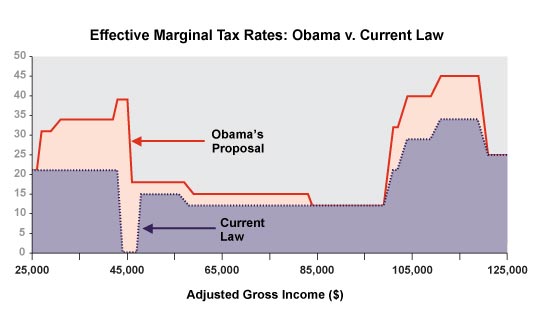
Alex Brill and Alan Viard don’t like Senator Obama’s tax plan, and I can’t say as I blame them. Here is the main point1:

In other words, unless you have income in the $85,000 to $100,000 (approx.) range you’ll have a higher marginal tax rate. A higher marginal tax rate on income will actually hurt work which is contrary to Senator Obama’s desire to “reward work, not just wealth”.
Although Obama is offering a new series of tax breaks, they undermine rather than improve economic incentives. First, whether or not you get those breaks will depend on your income. In Washington, taking away tax breaks as families work harder to make more money is called a “phase-out.” Economists have a different name for it—we call it a tax. Reducing a person’s tax credit as his income goes up also reduces his incentive to earn more income.
And a tax tends to penalize whatever activity is being taxed, not reward it. It is pretty much accepted by most economists that if you tax something you get less of whatever is being taxed. Taxes are a disincentive. Taxing labor income creates an incentive not to earn income from labor. If taxes on labor income go up and taxes on income from wealth do not, then you are going to see people shifting from labor income to income from wealth. Of course this assumes that people can shift from labor income to wealth income. If you can’t make such a shift you simply make do with less income.
Second, Obama would make some credits refundable for families with credits bigger than their tax liability, which would also have the nefarious effect of raising marginal tax rates. For example, consider a worker in the 10 percent bracket with $1,000 of tax liability before credits who claims $1,200 in credits. The tax impact of earning an extra $100 depends on whether the credit is refundable. If it’s not refundable, there’s no tax penalty on earning the extra $100 because the worker’s tax liability stays at zero. But if the credit is refundable, earning the extra money pushes the tax up from negative $200 to negative $190—that’s a 10 percent penalty on earning income.
Actually, it is a 10% penalty on earning that extra income, but still the point is valid: some people will be at the margin on earning that extra income and will decide, under Senator Obama’s tax plan, to simply forgo that extra income, and work, and opt for additional leisure time instead.
While Obama has publicly embraced a tax rate of 40 percent for couples earning over $350,000, his tax policies would result in a staggering 45 percent effective marginal rate in the $110,000 to $120,000 income range for this family. That is 11 percentage points higher than under current law.
Wow, that is quite an increase. Why? The problem is caused by Senator Obama’s reform of the Hope Scholarship Tax Credit for college tuition. Senator Obama wants to increase the tax credit from $1,000 to $4,000 but keep the phase out for the same income range. The larger phase out would increase the penalty on work from 9% under current law to 20%.
Because the phase-outs are so hard to decipher, many Americans may ignore them when making their work and saving decisions. Of course, those people are still burdened by the long and frustrating IRS worksheets required to compute the value of their tax credits; and creating a more confusing tax code certainly does not make for good government.
So, to recapitulate, Senator Obama’s plan would increase the marginal tax rates on those earning $25,000 to $85,000, exempt those from $85,001 to about $100,000 and then raise marginal rates on those making over $100,000. The largest increases would be on those in the $25,000 to $45,000 (not exactly those that most would call rich). Further, it will add to the complexity of the tax code for most Americans, and this means a social loss as well as more resources are devoted to determining people’s taxes instead of being productive. Definitely change we can believe in….or not. Sounds like the same old nonsense we always hear. “I have this hokey named plan that is rather complicated, wont achieve what I say it will, will discourage people from working, and make the tax code even more complicated….vote for me.” I think not.
_____
1These are the marginal rates in 2009 for a two-earner couple with two children—a college freshman and a 12-year-old receiving after-school care—under some specific assumptions. For comparison, the dotted line on the chart illustrates the effective tax rates under current law. The rates shown in the chart are not spelled out in the tax code; they are the result of giving and taking away tax breaks as the household’s income changes. –Brill and Viard