Senator Hillary Clinton, a member of the Senate Armed Services Committee, has been asking the Pentagon for months to brief her on the status of planning for a withdrawal of forces from Iraq. Her requests had been ignored until now but they were met by a stern rebuke yesterday from Undersecretary of Defense for Policy Eric Edelman.
AP reports they have a copy of the letter:
“Premature and public discussion of the withdrawal of U.S. forces from Iraq reinforces enemy propaganda that the United States will abandon its allies in Iraq, much as we are perceived to have done in Vietnam, Lebanon and Somalia,” Edelman wrote. He added that “such talk understandably unnerves the very same Iraqi allies we are asking to assume enormous personal risks.”
[…]
Edelman’s letter does offer a passing indication the Pentagon might, in fact, be planning how to withdraw, saying: “We are always evaluating and planning for possible contingencies. As you know, it is long-standing departmental policy that operational plans, including contingency plans, are not released outside of the department.”
While neither Clinton nor any other Member of Congress is in the chain of command, the Defense Department, like all other bureaucracies, is expected to answer reasonable inquires in order that Congress may conduct oversight and complete the budgetary process. Treating a request for information contemptuously is not only politically stupid — Clinton will be voting on budget requests and her colleagues are likely to be outraged about this response as well — but beyond the boundaries of a mere cabinet deputy. As Steve Benen puts it, Edelman’s response was “a) wrong; b) rude; and c) breaking protocol.”
As might be expected for a presidential candidate, Clinton is grandstanding for maximum political mileage.
Clinton spokesman Philippe Reines called Edelman’s answer “at once outrageous and dangerous,” and said the senator would respond to his boss, Defense Secretary Robert Gates.
[…]
Clinton aides said the letter ignored important military matters and focuses instead on political payback. Redeploying out of Iraq with the same combination of arrogance and incompetence with which the Bush administration deployed our young men and women into Iraq is completely unacceptable, and our troops deserve far better,” said Reines, who said military leaders should offer a withdrawal plan rather than “a political plan to attack those who question them.”
It gets better:
“I deeply resent the administration’s continuing effort to impugn the patriotism of those of us who are asking hard questions,” Clinton told ABC News.
Clinton said she heard from a former Pentagon official “that there was intense pressure from the vice president’s office and other places that the kind of detailed planning that’s necessary to take our troops out safely was just not a priority.” The letter from Edelman, she said, gave the impression “that it’s none of my business as to whether or not the Pentagon is doing what needs to be done to secure the safety of our troops.”
Now, of course, nobody here questioned Clinton’s patriotism. Rather, Edelman was pointing out the obvious. Of course the clamoring in Congress for “reinforces enemy propaganda that the United States will abandon its allies in Iraq.” It has already done so. The problem here isn’t with the statement but with the source. That’s a fight that should be carried on by equals.
Clinton’s rhetoric is having its desired effect. MyDD’s Todd Beeton accused Edelman of saying “dissent is anti-American” and “not so subtly questioning Sen. Clinton’s patriotism and, ultimately, her fitness to be commander in chief.” The problem with this line of reasoning is that it was a private letter sent to Clinton, not a press release. Presumably, it was Clinton’s office that released the letter to the press and made it an issue.
So, to recap: While it was doubtless politically motivated, Clinton’s request of the Pentagon was perfectly reasonable given that withdrawal is likely to happen and that the administration has a history of being ill prepared for contingencies. Edelman’s response was idiotic on a whole number of levels and people should be outraged at Pentagon officials thumbing their nose at Congress. The manufactured controversy over the administration’s “questioning of patriotism,” “stifling dissent,” and “using the Pentagon to influence the outcome of elections,” however, is silly.
UPDATE: Josh Marshall has an actual copy of the letter here. Reading Edelman’s response in context, it would seem this controversy is wildly overblown.
The letter is actually quite respectful. And Edelman makes it clear he’s responding on SECDEF’s behalf, not on his own accord.
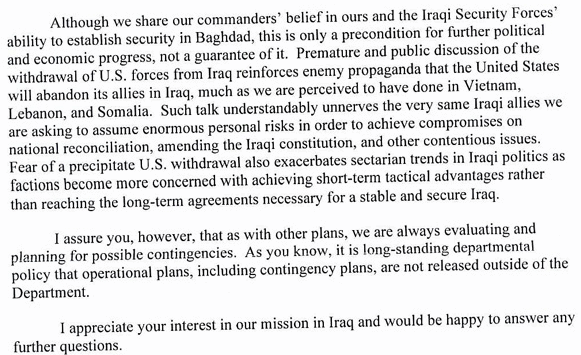
Marshall’s copy is a photograph, not a PDF, so I can’t cut-and-paste. Here’s a screencap of the controversial portion in context:

This is not a rebuke of Clinton’s question. After spending several paragraphs outlining the plan currently in place, he explains why the administration does not want to publicly discuss plans for withdrawal. The explanation, while succinct, strikes me as reasonable: The Iraqis we are counting on to side with us to defeat the militias and terrorist elements quite rightly fear that we will soon withdraw and leave them vulnerable. If Pentagon officials are going before Congress outlining plans for withdrawal, that perception will be, quite understandably, reinforced. This would undercut the plan that’s currently underway.
Despite that, Edelman assures Clinton that, of course, the Pentagon is working on all contingencies. Since the letter mentions several times that there is no guarantee of success, that presumably includes various plans for withdrawal based on given scenarios.
The only real problem here is the statement that “it is long-standing departmental policy that operational plans, including contingency plans, are not released outside the Department.” I’m certainly unaware of such a policy, let alone that it is “long-standing.” Certainly, though, members of key oversight committees are entitled to demand briefings on at least the broad outlines of these plans under the condition that they be handled as classified information.
Given that AP’s report was supposedly based on “A copy of Edelman’s response,” it’s outrageous that they released quotes out of context to give the appearance of a totally different response than was actually given. Presumably, since Josh Marshall has a copy, the other major news outlets reporting on this story also had a copy of the letter.
UPDATE: Amusingly, Penelope Trunk explains why, “It Doesn’t Matter that Journalists Misquote Everyone.”
Here’s my advice: If you do an interview with a journalist, don’t expect the journalist to be there to tell your story. The journalist gets paid to tell her own stories which you might or might not be a part of. And journalists, don’t be so arrogant to think you are not “one of those” who misquotes everyone. Because that is to say that your story is the right story. But it’s not. We each have a story. And whether or not someone actually said what you said they said, they will probably still feel misquoted.
So, while the quotes from Edelman’s letter totally misrepresented his exchange with Clinton, they were truthful in the context of the story Clinton and the journalists in question wanted to tell.