
New York Times, “Francis, the First Latin American Pope, Dies at 88“
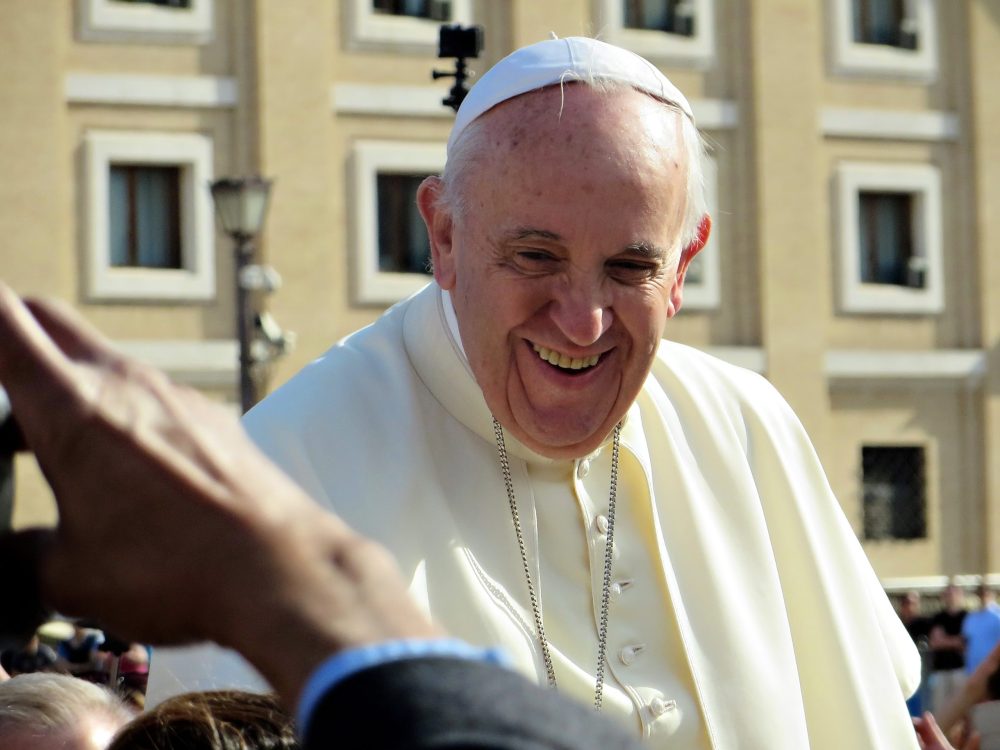
Pope Francis, who rose from modest means in Argentina to become the first Jesuit and Latin American pontiff, who clashed bitterly with traditionalists in his push for a more inclusive Roman Catholic Church, and who spoke out tirelessly for migrants, the marginalized and the health of the planet, died on Monday at the Vatican’s Casa Santa Marta. He was 88.
The pope’s death was announced by the Vatican in a statement on X, a day after Francis appeared in his wheelchair to bless the faithful in St. Peter’s Square on Easter Sunday.
Throughout his 12-year papacy, Francis was a change agent, having inherited a Vatican in disarray in 2013 after the stunning resignation of his predecessor, Benedict XVI, a standard-bearer of Roman Catholic conservatism.
Francis steadily steered the church in another direction, restocking its leadership with a diverse array of bishops who shared his pastoral, welcoming approach as he sought to open up the church. Many rank-and-file Catholics approved, believing that the church had become inward-looking and distant from ordinary people.
Francis reached out to migrants, the poor and the destitute, to victims of sexual abuse by Catholic clergy members, and to alienated gay Catholics. He traveled to often-forgotten and far-flung countries and sought to improve relations with an antagonistic Chinese government, Muslim clerics and leaders from across the fragmented Christian world.
After some early stumbles, he took strong steps to address a clerical sex abuse crisis that had become an existential threat to the church. He adopted new rules to hold top religious leaders, including bishops, accountable if they committed sexual abuse or covered it up, though he did not impose the level of transparency or civil reporting obligations that many advocates demanded.
In his final years, slowed by a bad knee, intestinal surgery and respiratory ailments that sapped his breath and voice, Francis used a cane and then a wheelchair, seemingly a diminished figure. But that was a misleading impression. He continued to travel widely, focusing on exploited and war-torn parts of Africa, where he excoriated modern-day colonizers and sought peace in South Sudan.
His insistence on shaking up the status quo earned him no shortage of enemies. He demoted conservatives in Vatican offices, restricted the use of the old Latin Mass dear to traditionalists, opened influential meetings of bishops to laypeople, including women, allowed priests to bless same-sex couples and made clear that transgender people could be godparents and that their children could be baptized.
He also refused to endorse calls to deny communion to Catholic politicians supportive of abortion rights, including when he was president, Joseph R. Biden Jr., who said Francis had called him a “good Catholic.”
His avuncular charm and easy smile belied his reputation inside the Vatican as a steely — his opponents said ruthless — administrator as he brought greater transparency to church finances and overhauled the Vatican’s bureaucracy.
The traditional Italian power bases of the Vatican grew frustrated with his purposefully unpredictable governing style, which relied on a small group of confidants, many of them Jesuits like himself, and his own gut.
Conservative Catholics accused him of diluting church teachings and never stopped rallying against him. Simmering dissent periodically exploded into view in almost medieval fashion, with talk of schisms and heresy.
But Francis also disappointed many liberals, who hoped that he might introduce progressive policies. His openness to frank discussion gave oxygen to debates about long-taboo subjects, including priestly celibacy, communion for divorced and remarried people, and greater roles for women in the church. While he opened doors to talking about such issues, he tended to balk at making major decisions.
“We are often chained like Peter in the prison of habit,” he said of the church in 2022 in a speech in St. Peter’s Basilica. “Scared by change and tied to the chain of our customs.”
Elisabetta Povoledo (“How Will a New Pope Be Chosen After Francis’ Death?“) answers the titular question and many others.
Immediately after a pope’s death is confirmed by the head of the Vatican’s health department and the body is dressed in a white cassock and brought to the pope’s private chapel, the cardinal chamberlain of the Holy Roman Church becomes the Vatican’s de facto administrator for day-to-day affairs.
That position, known by the Italian title camerlengo, is held now by Cardinal Kevin Joseph Farrell, a 77-year-old American of Irish origin, who was appointed by Francis in 2019.
[…]
The College of Cardinals decides on the day and hour that the pope’s body will be brought to St. Peter’s Basilica, in a procession led by the camerlengo. The Vatican has said that could take place as early as Wednesday morning.
[…]
The dean of the College of Cardinals, Cardinal Giovanni Battista Re, 87, summons the cardinals to Rome for the conclave to elect Francis’ successor.
Within 15 to 20 days of a pope’s death, the cardinals meet in the Sistine Chapel to vote by secret ballot. Only cardinals under age 80 are eligible to vote. Out of the 252 current cardinals, most appointed by Francis, 138 are cardinal electors, as those allowed to vote are known.
All cardinal electors must swear an oath of secrecy. A two-thirds majority is needed to elect a new pope, and politicking is part of the process.
Cardinals are not allowed to leave the conclave except in rare cases. The word conclave — from the Latin “with key” — refers to the isolation imposed on them, which is meant keep the electoral process from dragging on.
During the conclave, the cardinals live in Casa Santa Marta, which was built on John Paul II’s orders to replace the improvised rooming arrangements in the papal palace that had previously housed them.
To follow how the conclave is going, the curious can look to the skies above the Vatican.
After every vote, smoke is released through a chimney that can be seen from St. Peter’s Square, where crowds typically form to watch and wait. If a vote ends without a two-thirds majority, the smoke is colored black.
When a decision is reached, the smoke is white.
Inside the Vatican, the dean of the college asks the chosen successor whether he accepts the job. After getting the presumed yes, the dean asks him the name he wishes to be called as pope.
In the sacristy of the chapel, the new pontiff is dressed in a white cassock and red cape. After greeting the cardinals, he proceeds to a balcony of St. Peter’s Basilica, where a senior cardinal proclaims, in Latin, “Habemus papam.” (We have a pope.)
Thus he introduces the world to the church’s new leader.
I don’t have strong views on Francis’ papacy. He was a breath of fresh air after Benedict, who had big shoes to fill after John Paul II’s long reign and seemed in many ways a step backward. Francis offered promise of being a change agent but, as such, disappointed pretty much everyone. The NYT obit gets it about right in my estimation: he was enough departure from the past to make traditionalists irate but sufficiently hidebound by tradition to frustrate the progressives. Ultimately, this shouldn’t have been a surprise. As the old joke has it, the Pope is indeed a Catholic.