
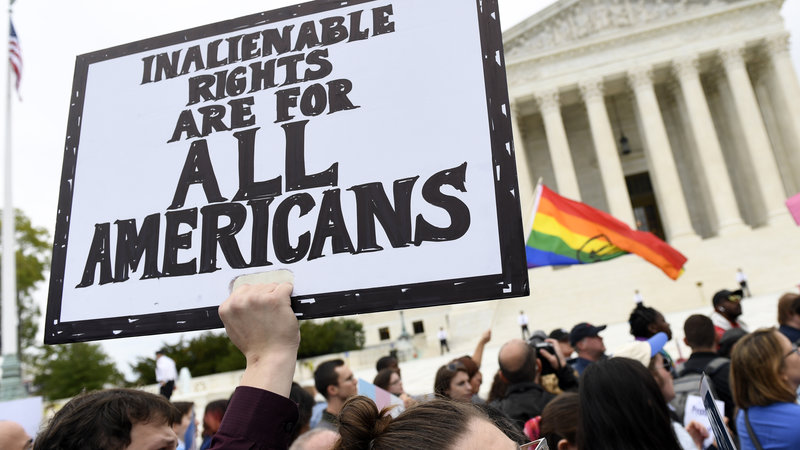

Via memeorandum, I see that an activist site called the 19th reports, “A lesbian mom raised her son for two years. An Oklahoma judge erased that in 15 minutes.”
For the first two years of her son’s life, Kris Williams read him the book “Love You Forever” before bedtime most nights. She took him to the park every Saturday.
In the middle of the pandemic, Williams cut out the cardboard babies on the front of diaper boxes and set them around the house — imaginary friends for W. when he couldn’t safely socialize. (The 19th has used only his first initial to protect his privacy.)[*}
Two years after their son’s birth, Williams and her wife, Rebekah Wilson, had started to split.
The split was nasty, Williams said, but she wasn’t prepped for the news she would receive at the couple’s divorce hearing in Oklahoma City last January.
Williams and Wilson are legally married and decided to have W. together, according to Williams, with Wilson carrying the baby. But within 15 minutes of the hearing starting, Oklahoma County District Court Judge Lynne McGuire declared that because Williams had not adopted her son, she was not his legal parent. Williams was ordered struck from W.’s birth certificate. In her place would go the couple’s sperm donor, who was now petitioning for custody.
“My body instantly started shaking,” Williams said. “I mean pure terror, as a queer person, to be erased.”
This is indeed heartwrenching and outrageous—although it turns out there’s more to the story, which we’ll get to. Rather obviously, Williams should have adopted the child, of whom she is not the biological mother. But it would have seemed reasonable for her to have believed that, since her name was on the birth certificate, she was legally recognized as a co-parent.
Williams has filed a motion to reconsider her case that is set to be heard on June 1. If the case makes its way to the appellate court, the ACLU of Oklahoma plans to step in, said ACLU attorney Hanna Roberts. Wilson and her lawyer declined multiple requests for an interview.
Williams’ case represents a nightmare scenario for many LGBTQ+ parents, who still lack the same rights granted to their heterosexual peers through marriage.
“The concern is if Kris loses, that’s going to set some pretty bad precedent in the state of Oklahoma, and possibly beyond,” Roberts said. “I think that this is just the first time that there has been such an adverse ruling that is so contrary to equal protection. It’s gotten the attention because same sex-couples get divorced all the time.”
So, while it’s true that heterosexual couples routinely divorce, the obvious comparison group is those who gave birth through surrogacy wherein only one of the two is biologically related to the child. That’s a relatively rare situation.
According to Williams, the couple found Harlan Vaughn on a paternity website together, and the three agreed that he would be involved at a distance. W. was born August 8, 2019. They named him after Williams’ uncle, she said.
When the couple separated, Williams said that Vaughn moved to Oklahoma City, where he and Wilson — W. in tow — moved in together. Williams said the last time she saw W. was in November after she and Wilson failed to come to an agreement about how to split up the holidays. Vaughn did not respond to requests for comment.
Given that I was heretofore unaware of the 19th’s existence and that it proclaims itself as being on a mission to “empower those we serve — particularly women, women of color and the LGBTQ+ community,” I searched for reports on this on more mainstream sites without success. The only source I’d heard of reporting on this was Newsweek, and it’s basically a re-reporting of the 19th’s piece. But an undated story from a local LGBTQ-friendly magazine from when the couple were still happy indicates that Vaughn was more than “involved at a distance.” He was an active part of W’s life from the beginning and his mother was involved as well.
Here’s the kicker:
The divorce has been ugly. Wilson was granted an emergency victim protective order on December 2. In the order, she alleges that Williams physically attacked her. Williams denies this. In January, Williams’ name was taken off of the birth certificate. The judge did not cite allegations of abuse in the decision.
Disputed claims of abuse are, sadly, not uncommon in divorce and custody battles. That it’s not mentioned in the decision (to which I don’t have access) is interesting.
Though parental laws vary from state-to-state, legal experts say Williams’ battle to maintain custody of her son could be a test case for Oklahoma and the nation seven years after the Supreme Court granted marriage equality nationwide.
After 2015, when marriage equality was granted federally, queer legal groups battled a series of cases to enshrine marriage rights for LGBTQ+ couples. That included parental rights through marriage. In 2015, two non-gestational parents — those who did not give birth — in Arkansas were not listed on their children’s birth certificates. Their case, Pavan v. Smith, went all the way to the Supreme Court, where the court ruled that states could not treat queer couples differently than heterosexual ones. If straight couples who conceived together in a marriage were presumed to be parents of that child, queer parents must be afforded that same right, the ruling said.
Karen Loewy, senior counsel at Lambda Legal, notes that decision had a profound impact on marriage and parental rights.
“The courts pretty uniformly have found the presumption to apply, have limited the ability of birth moms to try and rebut the presumption of parentage for their same-sex spouse who they’re in the midst of divorcing, and have recognized that children born to married same-sex couples have two parents in both of the spouses,” Loewy said.
Pavan v Smith was issued in June 2017 per curiam. The circumstances were similar but not identical to this case: lesbian couples who had given birth through an anonymous sperm donor. Just-confirmed Justice Gorsuch dissented and was joined by Justices Alito and Thomas. Their rationale was technical and didn’t turn on the issue of same-sex marriage at all but whether a state may privilege biological parents on a birth certificate and whether “the strong medicine of summary judgment” was warranted given the unsettled nature of this question. Since then, Justice Kennedy retired and Justice Ginsburg died, being replaced by Justices Kavanaugh and Barrett, respectively. It is entirely conceivable, therefore, that the precedent is on shaky ground.
Loewy said it is unclear in Oklahoma if being listed as a parent on a birth certificate grants parentage. Laws state-to-state regarding birth certificates are idiosyncratic, and while courts have generally granted parental rights to spouses regardless of biological connections, there have been exceptions.
Wilson has posted repeatedly about the case on Facebook. In text and video updates, Wilson alleges that Williams abused her during their marriage, which Williams disputes. She acknowledges that she “spoke ugly” towards the end of their relationship.
“We all have our moments, but to say I’m abusive…” Williams trailed off.
In her social media posts, Wilson says she is not motivated by a desire to undermine LGBTQ+ parental rights. Instead, she says her goal is to protect W. from perceived harm, using the tools available to her. (Wilson does not allege online or in the protective order paperwork that Williams harmed W. directly.)
“I will use any legal strategy I need to use, unapologetically,” she wrote on March 9.
I have no insight as to the degree the relationship grew abusive but, again, it doesn’t appear to have factored into the judge’s decision. Even if it were, the courts don’t typically (ever?) strip the presumption of parentage as part of divorce proceedings, even in cases where a parent is ruled unfit to have visitation rights. But, again, I just don’t know what the case law is with regard to cases where one parent is the biological and the other is admittedly not.
Nancy Polikoff is professor emerita at American University College of Law and an expert in LGBTQ+ family law. She says queer legal experts, fearing cases like Williams’, have warned clients to get confirmatory adoptions while case law in states catches up to federal marriage rights.
“Nobody wants to do it because it costs money and because it’s offensive to have to adopt your own child, but it is the guarantee that that parent-child relationship can be recognized anywhere, even if you move to the most homophobic possible state,” Polikoff said.
But the problem is that, whatever the emotional bond is, the biological parent is naturally going to be presumed to have greater rights to custody at separation. Adoption changes that presumption.
Regardless of whether the couple is same- or opposite-sex, it would be nice to live in a world where the couple wasn’t vindictive toward one another, let alone using the custody of the children as a weapon, in divorce proceedings. Or where lone judges and their personal quirks didn’t factor so heavily into such life-altering decisions. Alas, that’s not the world we live in.
____________________
*To avoid rerailing the post, I’ve reserved my observation that using the child’s first initial while providing the names of all four adults involved in the case does zero to protect his privacy for this footnote. This is even more true here, in that both women in the relationship have been outspoken LGBTQ activists and are thus easily findable with a simply Google search.









