
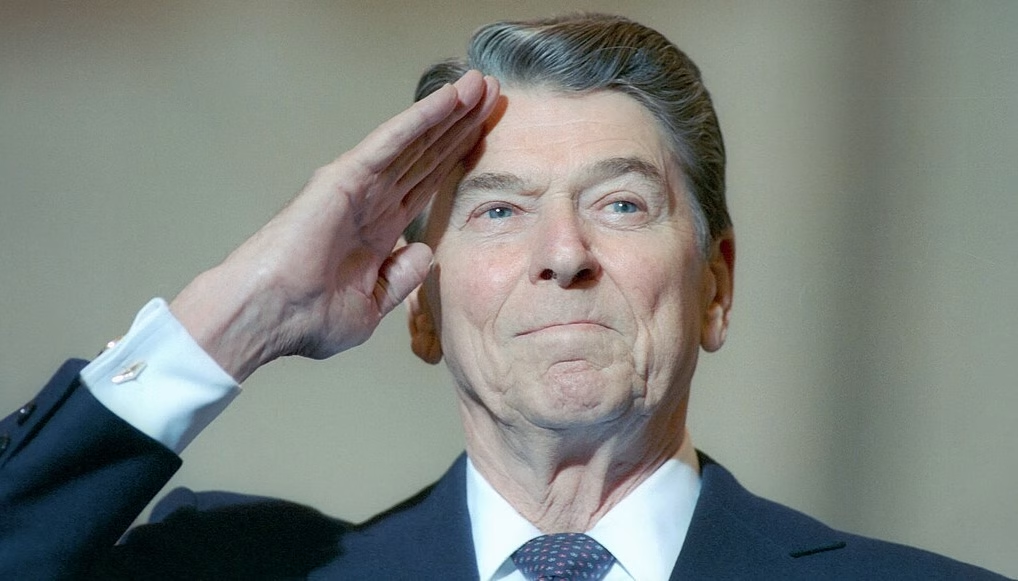
WaPo (“What we know about the plane and military helicopter crash in D.C.“):
An American Airlines plane and an Army Black Hawk helicopter collided in midair near Reagan National Airport on Wednesday night. Both aircraft crashed into the Potomac River in Washington. Police have had pulled 28 bodies from the water as of Thursday morning, according to officials, as search-and-rescue efforts turned to recovery. Reagan National Airport has been shuttered as emergency services work at the crash site but is expected to reopen late Thursday morning.
American Airlines said 60 passengers and four crew members were aboard American Eagle Flight 5342 from Wichita. The flight — a Bombardier CRJ700 regional jet operated by American Airlines subsidiary PSA Airlines — was set to land in Washington at 8:57 p.m., according to aircraft tracker FlightAware.
The plane and an Army UH-60 Black Hawk helicopter that was on a training flight collided at 8:47 p.m., according to publicly available flight-tracking data.
[…]
About 20 members of the U.S. Figure Skating community were aboard the American Airlines jet, according to a person professionally involved in the sport who spoke on the condition of anonymity to discuss a sensitive matter. Athletes, coaches and family members were returning home from the National Development Camp held in conjunction with the U.S. Figure Skating Championships in Wichita.
[…]
Three U.S. soldiers were on the helicopter at the time of the collision, two defense officials said. No senior U.S. leaders were aboard the Black Hawk, they added, speaking on the condition of anonymity because of the sensitivity of the matter.
[…]
The number of casualties is not yet known, but police have pulled 28 bodies from the water, Donnelly said Thursday morning: 27 from the plane and one from the helicopter. Officials had switched from search-and-rescue to recovery efforts as of Thursday morning, Donnelly said, and do not believe anyone survived the crash.
WaPo (“Champion figure skaters confirmed as passengers aboard crashed flight“):
A cohort of competitive figure skaters and their companions, including retired champions, athletic coaches and family members, was aboard the American Airlines flight that crashed into the Potomac River, according to the figure skating community and Russian officials.
In a statement shared with The Washington Post, U.S. Figure Skating, the sport’s national governing body, said “several” members of its community were on the Washington-bound flight from Wichita. A U.S. Figure Skating spokesperson declined to specify a number.
D.C. Fire Chief John Donnelly Sr. said at a news briefing Thursday morning, “We don’t believe there are any survivors from this accident.” Neither the airline nor aviation authorities had published an official list identifying the flight’s 60 passengers and four crew members by name as of early Thursday.
About 20 of the passengers were competitive figure skaters or coaches, numbering around one-third of those on board, according to a person professionally involved in the sport who spoke on the condition of anonymity to discuss a sensitive matter. The person confirmed that the list of figure skaters aboard included minors.
Two renowned Russian former figure skaters, Evgenia Shishkova and Vadim Naumov, were among the passengers, the Kremlin said.
At a news briefing, Kremlin spokesman Dmitry Peskov did not name the two former champions, but he answered in the affirmative when asked whether they were aboard the flight.
“There were other of our fellow citizens there as well,” Peskov added without identifying anyone by name.
Jon Maravilla, a Team USA pairs skater, told Russian state news agency RIA Novosti that at least 14 skaters were on the plane, in addition to coaches and family members. The Post could not independently verify the figure.
Obviously, a huge tragedy. There will certainly be a lot of questions about safety procedures at Reagan, including why an Army helicopter was anywhere near the the landing path of an airliner. Apparently, though, this is standard operating procedure.
WaPo (“D.C. crash took place in congested airspace shared by jets, helicopters“):
The airspace along the Potomac River where an Army helicopter and an airliner crashed Wednesday night poses some of the most complex challenges in the country for pilots, requiring them to rely on layers of procedures and electronic safeguards to avoid a catastrophe.
Military and Coast Guard helicopters frequently fly low over the river, sharing the skies with planes on the heavily used takeoff and landing routes for Washington’s Reagan National Airport. Congestion in the skies and on runways and taxiways around the airport has raised safety concerns for years. National was built to handle 15 million passengers annually; it now handles 25 million.
Dennis Tajer, an American Airlines captain, said that means pilots have to be at their best when flying into the airport.
“It’s a beehive of activity,” said Tajer, a spokesman for the Allied Pilots Association, American’s pilot union. “It’s extremely compact, and it’s a high volume of traffic.”
[…]
“We know the system has been under duress,” said Tajer, who does not represent pilots at American subsidiary PSA Airlines, which was involved in the crash.
There are designated routes for helicopters flying around the Washington region that tend to follow the area’s rivers. It appeared that the helicopter that collided with the airliner Wednesday was in or near one of those routes along the eastern bank of the Potomac, according to Scott Dunham, a retired National Transportation Safety Board investigator. Air traffic controllers also help manage traffic and were in contact with the helicopter, according to audio recordings archived by LiveATC.net.
“It’s a corridor where helicopters are allowed to fly at a low level,” said Jeff Guzzetti, a former NTSB and Federal Aviation Administration investigator. How the routes and altitudes of both aircraft intersected in the moments before the collision will be closely scrutinized.
As another layer of protection against midair collisions, airliners are equipped with the Traffic Alert and Collision Avoidance System, or TCAS, which issues automated verbal alerts to pilots to avoid an imminent crash. Experts said it will be up to investigators to determine whether the pilots received any warnings from the system, whether the military aircraft was detected by the system or whether it was providing alerts at such a low altitude with many other aircraft around.
As planes approach the ground, the system gradually limits the number of alerts it provides to avoid distracting pilots, according to retired United Airlines pilot Ross Aimer.
The crash occurred in one of the most sensitive air corridors in the country, many of whose operations are classified because of security considerations given the proximity to the White House, Capitol, Pentagon and numerous other civilian and military facilities. The region is home to three major airports, 11 regional airports and 55 heliports, not including those operated by the military.
According to a 2021 report to Congress, 50 entities operated roughly 88,000 helicopter flights between 2017 and 2019, based on FAA data. Most were tied to the military, but others included flights by medical operations, state and local law enforcement, and federal agencies.
Lawmakers proposed in 2023 to add more flights at National to serve new long-distance routes. Opponents of the idea raised questions about safety.
Last year, as part of legislation to fund the FAA, Congress added five round-trip flights. The decision came over the objections of members of the D.C.-area congressional delegation, who have long argued that the airport is at capacity.
U.S. airlines have had a strong safety record in recent years, with the last mass-fatality crash occurring in 2009. Federal aviation officials have scrambled to respond to a spate of near collisions at airports around the country that began in 2023. Industry leaders said they were a warning sign that there was risk of a crash as air traffic bounced back from pandemic-era lows.
The FAA has investigated at least three close calls at National in recent years. Two occurred in quick succession last year, heightening concerns. In one, air traffic controllers instructed a Southwest jet to cross a runway while a JetBlue plane was starting its takeoff roll down the same runway. In a second incident, an American Airlines jet preparing for takeoff nearly collided with a King Air plane that was landing on a shorter runway nearby. The FAA was investigating both incidents.
Michael McCormick, an associate professor at Embry-Riddle Aeronautical University who specializes in air traffic control, said complacency about the airport’s complicated traffic patterns and lower nighttime staffing levels for air traffic controllers could be a factor.
“This is an avoidable and unfortunate tragedy,” McCormick said.
I suspect there will be some changes after the investigation.









