
Two recent stories at the Atlantic, “The DOGE-ing of the Humanities Is Being Reversed” and “Trump’s Name Is Disappearing From More Than Just the Kennedy Center” illustrate the imbalance in our system of checks and balances.
A federal court [in May] ruled that the grant cancellations were unconstitutional, potentially reversing, for now, one of the many moves made by the Trump administration to influence how experts uncover—and then tell—the country’s story. Despite Trump officials’ efforts to impose their values and version of American history on knowledge-making institutions, doing so may not be as simple as they thought, particularly given their slapdash methods that have now been called out by a federal judge.
U.S. District Court Judge Colleen McMahon ruled in favor of plaintiffs, Kadetsky among them, finding that DOGE personnel didn’t have authority to terminate NEH grants and that the cuts violated the First and Fifth Amendments. The NEH, responsible for funding research, education programming, and restoration work, “was not created as a vehicle for government expression,” McMahon wrote in her ruling, but rather to “support the intellectual and cultural work of private citizens, scholars, teachers, writers, and institutions.”
and
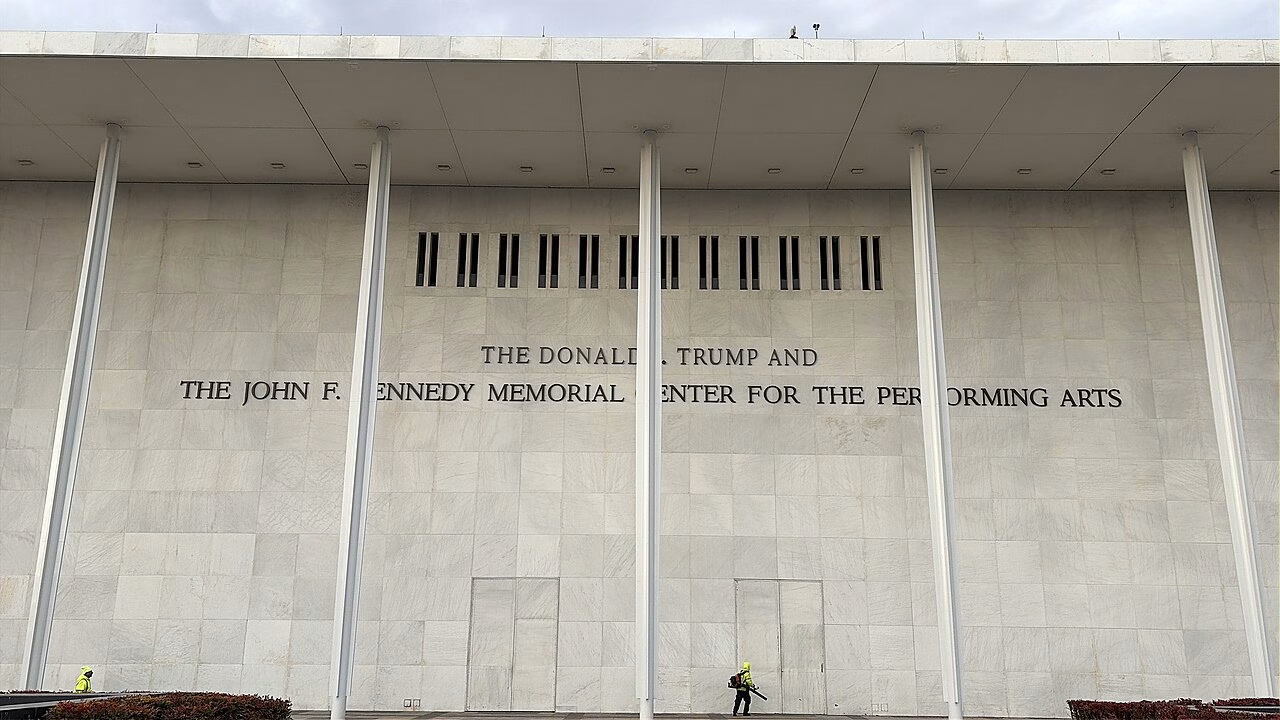
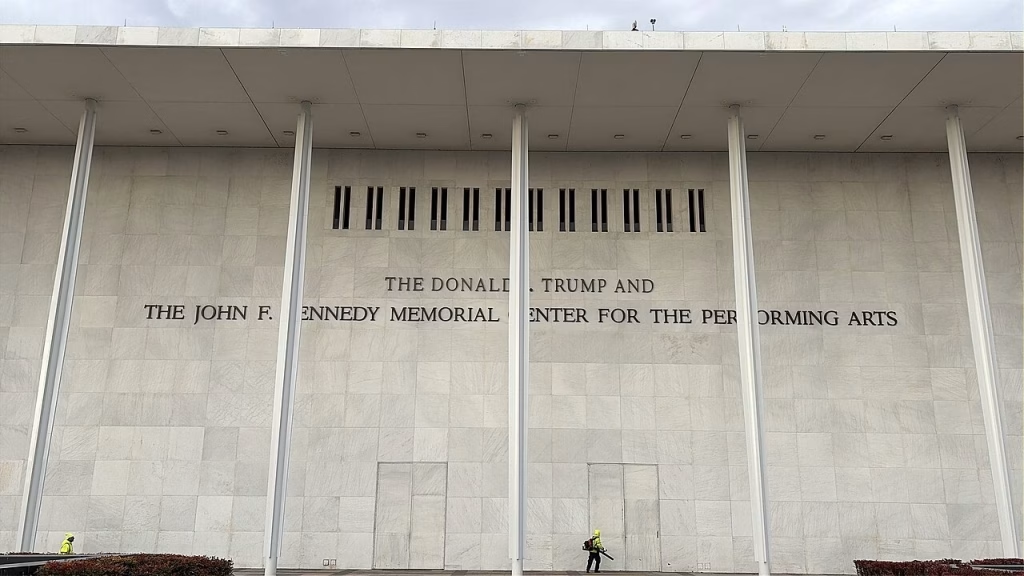
When a board packed with Donald Trump’s allies voted in December to add the president’s name to the John F. Kennedy Center for the Performing Arts, the transformation happened almost immediately. By the following morning, crews had worked quickly to fasten 18 letters to the institution’s marble facade.
Now that work is being quietly dismantled.In a memo obtained by The Atlantic, the Kennedy Center’s lawyers today directed employees to remove references to the center being named for anyone other than President John F. Kennedy. The note seems to suggest that Trump will accept a judge’s recent order to remove his name from the center.
“This includes email signatures, email communications, letterhead, website, brochures, promotional materials, press releases, signs, references in contracts, MOUs, and other agreements, and every other reference to the ‘Trump Kennedy Center,’ the Donald J. Trump and the John F. Kennedy Memorial Center for the Performing Arts, or similar name,” read the email, which I obtained.
Less than a week ago, a federal judge ordered the institution to remove all references suggesting the center had been renamed for Trump within 14 days, restoring its formal title as The John F. Kennedy Center for the Performing Arts.
“The Court ruled that the Board acted beyond its authority in adding President Trump’s name to the Center and gave the Center 14 days from May 29 to remove all references to the Center being named for anyone other than John F. Kennedy,” lawyers informed staff.
The memo offers the clearest sign yet that the institution intends to comply with the ruling, despite the board’s aggressive efforts in recent months to rebrand the center under Trump’s leadership.
While there have been some high-profile wins, many of the attention-grabbing actions taken in the Trump 47 administration have been overturned. It’s just that an aggressive Executive can move much more quickly than the relatively slow-moving Judiciary. Administrations can, if they so choose, issue orders hastily. With rare exception, court cases take time. Plaintiffs have to gather evidence, draft briefs, get on a judge’s docket, go through hearings, and wait for judges to write and issue opinions. And multiple rounds of appeals and delays may ensue.
Even though Trump wields unprecedented control over his copartisans in Congress, they, too, have undone many of his cuts. A lot of what DOGE did got undone. Ditto many of the high-profile budget recissions.
Of course, even when the administration is reined in, real harm has been done. People who were fired, lost grants, or whathaveyou underwent severe stress and financial harm, even if they ultimately got their jobs and grants back. Who knows how much money was wasted re-naming and then un-renaming the Kennedy Center?
Because the Executive can simply act, it is more powerful than its ostensibly coequal counterparts. Alexander Hamilton famously described the Judiciary as “the least dangerous” branch of government. The Executive is doubtless the most.








