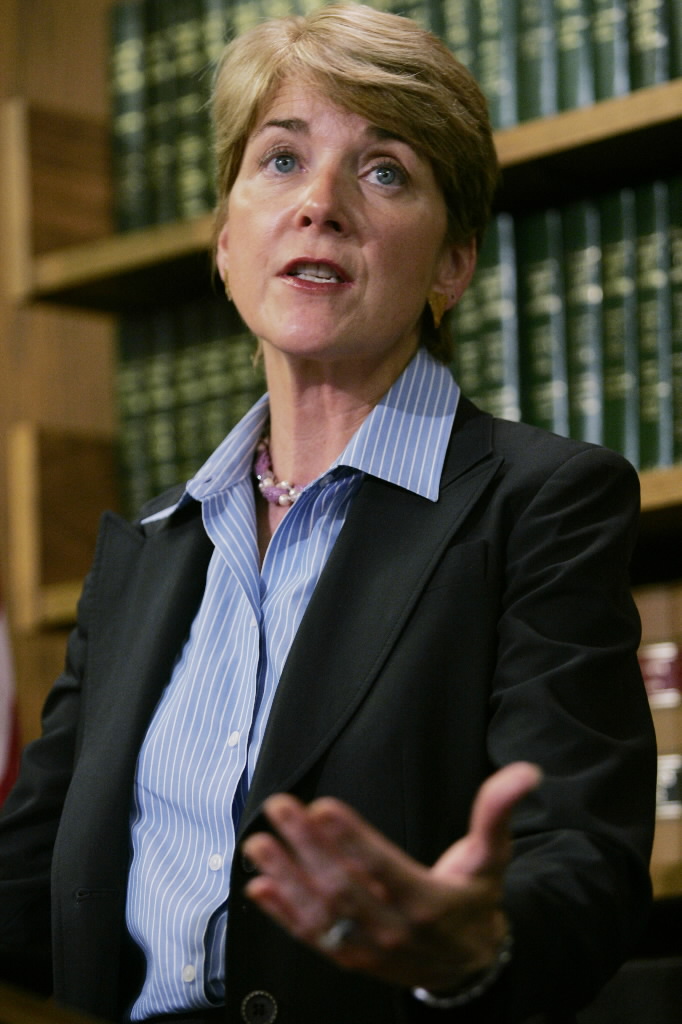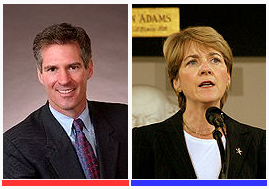
 A new Public Policy Policy survey shows a shocking result in the special election to replace the late Teddy Kennedy in Massachusetts:
Buoyed by a huge advantage with independents and relative disinterest from Democratic voters in the state, Republican Scott Brown leads Martha Coakley 48-47.
This naturally has Republicans excited, with Ed Morrissey, Dan Riehl, Michelle Malkin, William Jacobson, and others excited by the opportunity for a huge upset. It would be pretty sweet for a variety of reasons.
Could it happen? Perhaps. Special elections are notoriously unpredictable, since there aren’t a ot of other interesting races on the ballot to encourage people to turn out. And, by most accounts, Brown has run an engaging campaign while Coaxley has been horrendous.
Still, this is Massachusetts. And Teddy Kennedy’s seat!
Oh, and it’s worth pointing out that the latest Rasmussen poll, taken January 4th, has Coakley up by 9. And all the older polls show a Coakley blowout. But two Boston media polls about to be released reportedly show wide variance, one with Brown leading slightly and one with Coakley up by 15.
538’s Tom Schaller explains the craziness:
Senate elections are to me the most fascinating in American politics because, from an intergovernmental perspective, they are contests for federal office conducted on a statewide level but often with significant local factors at play. Other than the seven smallest states that elect their lone, at-large House member statewide, Senate contests are unique in this way. One reason that presidential results tend to be rather consistent across cycles, especially of late, is that candidate factors–aside from home-state connections–are essentially held constant across the states, making the result a purer referendum on the ideological-partisan identity of each state. But because every Senate race has its own candidates and campaigns, and the elections themselves are staggered, Senate delegations can split in a way Electoral College results–Maine and Nebraska aside–cannot.
[…]
Coakley–who, and maybe this is just me, bears a resemblance to former Democratic veep nominee Geraldine Ferraro–will probably hang on to win, maybe even by a comfortable margin. But the Republicans couldn’t be better situated. This is not a regularly-scheduled race in a presidential cycle, or even a regularly-scheduled race in a lower-turnout midterm cycle. It’s a special election in January of a midterm cycle year in which the Democrats have unified control of the state and national governments at a time of voter unease. If lower turnouts in midyear cycles tend to help Republicans, turnout during a special election on a (cold?) January day could be even worse and, thus, less likely to favor Coakley.
Further compounding the situation is the very short turnaround time Coakley, as nominee, has had to establish herself and her campaign operation during the holiday-interrupted, six-week sprint between winning the nomination on December 8 and the upcoming January 19 special general election. All else equal, a longer period between primary and general dates probably favors the stronger state party, much in the way that the better team during a 162-game baseball season often loses in a short playoff series. So the timing of the special election actually works two ways against Coakley and the Democrats.
If I had to bet the house on it, I’d go with the Democrat in this race without hesitation. But in a contest with what will likely be ridiculously low turnout, an upset is possible. If it is indeed a close race — and we just don’t know given that the polls aren’t clustering — then it’s not inconceivable that the Republicans will be more motivated.
Amusingly, Jules Crittenden reports, the Democrats are hedging their bets, planning to use delaying tactics to stall Brown’s election certification until after the health care vote. Just in case.