
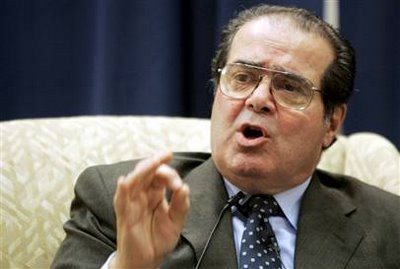
 In what some are viewing with irony, Antonin Scalia yesterday referenced decisions of courts in other nations in discussing how the Supreme Court should interpret an international treaty.
Supreme Court Justice Antonin Scalia practically hisses when his colleagues consult foreign law to help interpret the U.S. Constitution. But on Tuesday, Scalia found himself looking approvingly to other countries in a case over an international custody dispute.
The court is taking its first look at how American authorities handle the Hague Convention on child abduction, aimed at preventing one parent from taking a child to another country without the other parent’s permission.
“The purpose of a treaty is to have everybody doing the same thing,” Scalia said, “and I think, if it’s a case of some ambiguity, we should try to go along with what seems to be the consensus in other countries that are signatories to the treaty.” That view seemed to put Scalia, who has said the same thing before, on the side of a British father who accused his estranged American wife of violating Chilean law and a court order in Chile by taking their son to Texas without his consent. The child, born in Hawaii and now 14, is a U.S. citizen.
Timothy Abbott asked an American court to order the child returned to Chile, based on the treaty. The mother argued that she has exclusive custody of the boy and that U.S. courts are powerless under the treaty to order his return. The New Orleans-based 5th U.S. Circuit Court of Appeals agreed with the mother, Jacquelyn Abbott.
The high court appeared inclined to side with Timothy Abbott, although some justices raised concerns that a decision in his favor in this case could lead to undesirable results in others. Chief Justice John Roberts wondered who would decide whether a child should be returned “if you have the mother taking her daughter from, say, a country where she would be forced to be raised under Sharia (strict Islamic) law.” Justice Stephen Breyer said he worries about the case of a father who shouldn’t have access to his child, but who lives in a country that forbids one parent from taking a child to another country without the other parent’s consent. “Even Frankenstein’s monster is considered to have custody for the purposes of this,” Breyer said, despite a family law judge ruling, “‘Don’t let him near that child.’”
Breyer and Scalia, who often square off about the value of foreign law in the Supreme Court, joined Tuesday to help count up countries that have ruled on the child abduction treaty.
While Scalia’s position looks inconsistent, it actually makes perfect sense.
The fact that there is a growing international consensus against the death penalty, for example, has no bearing whatsoever on how American courts should interpret American law. It’s a purely domestic issue, so only the American Constitution, American statutes, and American judicial opinions are relevant. By contrast, the whole point of an international treaty is to standardize conduct among signatory countries. Naturally, then, the way courts in those countries have decided similar cases is valuable in setting precedent.
As to the specifics of the case, I’m insufficiently informed or interested to have an opinion. My general predisposition, however, is that courts ought to judge these cases based on the law — which decidedly includes the relevant international treaties — rather than on the basis of what a majority of the Supreme Court thinks the best outcome in a particular case. This isn’t family court, where “the best interests of the child” is the governing factor. The paramount consideration has to be the uniform enforcement of the law, so that it’s reciprocated when other countries are holding American citizens. The result of that, alas, may well be unfortunate outcomes in specific cases.








