Now that Vice President Kamala Harris is the presumptive Democratic Presidential Nominee, one big question is who she will tap to run as her Vice President. Axios published a rundown of six potential possibilities: North Carolina Gov. Roy Cooper, Arizona U.S. Sen. Mark Kelly, Illinois Gov. J.B. Pritzker, Kentucky Gov. Andy Beshear, Michigan Gov. Gretchen Whitmer, and Pennsylvania Gov. Josh Shapiro.
Of that list (note that other sites, like NBC News, have a much more extensive list), the three that seem to have the most momentum behind them are Cooper, Kelly, and Shapiro. Here’s Axios’s run down of each candidate followed by my (luke warm) takes:
Roy Cooper
Axios says:
- North Carolina Gov. Roy Cooper won in 2016 and 2020, even as former President Trump won the state during those same years.
- Democrats have invested heavily in North Carolina this cycle, viewing it as a pickup opportunity in the race for president, given the rapidly growing suburban populations around Charlotte and Raleigh. Harris has visited the state at least half a dozen times so far this year alone.
- Cooper and Harris, both attorneys general, have had a “really good relationship” that continued into her time in the Senate, Cooper said in a 2020 interview, CNN reports.
Matt’s take:
On the one hand, Gov. Cooper is term-limited and not eligible to run for governor again. He’s also won elections twice in North Carolina. And, as Axios notes, in both of those years, the State’s presidential votes went to Donald Trump. So there is no guarantee he can swing the State for Harris.
North Carolina is considered a “weak” governor State–the Republican supermajority has stripped the Governorship of a significant amount of power. Under normal circumstances, that would make it easier for Cooper to campaign across the county. However, as Michigan State Law Professor Quinn Yeargain pointed out on Twitter, the North Carolina Consitution, Article III, Section 3(2) specifies that “During the absence of the Governor from the State, or during the physical or mental incapacity of the Governor to perform the duties of his office, the Lieutenant Governor shall be Acting Governor.”
There are two reasons that Cooper may not want to allow Lieutenant Governor Mark Robinson to take over duties while he campaigns across the US. First and foremost, Robinson is the Republican candidate for Governor and as such the Democrats may prefer he not go into the election as a defact “incumbant.” Secondly, as acting Governor Robinson would have the power to issue executive orders and make appointments, both of which could play havok with Cooper’s and the Democrats overall political agenda.
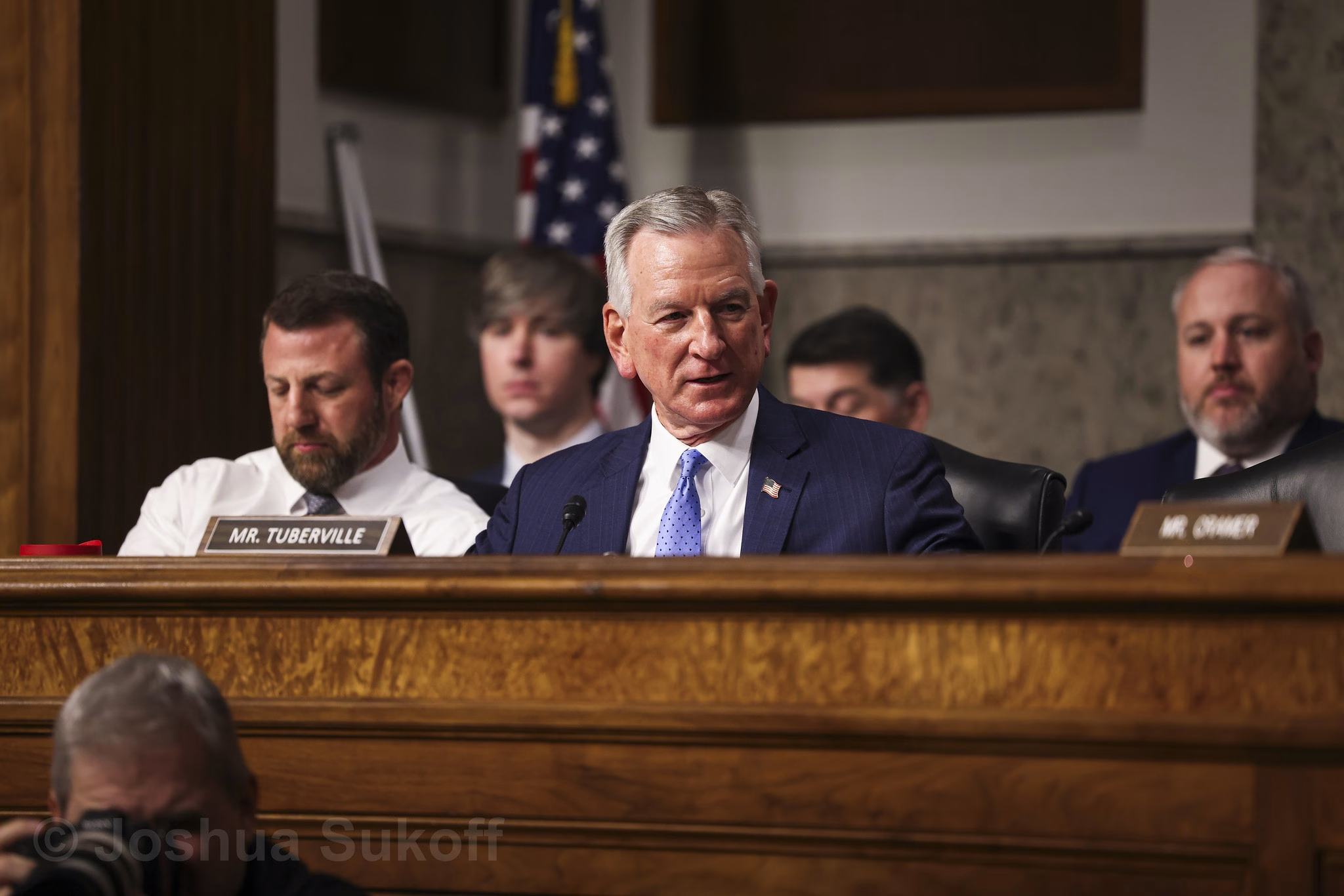
Mark Kelly
Axios says:
- Arizona U.S. Sen. Mark Kelly, a former astronaut and the husband of former Rep. Gabby Giffords, a victim of a 2011 mass shooting in Arizona, is another possible contender.
- Kelly has won two elections in the key swing state, including a decisive victory in 2022. Trump has been leading Biden in polling in the key swing state.
Matt’s take:
Kelly’s diverse background makes him an interesting candidate. His military experience as a Naval Pilot would counter J. D. Vance’s background as a Marine. He also is from a Border State and has been critical of Biden’s handling of the border in the past. He’s unafraid to throw elbows, which could be helpful for Harris on the campaign trail. And interestingly, like Harris, his spouse is Jewish as well (potentially helping shore up support within that community).
On the flip-side, conventional logic was that winning presidential tickets typically had someone with gubenitorial experience. However the last two Democratic administrations, Obama and Biden, and now Biden and Harris, have bucked that trend. So too has the current Republican Presidential ticket.
Additionally, Arizona falls into the “must win” category for Harris and if Kelly wins, he will be replaced though appointment by another Democrat.
Josh Shapiro
Axios says:
- Pennsylvania Gov. Josh Shapiro is another popular governor in a crucial swing state that Trump’s campaign has already indicated will be central to their November campaign strategy.
- Shapiro, a first-term governor, easily beat Trump-backed Republican challenger Doug Mastriano in 2022 and has broad bipartisan appeal, winning support from even some Republicans in his state.
Matt’s take:
Shapiro has been considered a rising star within the Democratic Party since 2022. He’s done a masterful job in reaching a number of bipartisan wins during his time in office. He’s seen by many as a moderate Democrat and could speak to more centrist members of the Democratic base and other independents. He’s also excellent at retail politics and making connection with voters across the asile. As a recent example, watch his empathy and poise while sharing details about the recent assination attempt on former President Trump. And, in terms of the base, he would make history as the first Jewish Vice President. [I completely forgot about Joe Lieberman making history in 2000-m.b.]
At the same time, he’s still relatively new to the national spotlight. He also has yet to complete a full term as Governor. This may not be an issue for some, but I see that as a potential weakness. Additionally, there are significant political risks to being Vice President, especially if the ticket loses. Instead of being a stepping stone for Shapiro, this could easily become the end of his political career.
Additionally there is the issue that, as with Arizona, Pennsylvania is a must-win state for the Democrats. As such it’s woth asking if Shapiro is better utilized as an campaign surrogate whose sole focus is helping deliver Pennsylvania.
Wrap up
As Scott pointed out in the comments on another post, the VP role has always been about ticket balancing. All three of these men bring that balance in different ways. Prior to learning about the stipulations of the North Carolina Constitution, I had expected that Governor Cooper was the obvious choice (especially given the reported number of calls he and Harris have had). I still think he’s a strong contender.
I personally think tapping Shaprio at this point would be a poor choice. I think both he and the Democratic party would be better served by allowing him to finish his first term and, if he chooses, stand for reelection.
Kelly is honestly someone that I was initially suprised to hear was being strongly considered. However in doing research for this post, his strengths become readily apparent. Additionally, in many ways he is the least risky candidate from the perspective of disrupting existing governing and legislative structures.
Acknowledging that I have a long and very public history of being wrong with predictions, if I had to place a bet today, I’d put my money on Mark Kelly as ultimately getting the nod.
I’m curious: Who did this analysis miss? Who do you think Harris will pick for VP and why?