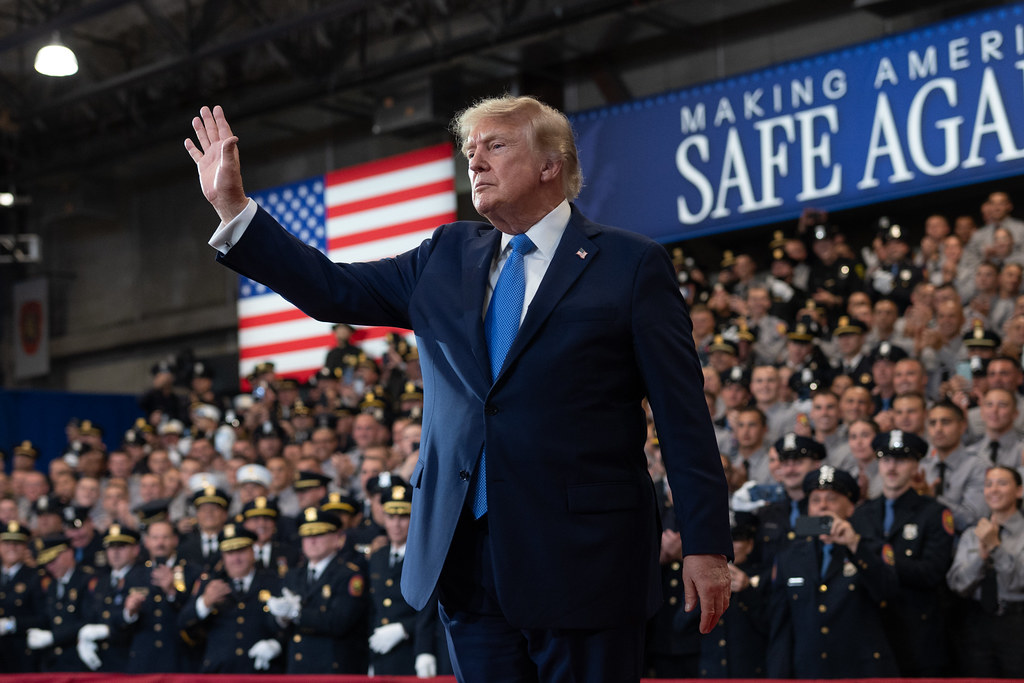
An unsigned Economist leader (“Donald Trump is unpopular. Why is it so hard to stand up to him?“) gets to the crux of our national crisis:
If a single political idea has tied Americans together over their first quarter of a millennium, it is that one-person rule is a mistake. Most Americans also agree that the federal government is slow and incompetent. Together, these things ought to make it impossible for one man to govern by diktat from the White House. And yet that is what this president is doing: sending in the troops, slapping on tariffs, asserting control over the central bank, taking stakes in companies, scaring citizens into submission.
The effect is overwhelming, but not popular. President Donald Trump’s net approval rating is minus 14 percentage points. That is little better than Joe Biden’s after his dire debate last year, and no one fretted that he was over-mighty. This is a puzzle. Most Americans disapprove of Mr Trump. Yet everywhere he seems to be getting his way. Why?
One answer is that he moves much faster than the lumbering forces that constrain him. He is like the TikTok algorithm, grabbing attention and moving on to the next thing before his opponents have worked out what just happened. The Supreme Court has yet even to consider whether deploying troops to Los Angeles in June was lawful. While the justices take their time, the president may soon use the same routine in Chicago. The court may not rule on the legality of his tariffs for months. So far the president has obeyed Supreme Court rulings, but if one legal avenue is closed he will try another and the clock resets.
Another answer is that the Republican Party always lets him have his way. It is not just that he dominates it, with an approval rating among Republicans of almost 90%. It is that the party’s organising idea is that Mr Trump is always right, even when he contradicts himself. Policy debates have turned into theological disputation in which sides fight over the real meaning of his words.
Independent institutions—companies, universities or news organisations—might oppose him. But they suffer from a co-ordination problem. This is much easier to point out than to fix, because organisations that compete with each other would have to collaborate. What is bad for Harvard may not be bad for its rivals. If a single law firm can be picked off, its business may go to a competitor.
Behind all these lurks the ugly reality of Mr Trump’s vindictiveness and intimidation. Previous presidents were influenced by independent-minded experts and the cabinet. The new definition of an expert in the Oval Office is someone who agrees with the boss. Bearers of bad news are sacked; awkward Republicans primaried; business leaders punished; opponents investigated. For each, the rational response is to apologise, settle and hope that someone else will do the right thing. Having seen what that entails, someone else may prefer a quiet life.
Politically, therefore, the main task of opposition falls to the Democrats. They are, to put it kindly, confused. Should they fight Mr Trump with ALL CAPS posts, as Gavin Newsom is doing? Is it all about mastering curated authenticity, like Zohran Mamdani? Do they move left? Do they occupy the centre? Is the problem merely one of messaging that can be fixed if only activists would stop calling women “birthing people”?
The fact that Democrats can neither constrain Mr Trump nor even communicate clearly leaves their base angry. Mr Trump’s ratings are low, but he is more popular than the Democratic Party—not because Republicans and independents disapprove of it (though they do), but because Democrats disapprove of themselves.
A recent NYT news analysis by Julian Barnes and Catie Edmondson (“Trump Tramples Congress’s Power, With Little Challenge From G.O.P.“) treads much the same ground and adds,
The Trump administration continues to erode the power of Congress, trampling on its constitutional prerogatives in ways large and small. Through it all, Republicans in charge have mostly shrugged — and in some cases, outright applauded — as their powers, once jealously guarded, diminish in ways that will be difficult to reverse.
[…]
For nearly a century, Democratic and Republican presidents alike have sought to amass more power, particularly to conduct foreign policy and military operations, and with a few exceptions, succeeded in chipping away at congressional influence. What is different now is the degree of disdain Mr. Trump has shown for Congress — and the willingness of G.O.P. leaders to defer to him even when it means undercutting their coequal branch of government.
“That is the big story here — not that a president is trying to push the bounds of their authority, because our system was designed with that in mind,” Representative Jason Crow, Democrat of Colorado and a member of the House Armed Services and Intelligence Committees, said in an interview. “The true story is that Republicans in Congress have capitulated and are not pushing back to assert authority.”
Republicans largely reject the idea that they have ceded congressional powers of oversight and spending to the White House. They argue that Mr. Trump is wielding his executive authority appropriately to bring a vast federal bureaucracy to heel, and pointed to the testy hearing featuring Mr. Kennedy as proof that they are willing to scrutinize the administration’s actions.
But so far, their most tangible response has come in the form of mild protests from a few Republicans.
[…]
Members of Congress have complained the withholding of information has continued, and grown worse, during Mr. Trump’s second term. Lawmakers who sit on the congressional intelligence committees have been alarmed that the Trump administration is withholding classified assessments of the state of Iran’s nuclear program that would have been shared with them in the past.
Given that American spy agencies operate in secret, denying the public knowledge of either their covert operations or their analytic assessments of U.S. adversaries, congressional oversight is effectively the only way to hold intelligence agencies accountable.
But this week, the Pentagon announced it would block a visit by Senator Mark Warner, Democrat of Virginia and the vice chairman of the Intelligence Committee, to the National Geospatial-Intelligence Agency after Laura Loomer, a right-wing influencer who holds no official role in the Trump administration, criticized the planned visit.
Defense officials said they would only allow bipartisan visits to military intelligence facilities, a requirement members of Congress said had never been in place before. Senator Tom Cotton of Arkansas, the Republican chairman of the intelligence panel, lodged no public protest.
So, Republicans control the White House, Senate, House of Representatives, and the Supreme Court. Congressional Republicans are, for perfectly understandable reasons, more afraid of Trump turning their primary electorate against them than they are interested in preserving their institutional prerogatives and serving their broader constituencies. The Supreme Court is, at best, slow to respond to seemingly obvious Constitutional violations and, worse, by all indications, actively enabling them through its shadow docket.
Therefore, of course, it’s the Democrats’ responsibility to fix it.
Economist (“A budget battle offers Democrats a chance to show some backbone“):
Funding for the federal government expires on September 30th: welcome to shutdown season. In theory, the president proposes a budget, Congress negotiates and legislation is signed into law ahead of the new fiscal year, which begins on October 1st. But this is Washington and so, with just three weeks to do a deal, prediction markets place the odds of a shutdown at around 50%.
Although Republicans hold majorities in both chambers of Congress, they need at least seven Democratic votes in the Senate to pass spending legislation, even if it is just a temporary stopgap bill. Democratic leverage is slim—and the expectations of Democratic voters hard to meet. Few want to compromise as President Donald Trump, abetted by Republican lawmakers, has dismantled government agencies and withheld billions of dollars in appropriations. Democrats are still smarting from their last budget bout in March, when Chuck Schumer, the Democratic leader in the Senate, and nine other colleagues, broke ranks to back a stopgap spending bill. The decision sparked vituperative backlash within the party and calls for Mr Schumer to resign. “What happened in the spring was a disaster,” sighs a senior Democratic aide. “There’s a real desire not to repeat that.”
The challenge now facing Mr Schumer is three-fold. First, to show that Democrats still have some fight left in them. Second, to settle on a demand going into negotiations with Republicans. And third, should talks fail, having a clear message as to why Democrats have shut the government down. Back in March Mr Schumer worried that a shutdown would hand Elon Musk, who was slicing through the government, the opportunity to do more damage. Buoyed by the president’s sinking popularity and Mr Musk’s departure in May, Mr Schumer is showing more mettle than six months ago, warning Republicans they should not expect Democrats to “act as business as usual”. Along with Hakeem Jeffries, the minority leader in the House, he has threatened a shutdown should Republicans try to push for a stopgap spending bill without making any bipartisan concessions. But for all the fighting talk, Democrats seem as unprepared for a government shutdown as they did in March.
Ezra Klein (“Stop Acting Like This Is Normal“):
In about three weeks, the government’s funding will run out. Democrats will face a choice: Join Republicans to fund a government that President Trump is turning into a tool of authoritarian takeover and vengeance or shut the government down.
Democrats faced a version of this choice back in March. DOGE, the Department of Government Efficiency, was chain-sawing its way through the government. Civil servants were being fired left and right. Government grants and payments were being choked off and reworked into tools of political power and punishment. Trump was signing executive orders demanding the investigation — I would say, the persecution — of his enemies. He had announced shocking tariffs on Mexico and Canada. We were in the muzzle velocity stage of this presidency. And Democrats seemed completely overwhelmed and outmatched.
I often heard people complain that Democrats lacked a message. What Democrats really lacked was power. They didn’t have the House or the Senate, but they did have one sliver of leverage: To fund the government, Senate Republicans needed Democratic votes. And not just one or two. They needed at least seven Democrats to reach that magic 60-vote threshold. House Democrats wanted a shutdown. But Chuck Schumer, the leader of the Senate Democrats, didn’t. He voted for the funding bill and encouraged a crucial number of his colleagues to do the same. The bill passed.
[…]
Not a single argument Schumer made then is valid now. First, Trump is not losing in the Supreme Court, which has weighed in again and again on his behalf. Instead of reprimanding Trump for his executive order unilaterally erasing the 14th Amendment’s guarantee of citizenship to all born here, it reprimanded the lower courts for imposing a national freeze on his order in the way they did. It has shown him extraordinary deference to the way he is exercising power.
[…]
We are no longer in the muzzle velocity stage of this presidency. We are in the authoritarian consolidation stage of this presidency.
I want to be very clear about what I am saying here. Donald Trump is corrupting the government — he is using it to hound his enemies, to line his pockets and to entrench his own power. He is corrupting it the way the Mafia would corrupt the industries it controlled. You could still, under Mafia rule, get the trash picked up or buy construction materials. But the point of those industries had become the preservation and expansion of the Mafia’s power and wealth. This is what Trump is doing to the government. This is what Democrats cannot fund. This is what they have to try to stop.
[…]
The case for a shutdown is this: A shutdown is an attentional event. It’s an effort to turn the diffuse crisis of Trump’s corrupting of the government into an acute crisis that the media, that the public, will actually pay attention to.
Right now, Democrats have no power, so no one cares what they have to say. A shutdown would make people listen. But then Democrats would have to actually win the argument. They would need to have an argument. They would need a clear set of demands that kept them on the right side of public opinion and dramatized what is happening to the country right now.
[…]
But Democrats cannot pretend this is a normal Republican administration. They cannot ignore masked agents in the streets, armed troops in the cities, billions of dollars of money going into the Trump family’s pockets, an administration that spins off several scandals in a week that would have consumed other presidencies for years. If Democrats cannot make an issue out of all that, then they are screwed and so are we.
And we might be. Even if Democrats could agree on a message, do they have the messengers? Have Hakeem Jeffries and Chuck Schumer distinguished themselves as able to win an argument? Are they going to hold the line as national parks close down, as federal employees are furloughed, if checks stop going out the door, if flights are delayed because air traffic controllers aren’t getting paid? I don’t know that they will. I am quite certain that this moment deserves real opposition — that Democrats, morally speaking, should not fund a government that Trump is turning into a tool of personal enrichment and power. But I am not certain that Democrats can win a shutdown — I am not certain that they have the leaders that they need. It is absolutely the case that Democrats could lose a shutdown, but whatever they’re doing right now, it’s not called winning.
Whether a shutdown is a good strategy (and even Klein admits he’s not so sure it is) really depends on what concessions Democrats can force as a condition for reopening. But Schumer’s original concern, that Democrats care more about a functioning government than Republicans, remains valid.
Ultimately, if Republicans don’t turn on Trump, Democrats have extremely limited power. Unlike previous Presidents, he doesn’t seem particularly interested in passing legislation. Instead, he’s happy to rule via executive fiat and dare the courts to stop him.
That would change, at least somewhat, if Democrats can win back control of one or both Houses of Congress in the next election, which is fourteen months away.
Still, The Economist (“How America’s Democrats might win back power“) is strategizing how they might do that. Stop me if you’ve heard this one before.
The Democrats are painfully divided over how to fight back. Should the party lurch to the left to boost turnout among true believers, or cleave to the centre? Should it focus on denouncing Mr Trump, or promote a platform of its own? Should it fight back hard and dirty, or follow Michelle Obama’s advice from 2016: “When they go low, we go high”?
When the party was locked out of the White House for 12 years in the 1980s and early 90s, Bill Clinton revived its brand by forcefully occupying the centre. He embraced fiscal sobriety, market-friendly economics and a tough approach to crime. He also distanced himself from activists who repelled middle America. In 1992 Sister Souljah, a rapper, said of the LA riots, “If black people kill black people every day, why not have a week and kill white people?” Mr Clinton denounced her furiously and won the presidency soon after.
To win over swing voters today, many Democrats think their party needs a “Sister Souljah moment”.
[…]
Most Democratic officeholders do not govern on “wildly out-of-touch social positions”, argues Third Way, a centrist group. But “Democrats and their allies use an awful lot of words and phrases no ordinary person would ever dream of saying. [The intent]…is to include [but] the effect…is to sound like the…obfuscatory enforcers of wokeness.” Pressure groups give candidates questionnaires and want them to tick every box. Kamala Harris gave Donald Trump his best attack line in 2024 by telling one such group that she favoured paying for “gender-affirming” surgery for prisoners. Hence “Kamala is for they/them. President Trump is for you.”
Several senior Democrats are now snubbing the activists. Rahm Emanuel, a former mayor of Chicago and White House chief of staff, has said that a man cannot become a woman. Gavin Newsom, the governor of California and a probable presidential candidate in 2028, says it is “deeply unfair” for biological males to compete in women’s sports. Such views are popular everywhere except in progressive circles. A party grandee predicts that Democrats will keep insisting that “you shouldn’t bully trans people for who they are”, but drop policies such as paying for trans medicine for children.
In places that Democrats hope to flip, candidates are downplaying culture and emphasising the cost of living. The candidates for governor in New Jersey and Virginia, a former Navy pilot and an ex-CIA officer, both fit this description. So do several contenders for Congress next year.
People “are seeing the price of utilities, groceries and rent go up and up, and there’s too much month at the end of the money,” says Roy Cooper, a former governor of North Carolina, who is hoping to bag a crucial open Senate seat next year. Mr Cooper is no one’s idea of an extremist. As governor, he worked with Republicans to balance the state’s budget and expand public health insurance. In person, he is soft-spoken and warm. Visiting Chimney Rock, a village that was flooded last year, he praises locals’ “courage, resilience and hard work” rebuilding. One points to floorboards that were nailed in place by another politician; Mr Cooper jokes that he’d better be “careful” stepping on them.
[…]
Though Democrats all want to ease economic pain, they differ as to how. The left favours old-fashioned public spending, paid for by squeezing the rich. Moderates are warming to “abundance”, a reference to a fashionable book by Ezra Klein and Derek Thompson, two journalists who call for loosening regulations to make it easier to build new homes and energy projects.
Among the party’s footsoldiers, the left stirs more passion. Bernie Sanders, an 83-year-old senator from Vermont, is criss-crossing the country on a “Fighting Oligarchy” tour. On a recent evening in Davenport, Iowa, he raised thunderous applause for promises of free health care, free college tuition and larger pensions, and thunderous boos at every mention of plutocrats. (Humdingers like “government of the billionaire class, by the billionaire class, for the billionaire class” gave him ample time to catch his breath.) The crowd loved it. But his promises are implausible. By one estimate, his spending plans in 2020, when he last ran for president, would have doubled federal spending.
[…]
When Democrats are in power, moderates tend to have more influence over economic policy than the far left. But given the foul mood of voters, some populist policies would be likely under a future Democratic administration. Raising taxes on companies and high earners is popular; so is the idea of forcing drug firms to reduce prices. Government-run grocery stores get a thumbs-down in polls, but two-thirds of Americans like the sound of rent controls, despite decades of evidence that they reduce the supply of new housing.
The abundance agenda is more likely to deliver results. Draconian land-use rules make housing unaffordable in the cities where the best jobs are. Easing them could raise output per worker by 8%, by one estimate. Demand for energy is soaring owing to AI, yet Mr Trump is throttling the expansion of the cheapest sort, renewables. Abundance Democrats vow to dynamite such roadblocks to prosperity.
Changes in rhetoric and recalibrations of policy positioning might help, at least at the margins. But, of course, few House seats are competitive, and that number is getting intentionally smaller as states race to outdo each other in partisan gerrymandering. The Senate is marginally more competitive, in that gerrymandering isn’t possible, but most states nonetheless lean sharply toward one party, with the other party’s candidate winning requiring a perfect storm. (This is compounded by the fact that only a third of the Senate is up in a given cycle and, for 2026, 22 races feature Republican-held seats while only 13 feature Democratic-held seats.)
That said, nothing is fixed. I’m old enough to remember when the winner of the Democratic primary was just about guaranteed to win across most of the Deep South. And when California was a reliable Republican vote in the Electoral College. Even more recently, Virginia was considered a Red state when I moved here in 2002, yet now has two Democratic Senators and has voted for every Democratic Presidential nominee since 2008.
For that matter, while there were certainly seeds of the MAGA Republicans in Newt Gingrich’s 1994 “Revolution” and, especially, the Tea Party movement, Trump’s force of personality has significantly reshaped the party coalition. There’s no reason a charismatic Democrat couldn’t do the same. I do, however, doubt that Bill Clinton’s 1992 campaign will provide the Rosetta Stone.