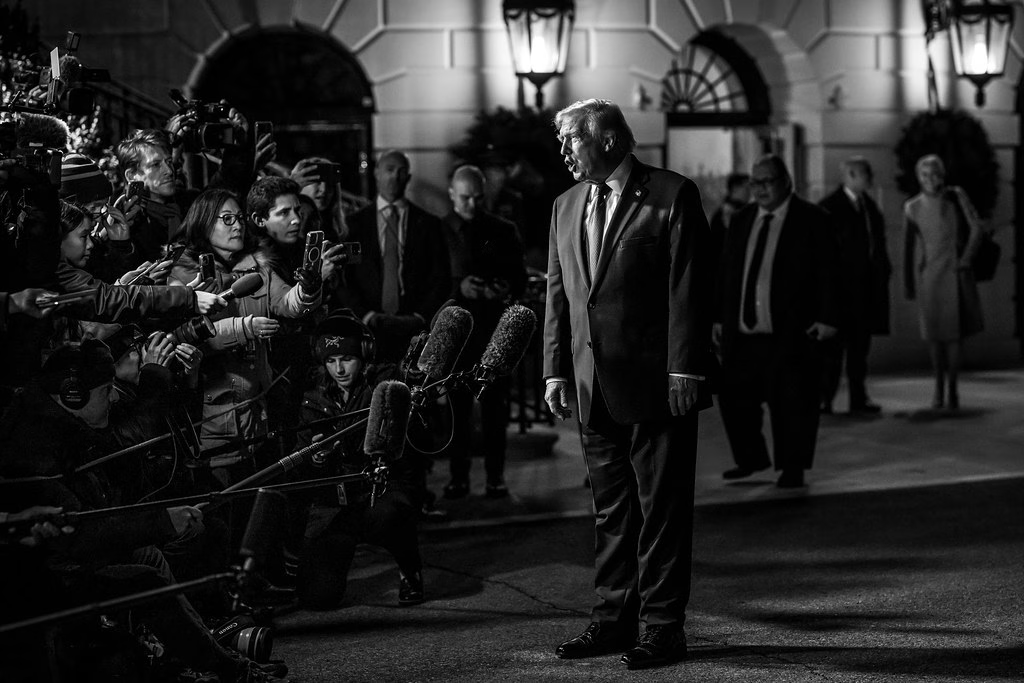

Today’s Sunday morning shows will, understandably be devoted to last week’s revelations regarding the National Security Agency’s various surveillance programs. Among the guests will be the Chairs of the House and Senate Intelligence Committees, a former director of the NSA itself and, in what has become a seemingly endless tradition, Arizona Senator John McCain. Indeed McCain seems to stand as Exhibit A for the argument that these shows seem to recycle the same guests over and over again:
WASHINGTON — In mid-February, Senator John McCain went on the NBC program “Meet the Press” to explain his unhappiness with President Obama’s nominee for defense secretary. A week later, he took to “State of the Union” on CNN to chat about sequestration (bad) and the attack in Benghazi (worse).
In May, he was on “Fox News Sunday,” talking about Middle East politics with Chris Wallace. Last week, Mr. McCain, who was in California for his oldest son’s wedding, hit “Face the Nation” on CBS, via satellite, to discuss his trip to Syria.
Mr. McCain, Republican of Arizona, is not his party’s most recent presidential nominee. He is no longer the highest-ranking Republican on any major Congressional committee. And as party spokesmen go, these days he is just as often speaking against Congressional Republicans as with them.
Yet on many given Sundays — over 60 of them since 2010 — Mr. McCain repairs to a television studio in Washington to hold forth. On “Face the Nation” alone, Mr. McCain has appeared more than any other politician in the program’s 60-year history.
His Sunday ubiquity has set off some grumbling in Washington that producers give him too much airtime. It also tends to solidify the impression in living rooms across America that he remains the spokesman for, and titular head of, his party.
“Really?” Mr. McCain said with a soupçon of glee when informed of his record-breaking Sunday showiness. “Well I enjoy them. I find it is the best way to communicate with the American people.”
In many ways, the Sunday morning talk shows are like ID lanyards and BlackBerries. While much of the nation has lost interest in them, they hold a big — some would say disproportionate — sway in Washington.
The programs’ producers and members of Congress — and, to some degree, White House officials — collaborate in a weekly seduction ritual in which producers try mightily to get the most powerful guests and newsmakers of the moment, as the guests’ staffs weigh the risks of stepping before some of the toughest questioners in Washington.
When it comes to a dream guest, program hosts say, Mr. McCain checks almost every box: a senior Republican senator who can speak authoritatively and contemporaneously on many issues, flies secretly to Syria, compares members of his own party to deranged fowl and yet is a reliable opponent of most Obama administration policies.
“What makes a good guest is someone who makes news,” said Mr. Wallace, the Fox host. “To make news, you have to be at the center of the news and willing to talk about it in a noncanned way, someone who always come to the shows ready to play.”
He went on: “I sometimes think to myself, ‘Gee we’ve had McCain on a lot,’ ” not to mention Senators Lindsey Graham, Republican of South Carolina, and Richard J. Durbin, Democrat of Illinois. “But the fact of the matter is they are good guests.”
And good guests become frequent guests. The programs tend to be dominated by a handful of predictably quotable politicians. Others make only rare appearances when a pet issue rears its head. And still others, by choice or by elimination, never make the cut at all.
The constantly repeating guests is one of the reasons that these shows have become mostly unwatchable. Week after week, you get the same conventional wisdom from virtually the same people while other voices and other points of view tend to get crowded out. In some sense, it may be because all of these shows are recorded in Washington. While you’ll occasionally see This Week, Meet The Press, or the others, have a guest appearing via video link from a remote location, it’s rather obvious that the shows prefer to have their guests in studio. That means that Congressman and Senators who don’t spend their weekends in Washington rarely get on these shows, while pundits and political analysts who don’t live in the area rarely get invited to be part of the “round table” segment that seems to have become a ubiquitous part of all these shows. That, quite likely, is the main reason why these shows are accused, largely correctly, of having an inside the beltway, conventional wisdom, bias to them.
Another issue with these shows, though, is that they are given far more importance in the news cycle than the probably deserve:
Critics of the Sunday programs argue that the words spoken on them are at once too calculated and overly interpreted, simply by virtue of where they are delivered. “You can go on Charlie Rose midweek and have a long conversation that ends in a game of strip poker and no one will pay attention,” said Philippe Reines, a senior adviser to former Secretary of State Hillary Rodham Clinton. “You go on a Sunday show, and everyone is looking for the slightest change, a new syllable, some new nuance.”
The prominence of guests with strong points of view can give viewers a false sense of proportion to certain sides of policy debates. This is most clearly the case with Mr. McCain, whose advocacy for military intervention in Syria and criticism of the administration’s policies there might create a sense that there is a robust policy debate over the matter in Washington when there really is not.
“In order to deal with complexity but also create a basis for entertainment,” said Aaron David Miller, a vice president at the Woodrow Wilson Center, “you need someone who knows what they are talking about who is pursuing daylight between themselves and the administration.”
Many guests believe that the talk shows also contribute to the partisan disharmony in Washington, though that may be like blaming a speck of pepper for the flavor of a 10-gallon pot of soup. Even the highest-rated programs attract fewer than 2.5 million viewers, a tiny audience by the standards of network television.
“There is a tendency on the Sunday shows to look more toward partisan polarization,” said David Gergen, a senior analyst for CNN who has advised four presidents. “They seek out people who are further out on the spectrum,” Mr. Gergen said, adding that “more than one senator” has told him the story of being bumped for a more partisan guest when they expressed moderate positions on issues in pre-interviews, something producers and hosts say is untrue.
“We aren’t looking for someone because of their ideological view,” said Bob Schieffer, the chief Washington correspondent for CBS and the moderator of “Face the Nation.” “We are trying to move the story forward.”
Schieffer’s protestations notwithstanding, it seems fairly clear that there is a strong desire on the part of all of these shows to do far more than just “more the story forward.” Instead, what is said on these shows ends up becoming the story far more often than it probably should. The best known recent example of this, of course, are the appearances by UN Ambassador Susan Rice on all five news network morning shows, referred to among Washington pundits as “the full Ginsburg,” in the wake of the attack on the U.S. diplomatic outpost in Benghazi.What she said on those five shows ended up becoming the subject of controversy and Congressional hearings for months thereafter, even though it now quite clearly appears it was based not an any effort on a cover up, but on a turf war between the CIA and the State Department about how the attack would be initially described based on the available intelligence. No doubt, someone will say something today on one of these shows that will also make for headlines for the rest of today and into tomorrow. Had they said it during a 2pm news block on CNN on Tuesday, it would hardly get noticed. Because they’re saying it on Sunday morning, though, it’s going to get a lot of attention, probably more than it deserves.
Finally, perhaps the most important thing to remember about these Sunday shows is that they largely consist of the political class, mostly inside Washington, talking to itself. That’s why, if you do watch them, you end up seeing a lot of commercials for defense contractors and large corporations rather than commercials from the kind off advertisers buying up time during the rerun’s of Law & Order that run on TNT during the same time block. For the most part, none of these shows have what could be described as spectacular ratings but they are regular viewing for the powers-that-be, the lobbyists, and the people who help set policy and drive the narrative that will shape news in the coming week. That’s why they have become so important, and why they’re likely to stay that way for the foreseeable future. Whether that should be the case, of course, is an entirely different question.