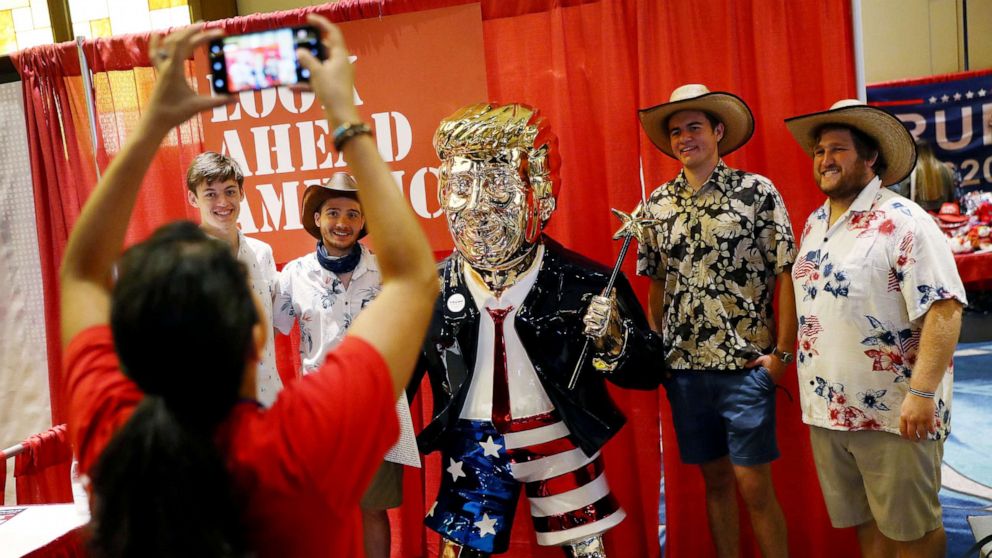

Washington Post contributing editor Greg Abernathy implores us, “Stop insulting Trump voters and their concerns. Talk to them.”
His argument, alas, is unpersuasive.
When supporters of former president Donald Trump hear media pundits analyze them with the usual collection of belittling observations, they must be tempted to respond, “Hey, we’re right here! We can hear you!”
Yes, they are indeed here, and living among us. And they have every right to be insulted by being accused of believing a “big lie,” and by the implication that they are violent, or traitors, or mindless sheep — racist sheep, of course. They’re fed up not just with the overt insults, but also with more subtle digs, such as former defense secretary Leon Panetta saying last week that he worries that Trump “will continue to try to somehow sway his followers” to attempt another Jan. 6-style uprising. Followers? No one refers to President Biden’s “followers.” It’s a word generally reserved for adherents of cult figures.
The problem is that, as Abernathy later acknowledges, a plurality of these people actually do believe in a big lie and, while he doesn’t directly acknowledge it, the only possible rationale for that is their cult-like devotion to Trump over all reason.
I live in Trump Country. I was a Trump supporter, until he lost me with his actions after the 2020 election. But most Trump voters have stuck with him. With Trump’s encouragement, they sincerely believe the election was stolen. They’re not racists. They’re not traitors. Some of them think anyone who accepts Biden’s win is a traitor. Some of them think I’m traitorous — or at the very least I’ve succumbed to the evil influences of the mainstream media — for accepting Trump’s defeat.
So, if the first time Trump “lost you” was with his incitement of the Capitol riots and outrageous claims that the election had been stolen, you’re probably a racist. If you think accepting the legitimate outcome of the race makes a person a traitor, you’re pretty much a traitor, in the sense of being an enemy of the Constitution.
Still, I agree with the larger point that a lot of Trump voters—and I know and work with many of them—are simply garden variety Republicans faced with binary choices, both of which they found awful. And that, yes, some large number of them are worth talking to.
Polls are occasionally produced to perpetuate the myth that Trump voters are ready for war. Even the conservative American Enterprise Institute reported in February that 39 percent of Republicans polled agreed with the statement “if elected leaders will not protect America, the people must do it themselves, even if it requires violent actions.” The survey’s director, Daniel Cox, acknowledged the speculative nature of the question by cautioning, “We shouldn’t run out and say, ‘Oh my goodness, 40 percent of Republicans are going to attack the Capitol.’ ” No, they aren’t. In fact, the Capitol riot wasn’t mentioned in the question, so it wasn’t necessarily what respondents were thinking of when they answered.
It’s my unscientific conclusion that about half of Trump’s supporters will go to their graves believing the election was stolen. The other half can be persuaded otherwise, but only by time and reflection, like accepting a death. Shaming will never work.
The linked poll showed that 66 percent of Republicans believed Biden’s election win was not legitimate. That few of them are willing to riot in the streets or otherwise commit acts of violence to overturn the outcome is a collective action problem, not a sign that things are good. And, if most of those people will “go to their grave” with their minds unchanged, talking to them is unproductive.
But, yes, there’s the other half. And, no, shaming won’t help reach them.
Considering the Reuters Institute for the Study of Journalism recently found that the U.S. media ranks last in trust among 46 countries, some self-examination on this issue should be welcomed. In 2016, the New York Times decided to start applying the word “lie” to many of Trump’s claims. “We owed it to our readers,” executive editor Dean Baquet said at the time. Others followed suit. But using words such as “lie” and “falsely claimed” in news stories arrogantly supposes an absolute knowledge of truth and makes it appear the news outlet has chosen sides.
So stop calling people liars. The media should return to the non-accusatory style that worked for decades. Instead of writing that election fraud is a lie, or Republicans are “falsely claiming” fraud, go back to the style that worked for decades: “Republicans again claimed the 2020 election was rigged, but no evidence has emerged to support that allegation and courts have dismissed all suits challenging the results.”
So, I actually agree with this, if only from a stylistic standpoint. While I don’t mind the editorial pages using Big Lie to describe the claim that the election was stolen, it is essentially impossible to prove that the people making those claims know that they’re untrue–the definition of a lie. We can only reiterate that there is no evidence for the claim and that every attempt to prove the claim has come up empty.
Next, abandon the narrative that Trump supporters are insurrectionists, and stop elevating groups such as QAnon and the Proud Boys beyond the fringe elements they are. As shameful as the Jan. 6 attack on the Capitol was, only about 800 people were involved — hardly representative of millions of Trump supporters. Despite their suspicions, the vast majority of Trump voters are not interested in invading federal buildings or overthrowing the government. They’re interested in going to work and church and soccer games, taking care of their families and voting in the next election.
So, again, this is demonstrably true. But who is it that is claiming otherwise?
There’s no big mystery to effectively communicating with Trump supporters — or for Trump supporters to communicate with everyone else. Treat each other with politeness and courtesy. Respect other opinions even if you disagree. Acknowledge each other’s patriotism and love of country. Don’t assume you understand each other because you’ve read some think-tank analysis. Reach out, be curious and start a dialogue.
Abernathy made a longer form of this argument in a previous column (“The simple fix to our polarization: Befriend someone you disagree with.“). At a micro level, I agree. Indeed, it’s how I live my life. But, at the macro level, it’s problematic. Pretending that the results of the last election are in factual dispute undermines the legitimacy of our system while fueling the notion that any means necessary to thwart the will of Democratic voters is justified. If, in fact, Biden and his party somehow stole the election, not only was the 6 January riot justified, it should have been joined by millions.
So, yes, we should treat people who disagree with us on the election, vaccination, and the like as human beings worthy of dignity. But, no, we should not pretend that their views are equally valid.
Trump supporters aren’t going away, and those who continue to paint them as the lowest forms of life reveal themselves to be more interested in perpetrating stereotypes and nurturing divisions than in achieving what’s needed for our nation to survive — reaching across our political chasm, respecting our differences and finding common ground where we can.
So, here’s the thing. Trump got to be President despite getting 3 million fewer votes than his opponent in 2016. He’s fomented violence and attempted to steal the 2020 election after getting 7 million fewer votes than his opponent. And yet the people who are in the decided minority are doing everything they can to further stack the deck to make it harder for the opposition to vote. They’re refusing to get vaccinated, putting the most vulnerable people in our society—including our youngest children—in literal mortal danger. Maybe—just maybe—it’s not us who need to show respect and find common ground.