
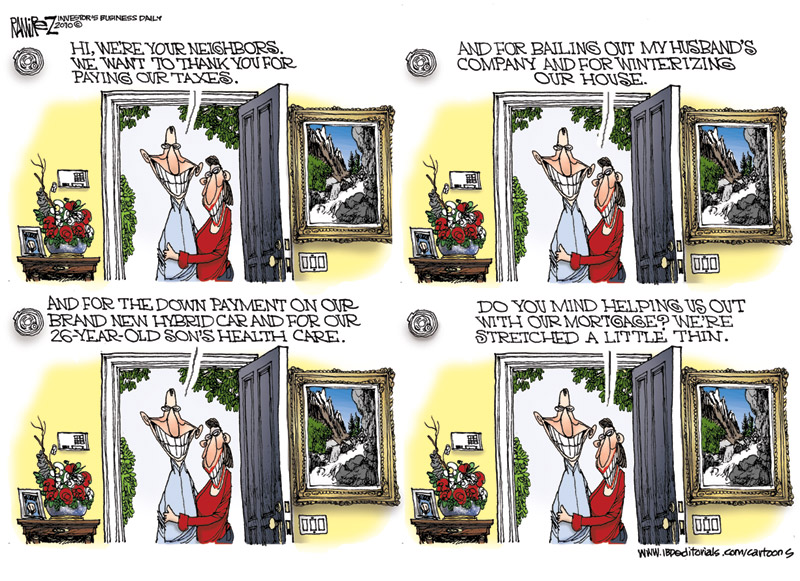
John Hinderacker pronounces this the “Greatest. Cartoon. Ever.”
 He comments:
Is the US turning into a nation of freeloaders? One certainly hates to think so, but there are powerful forces pushing us–lots of us–in that direction. Michael Ramirez captures the phenomenon of the 21st-century freeloader brilliantly. If you’re not outraged, you haven’t been paying attention.
Ramirez certainly captures the resentments caused by our political financing system. The fact that 47% of Americans pay zero Federal income tax. There’s an argument to be made that we’ve reversed the cause of the American Revolution and have representation without taxation for a large swath of society.
But the cartoon’s implicit argument is wrong in at least four ways.
First, nobody thinks they’re free riding on their neighbors. Politicians have so successfully waged class warfare that everyone’s confused and resents everyone else, since they invariably think “people like me” pay most of the taxes. Thus, we’ve carefully crafted a system where those paying the least taxes resent those paying the most for not paying their fair share. And politicians, including our current president, promise to remedy this by enacting more programs and paying for it by taxing the rich. But it’s not a one-way street, either. Even the Tea Party protestors, who care enough about taxes and spending to take time to rally, are ignorant on taxes and wildly overestimate their own burden. But that shouldn’t be surprising, since our tax code is so complex it’s a tax itself.
Second, in the truest sense, the successful neighbor isn’t paying for these programs, either. At best, they’re helping pay the interest on the loan that’s paying for these programs.
Third, it’s incredibly unlikely that the neighbors have wildly disparate tax burdens, given the way we economically segregate.
Fourth, assuming that the pictured neighbors are young and employed, they’re certainly paying taxes to the federal government. Most notably, they’re paying Social Security and Medicare taxes which, while theoretically insurance programs from which they directly benefit, are simply thrown into the general revenue pile with the hope that future generations will keep paying in. Indeed, if, for some reason, the unseen neighbor is indeed much more financially successful, the less-well-off neighbors are likely paying a much higher portion of their income into those programs, since we (quite reasonably) cap payments into FICA since payouts are capped.









