
In yesterday’s post lamenting that President Trump seems to be abdicating America’s role as leader of the free world, I offered that,
To the extent there’s a rational American foreign policy goal here, it’s to get European nations to pick up a larger share of the burden of defending Ukraine and containing Russia so that our resources can be allocated to the threat in the Indo-Pacific. And that might in fact happen as a result of all of this.
This generated strong pushback that, by seeing any foreign policy goal at all at work, I was justifying the policy. Given the broader context of the post, I found that rather odd. But I’ll unpack it further here, in what’s going to be a long one.
Constraints and Restraints on My Writing
As I noted a few days back, the current atmosphere has created a chilling effect such that, “While I will never publish things that conflict with my beliefs, I will almost certainly be considerably more constrained until circumstances change.”
In some cases, this will mean that I simply won’t write about topics where saying what I think could put my livelihood in jeopardy. In other cases, the voices I highlight in the posts will have to say what I can’t.
With respect to yesterday’s post, “To the extent there’s a rational American foreign policy goal here” does a lot of work. In the case of Russia and Ukraine, I think there are many, many factors at play, some of which seem obvious and some of which can only be intuited.
Transactional Leadership
Friday’s episode of The Daily podcast, “Trump 2.0: The Art of the Deal,” which predated the Oval Office spectacle, influenced my analysis heavily. It was a roundtable discussion featuring NYT White House and congressional correspondents, and focused on how Trump has handled two sets of negotiations: the attempt to get a budget through the House and to extract a mineral rights deal from Ukraine. The former is pretty simple: he strongarmed them. The second is, well, more complicated.
Here are some key excerpts:
Zolan Kanno-Youngs: So we’ve talked about how President Trump’s approach to foreign policy can best be described as transactional. And we got some examples of that early on when, after coming into office, when it came to aid for Ukraine, it started out as sort of a musing over having an exchange of the natural resources in Ukraine for aid to Ukraine. And that has really become a focus of the negotiations that we’ve now seen in recent days and in recent weeks.
So a pivotal point in this is when Trump’s Treasury Secretary, Scott Bessent, took a trip to Kyiv, Ukraine, and presented an initial version of this deal. And the initial version, Ukraine balked at it.
Michael Barbaro: What was the initial version?
Zolan Kanno-Youngs: First, the US basically wants back-pay for the aid they already sent to Ukraine. Trump is basically saying, you have these critical earth minerals in Ukraine, and the US is going to get a significant amount, half of the revenue from that up to $500 billion.
Michael Barbaro: That’s a lot.
Zolan Kanno-Youngs: The maybe even more significant thing is what’s not in that proposal. And that’s the assurance Zelenskyy wants of a long-term security guarantee. The concern for Ukraine is that any pause in fighting that US and Russia agree to. Well, what if Russia uses that to build up its forces, and then Ukraine is left without the assurance, the knowledge that the United States will come to their defense, that the United States will actually support Ukraine.
Michael Barbaro: And it might be left without some rare earth minerals that would help it pay for its own defense if it were to accept this deal. Maggie, how should we understand this initial offer that, on its face, seems like a very good deal for the US, and not much of a deal at all for Ukraine.
Maggie Haberman: I think you just answered your own question. I mean, essentially, Trump has separated out Russia and Ukraine from one another, as he is saying that he is trying to negotiate a peace deal. He’s got Russia at one table with the US. He’s got Ukraine at another table with the US.
Michael Barbaro: A smaller table.
Maggie Haberman: A much smaller table with Ukraine. Trump said it himself, and it’s really true. Ukraine basically has no cards to play. Trump has rejected the idea of NATO membership for Ukraine, and Trump also does not want to provide security guarantees for Ukraine. He wants Europe to do it. And that is going to require a heave of the will by Europeans, and we’ll see what that looks like. So the new deal that is being negotiated —
Michael Barbaro: Because the first one kind of got rejected.
Maggie Haberman: — first one was rejected, and then other iterations of it were rejected. And then the Commerce Secretary, Howard Lutnick, jumped in. And that complicated matters.
Michael Barbaro: Yeah, how do we get to a deal?
Maggie Haberman: So what is now there, because of various forces, is a smaller deal in terms of what the US will get. Trump keeps saying $350 billion. My understanding is the actual number is smaller than that, but it still does not include a security piece. And that was clearly a red line for Trump. And Zelenskyy clearly realizes that and is taking what he can get.
Michael Barbaro: But that doesn’t seem like a deal the president of Ukraine would sign. And yet, Zolan, he’s about to arrive in Washington and sign it. So at some point, he decides that even though he’s not really getting anything from it, it’s still somehow worthwhile. Why?
Zolan Kanno-Youngs: Well, for one, I mean, a late version of a US proposal did vaguely say that the US would support Ukraine’s security. But then Trump came around the next day in a cabinet meeting and said, essentially, that was going to be the responsibility of European nations that are closer to Ukraine. Zelenskyy is in a really tight spot here. I mean, he knows Ukraine has been relying on a lot of US aid. And he’s now put in a position where, like many other world leaders, he now needs to come to Washington and try to placate Trump, try to use old fashioned diplomacy to try and secure any kind of assurance for Ukraine.
[…]
Michael Barbaro: Well, to that point, if you subscribe to this ascendant now victorious America-first worldview that has now dominated the party under Trump, isn’t this quite an achievement? The United States is going to recoup the money it spent in Ukraine, with no commitment to spend much more, or to ever put American troops in harm’s way in Ukraine in a war that Trump and many Republicans don’t think the US has a real interest in?
Maggie Haberman: Yes, I mean, this is — look, in a long line of things that Donald Trump promised during the campaign and is doing, this is one. He made very clear that he did not support the aid to Ukraine. Trump also looks at all of these engagements through an economic lens. He does not look at them through a foreign policy end, as some kind of a moral exercise.
He is looking at it as what is the best deal for the US. He sees Ukraine as a tiny country. Russia is obviously not the superpower it once was, but in Trump’s mind, it looms much larger from its stature decades ago. And he sees more business opportunities for the country, as he has said, with Russia than he does with Ukraine.zolan kanno-youngs
Zolan Kanno-Youngs: It’s interesting. Even when the administration is trying to reassure Ukraine that the United States will be here, they actually point to the fact that, look, if we have an investment in your critical earth minerals, that is, in a form, the best kind of security assurance that you could get because we don’t want Russia to take over all of this territory. If we have an agreement with you to continue to financially benefit from these critical earth minerals, isn’t it more likely that we will continue to support your defense of your land, which I think says a lot about Trump.
Michael Barbaro: That’s fascinating.
Zolan Kanno-Youngs: it says a lot about him.
Michael Barbaro: Right. The best way to get America’s support is to allow us to have a financial interest in you not being overrun by your larger neighbor.
Zolan Kanno-Youngs: That’s right.
Michael Barbaro: Which in this case, he’s just struck.
Zolan Kanno-Youngs: That’s right. It’s also worth noting just some of the criticism that’s come from some other European leaders who have said that this does echo colonialism as well. And a colonialist approach where you are looking to extract the resources of a country that you have leverage over or even power over.
Michael Barbaro: I just want to end by asking for a larger reflection on all this dealmaking. We started, of course, in Congress. Now, we’ve gotten to this deal with Ukraine. But if you zoom out even further and you think about all the Trump deals that have been struck since he was inaugurated, you’ve got a deal with Canada on tariffs. You’ve got a deal with Mexico on tariffs.
On top of that, the prime minister of the UK was just at the White House offering Trump a deal of his own to increase the UK’s defense spending, something that as we’ve hinted at here, Trump has asked all European countries to do so that they are less reliant on United States defense spending. And when you think about it, the common thread here is Trump’s allies — and stay with me, this is one of those heady, stretch ending questions — his allies, both within his party and America’s allies across the world, are all kind of bending to him in ways that don’t seem to hew to tradition, or in some cases, to their own best interests.
[…]
Zolan Kanno-Youngs: I think that’s right. And it’s a little bit of what have you done for me lately approach to foreign policy. And you’re seeing other nations react in a way to try and give him something that he can cite that they’ve done for him lately. And it’s not just today.
The Japanese Prime Minister came to the White House and was showering Trump with compliments, complimenting his appearance on TV. Netanyahu also showered him with compliments. When he threatened tariffs against Mexico —
Michael Barbaro: Right.
Zolan Kanno-Youngs:— Mexico agreed to new border security measures. You saw Canada also threatened with tariffs and talked about different things they were going to do at their northern border. So you’re seeing Trump make clear what his approach to foreign policy is. And you’re seeing other world leaders respond by giving him something, whether it be something tangible on the ground or simply even the appearance of placating at the White House.
The upshot of all of this is that, while I don’t think Trump has a grand strategy in the way that Woodrow Wilson, Harry Truman, or Ronald Reagan did, he very much has a foreign policy instinct. It’s that of someone who has spent decades in the world of commercial real estate, which he sees as a system to be played and where rules are for suckers.
He sees the American foreign policy vision of the last century, where we have borne an outsized share of the burden of creating and maintaining a rules-based order and a global commons, as a mug’s game. The most powerful nation in the world should win every transaction by virtue of that power. If we do something for you, you should do something for us.
Similarly, he’s the most powerful man in the world. Everyone who meets him should make it clear they understand that fact and accord him the appropriate deference.
Trump, Russia, and Ukraine
Now, in the particular case of Russia-Ukraine, there are clearly other factors playing in.
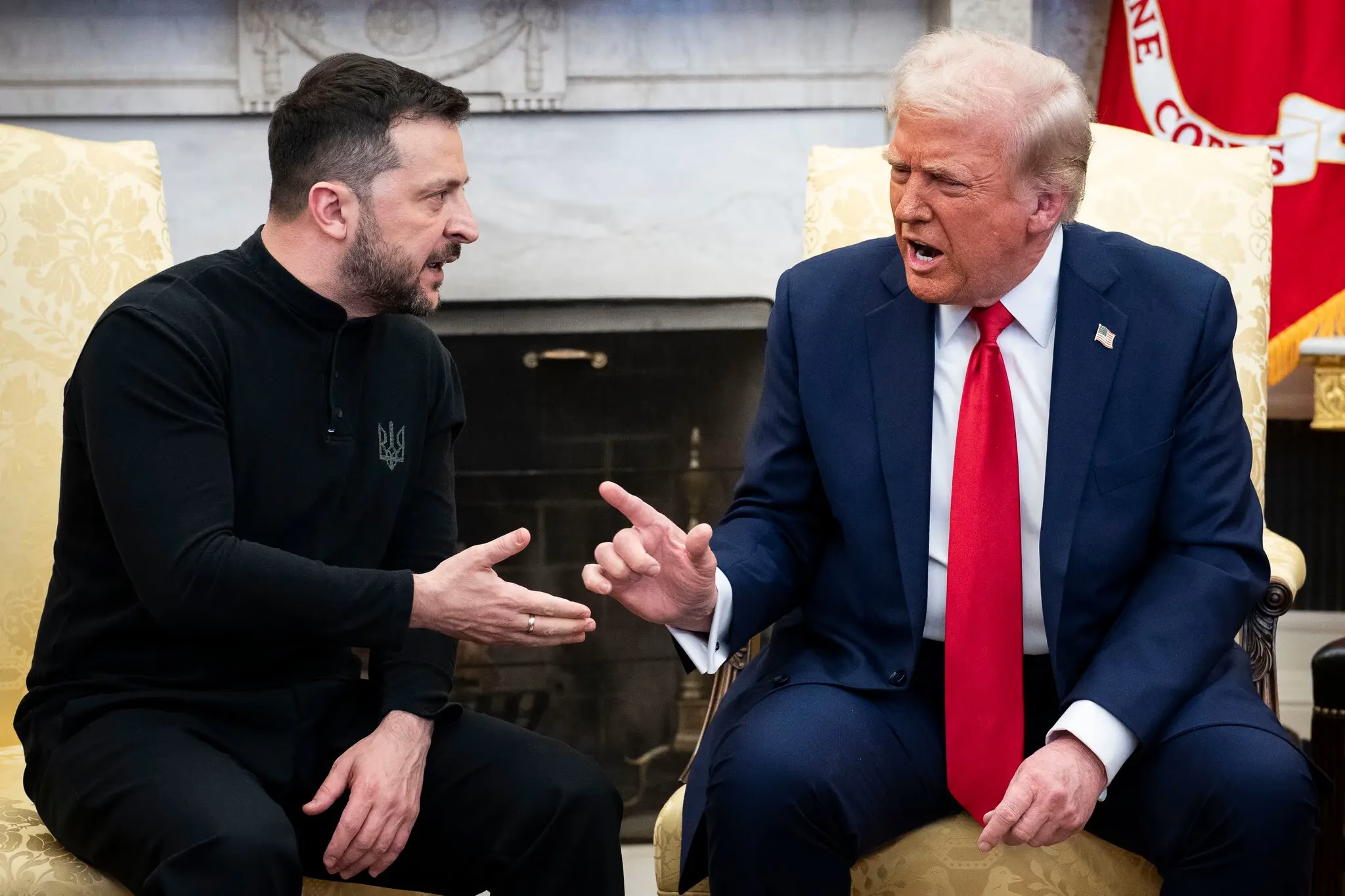
With regard to Ukraine, he obviously holds a grudge against President Zelensky going back to the scandal that led to his first impeachment. He remains baffled as to why trying to strongarm the leader of a weak country to get dirt on his political opponent is problematic. Who wouldn’t do that? A sucker, that’s who.
There’s also clearly something going on with Russia and Putin. While there has been plenty of speculation as to blackmail, I have no direct evidence for it. But it’s not just Trump. There has been a growing fascination with Putin among factions of the Republican Party going back to the Obama administration—well before Trump came down the golden escalator and announced his run for the Republican nomination. I’ve never really understood it, although it clearly has something to do with the struggle over masculinity. The images of Putin practicing karate or riding bareback on a horse have been seized on as what real men should look like. His crackdown on Russian LGBTQ communities also factors in.
Trump clearly admires Putin and other strongmen like Hungary’s Victor Orban. He enjoys displays of power and the pomp and circumstance that comes with it. (Left out of the Daily Show excerpt above is a longish discussion of his fascination with the British royal family.) He rather clearly wants to be more like them.
Trump on NATO
With regard to NATO, I honestly don’t fully understand his motivations. But his transactional worldview seems a perfectly adequate explanation for most of what he’s said and done. Going back to the 2016 campaign, he has expressed resentment that the European allies have not paid their fair share. And, while I get accused of “bothsidesing” when I point it out, it’s simply irrefutable that American leaders have been frustrated by the burden sharing issue for decades. Bob Gates warned them in his 2011 valedictory that the American public was losing patience. Trump was the manifestation of that.
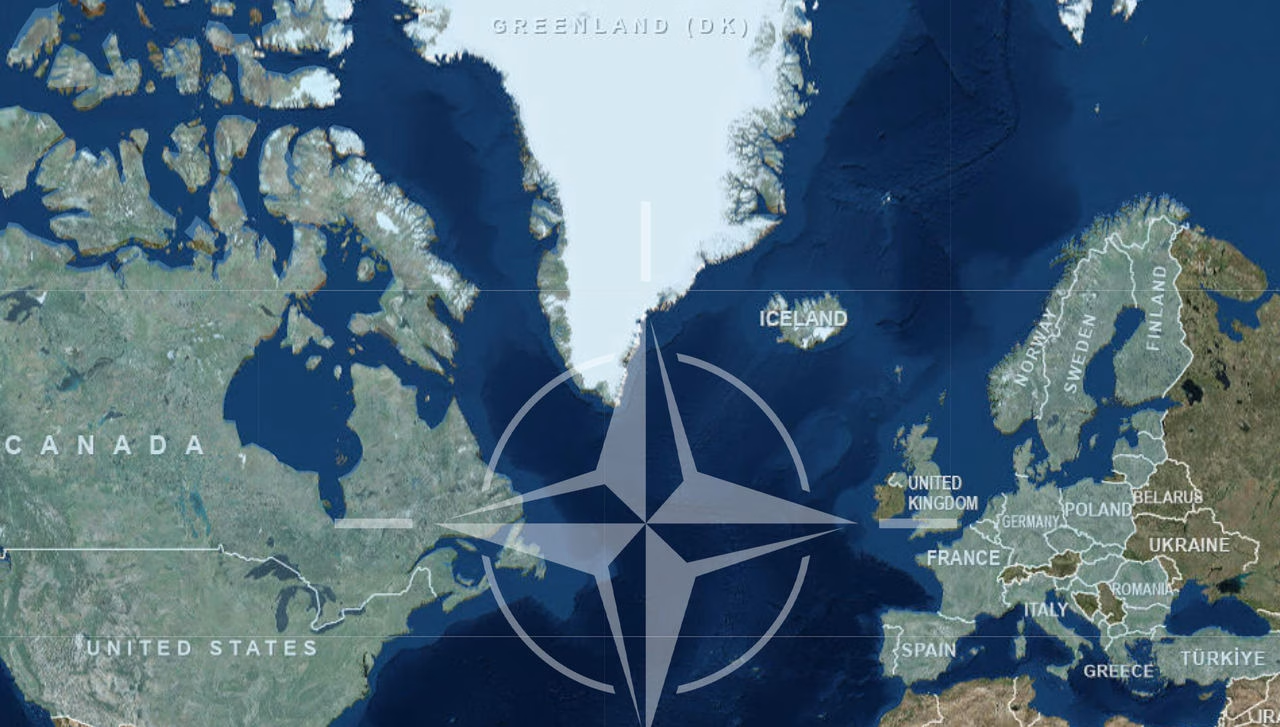
While I find his approach reckless and uncouth, the frustration with free-riding is not unreasonable. But Russia’s invasion of Ukraine had already galvanized European allies into upping their spending and, indeed, got Finland and Sweden off the fence and into the fold.
Similarly, while I think our investment in Ukraine’s defense has been worth every penny on both moral and strategic grounds, it’s not unreasonable to believe the stakes are higher for our European allies than for us and they should therefore be picking up more of the tab. I just don’t believe it’s worth risking the Western alliance to get them to do it.
I’ll write more on Trump’s larger foreign policy vision, such as it is, in a separate post.